Aircraft towing is a common ground-handling operation used to move aircraft around airports, flight lines, and hangars. Large aircraft are usually moved using tow tractors (also called tugs) and suitable tow bars. Smaller aircraft may be moved by hand, provided personnel push only at approved locations, or may be taxied by qualified personnel.
Aircraft towing can be hazardous. Improper towing procedures can cause aircraft damage and injuries to personnel. Therefore, all towing operations must be conducted carefully, using suitable equipment and following the aircraft manufacturer’s maintenance instructions. The general procedures described below provide guidance, but the specific instructions for each aircraft model must always be followed.
Towing Equipment and General Precautions
Movement of large aircraft around the airport, flight line, and hangar is usually accomplished by towing with a tow tractor (sometimes called a tug). [Figure 1]
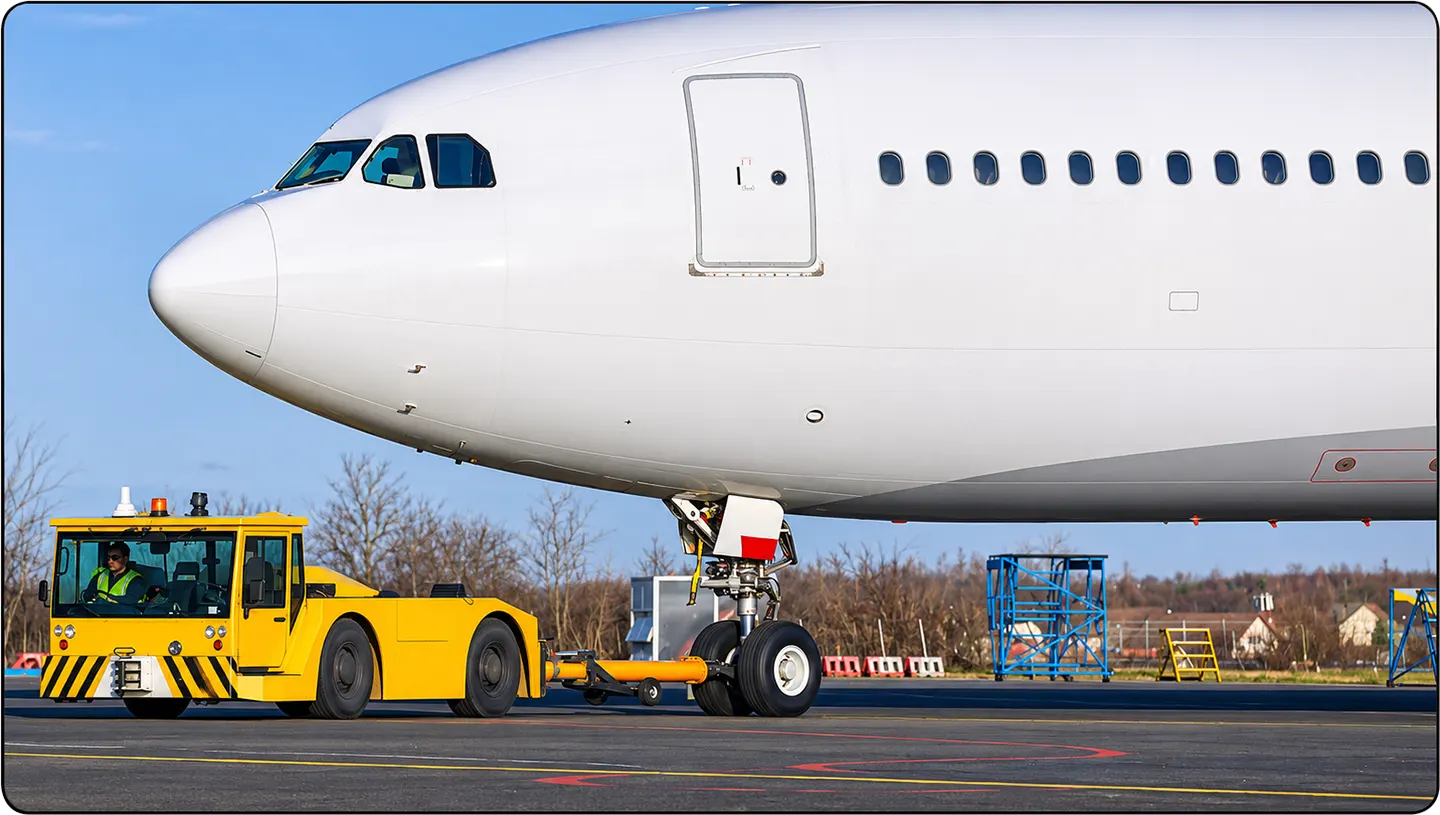
In the case of small aircraft, some movement is accomplished by hand pushing at the correct areas of the aircraft. Aircraft may also be taxied around the flight line, but usually only by qualified personnel.
Before an aircraft is moved by towing, a qualified person must occupy the flight deck to operate the aircraft brakes if the tow bar fails or becomes disconnected. This allows the aircraft to be stopped and helps prevent possible damage.
Some types of tow bars available for general use can be used for many types of towing operations. [Figure 2]
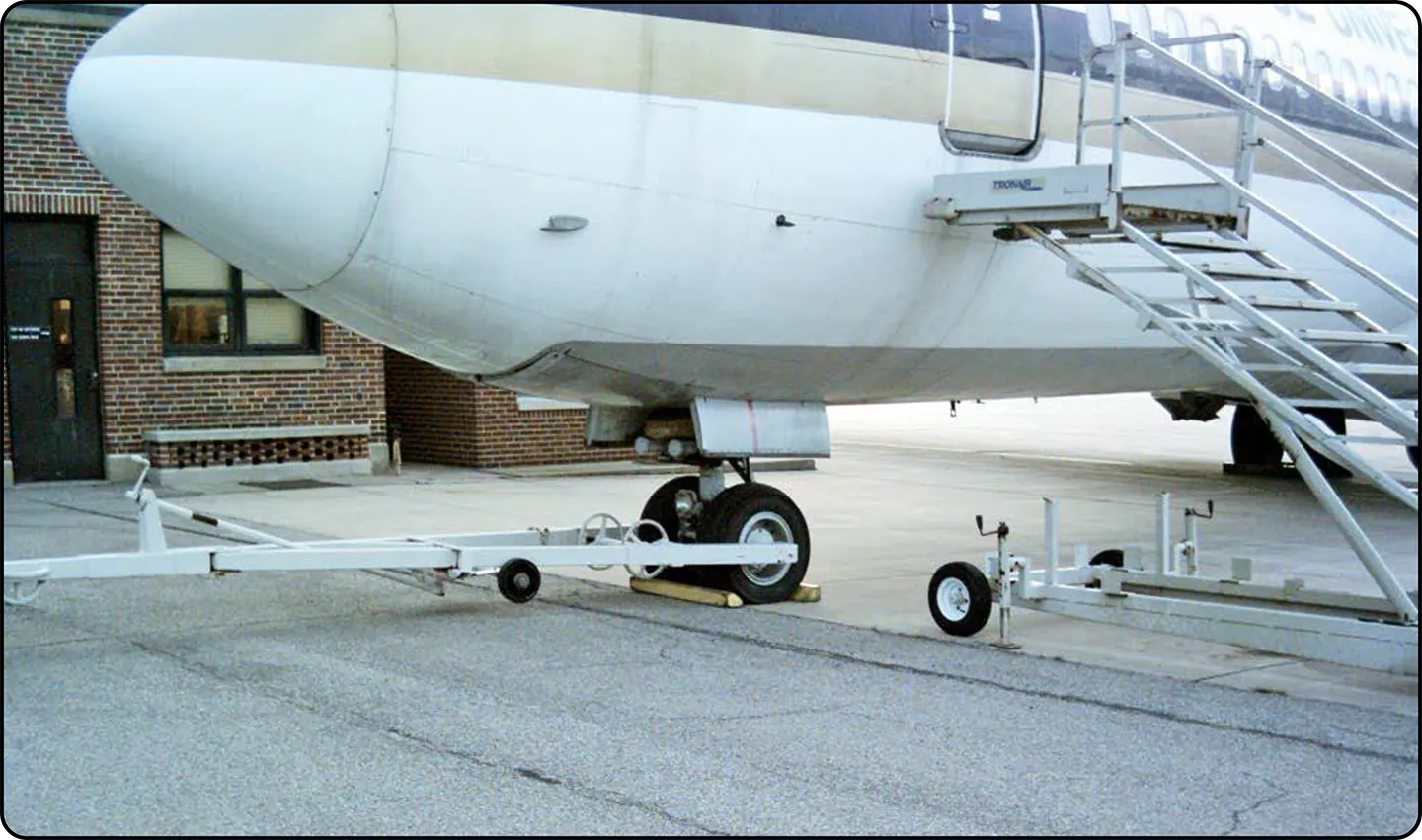
These tow bars are designed with sufficient tensile strength to pull most aircraft but are not intended to withstand torsional or twisting loads. Many have small wheels that allow them to be pulled behind the towing vehicle when traveling to or from an aircraft.
When a tow bar is attached to an aircraft, inspect all engaging and connecting devices for damage or malfunction before moving the aircraft. Additionally, some aircraft have specified tow-steering turn limits that must not be exceeded.
Some tow bars are designed for use with various types of aircraft. However, other special tow bars can be used only with a particular aircraft type. These bars are usually designed and built by the aircraft manufacturer.
When towing an aircraft, the towing vehicle must be operated at a reasonable speed, and all personnel involved in the operation must remain alert. When stopping the aircraft, do not rely on the towing vehicle’s brakes alone. The person in the flight deck must coordinate the use of the aircraft brakes with those of the towing vehicle in accordance with the applicable towing procedure.
A typical smaller aircraft tow tractor (or tug) is shown in Figure 3.
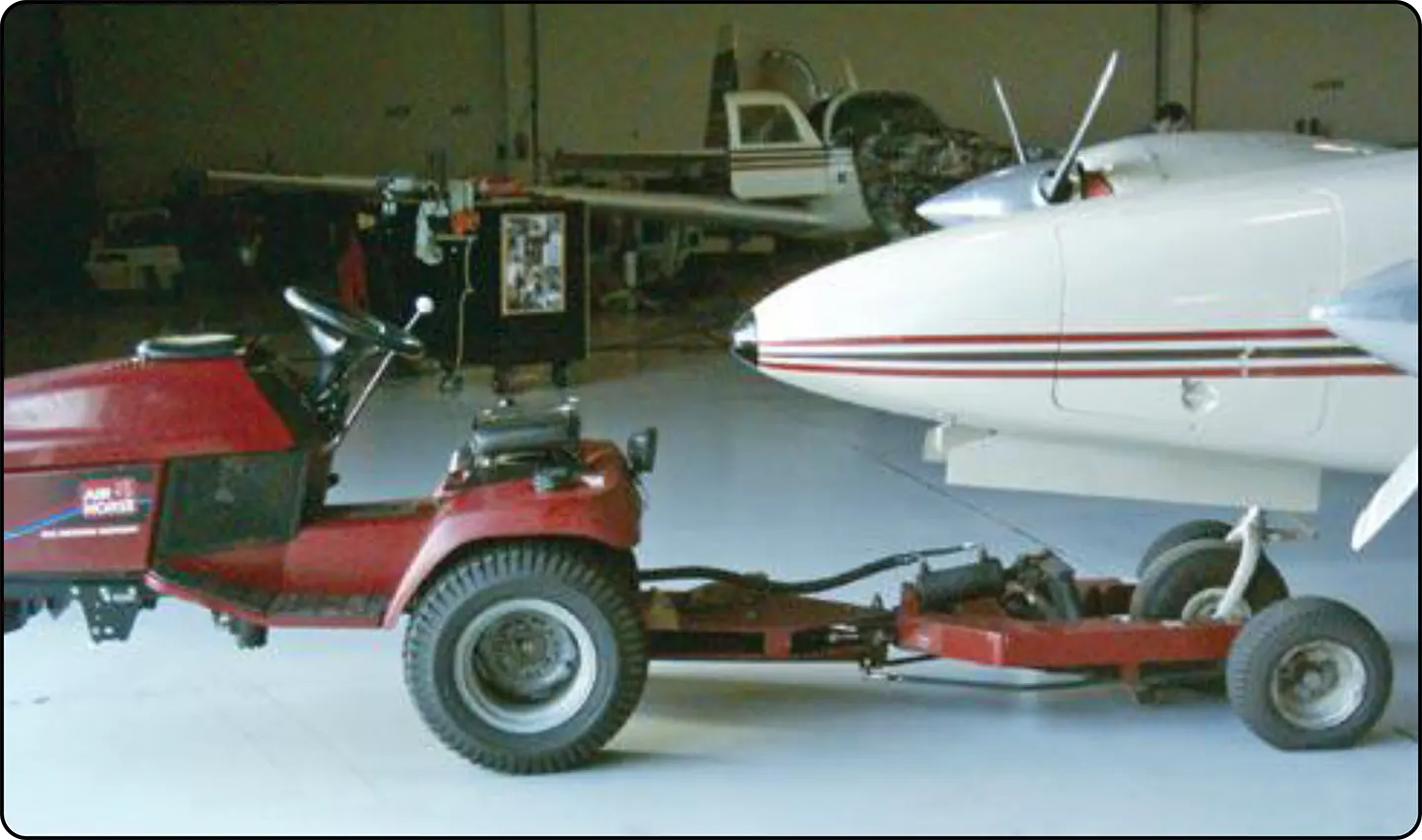
Tow Bar Attachment and Steering
The attachment of the tow bar varies among aircraft types.
Aircraft equipped with tailwheel landing gear are generally towed forward by attaching the tow bar to the main landing gear. In most cases, the aircraft may be towed in reverse by attaching the tow bar to the tailwheel axle, provided the manufacturer’s instructions permit this procedure.
Whenever an aircraft equipped with a tailwheel is towed, the tailwheel must be unlocked or its locking mechanism disengaged as specified by the manufacturer. Failure to do so may damage or break the tailwheel locking mechanism.
Aircraft equipped with tricycle landing gear are generally towed forward by attaching a tow bar to the nosewheel axle. They may also be towed forward or backward by attaching a towing bridle or specially designed tow bar to the towing lugs on the main landing gear. When an aircraft is towed in this manner, a steering bar is attached to the nosewheel to steer the aircraft.
Towing and Parking Procedures
The following towing and parking procedures are typical of one type of operation. They are examples and are not necessarily suitable for every type of aircraft or operation.
Aircraft ground-handling personnel must be thoroughly familiar with all procedures applicable to the types of aircraft being towed and with local standards governing aircraft ground handling. Competent personnel who have been properly trained and qualified must direct the aircraft towing team.
The typical procedures are as follows:
- Towing vehicle driver: The towing vehicle driver is responsible for operating the vehicle safely and obeying emergency stop instructions given by any member of the towing team.
- Wing walkers and tail walker: The person in charge assigns personnel as wing walkers. A wing walker is stationed at each wingtip in a position that allows them to ensure adequate clearance from any obstruction in the aircraft’s path. A tail walker is assigned when sharp turns are to be made or when the aircraft is to be backed into position.
- Flight deck personnel: A qualified person occupies the pilot’s seat of the aircraft being towed to observe the operation and operate the brakes when required. When necessary, another qualified person is stationed to monitor and maintain aircraft hydraulic system pressure.
- Nosewheel steering: The person in charge of the towing operation verifies that, on aircraft with a steerable nosewheel, the applicable steering bypass or locking device is configured as prescribed by the aircraft manufacturer for towing. The device must be restored to its normal operating configuration after the tow bar has been removed. Personnel in the aircraft must not attempt to steer or turn the nosewheel while the tow bar is attached unless the approved towing procedure specifically permits it.
- Personnel safety: Under no circumstances is anyone permitted to walk or ride between the nosewheel of an aircraft and the towing vehicle. Personnel must not ride on the outside of a moving aircraft or on the towing vehicle. In the interest of safety, no attempt to board or leave a moving aircraft or towing vehicle is permitted.
- Towing speed and engine operation: The towing speed must not exceed the walking speed of the towing team members. Aircraft engines are usually not operated when the aircraft is being towed into position.
- Aircraft brakes and emergency chocks: The aircraft brake system must be charged before each towing operation. Aircraft with faulty brakes should be towed only when necessary to move them for brake-system repairs and then only under an approved procedure, with personnel standing by and ready to use chocks in an emergency. Chocks must be immediately available throughout the towing operation.
- Doors, ladders, and landing gear locks: To avoid personal injury and aircraft damage during towing, entrance doors must be closed, ladders retracted, and landing gear down-locks installed, as applicable and in accordance with the aircraft manufacturer’s instructions.
- Tires and landing gear struts: Before towing an aircraft, check all tires and landing gear struts for proper inflation. This does not apply to the inflation of landing gear struts on aircraft undergoing overhaul or in storage.
- Starting, stopping, and brake application: When moving aircraft, do not start or stop suddenly. Aircraft brakes must not be applied during towing except in an emergency and in accordance with the towing team’s established emergency instructions.
- Aircraft parking areas: Aircraft must be parked in designated areas. Generally, sufficient distance is maintained between rows of parked aircraft to allow emergency vehicles immediate access in case of fire, as well as to provide free movement of equipment and materials.
- Wheel chocks: Place wheel chocks fore and aft of the main landing gear of the parked aircraft.
- Control locks: Use internal or external control locks (gust locks or blocks) while the aircraft is parked, as applicable.
- Runway and taxiway clearance: Before moving an aircraft across runways or taxiways, contact the airport control tower on the appropriate frequency and obtain clearance to proceed.
- Aircraft grounding: An aircraft parked in a hangar must be statically grounded immediately, in accordance with the applicable grounding procedures.