
Working on an aircraft flight line involves several hazards that require constant awareness and attention. Aircraft maintenance technicians must remain alert to their surroundings and follow established safety procedures when working near operating aircraft, ground-support equipment, and other flight line activities.
The flight line contains multiple sources of noise, moving equipment, loose objects, engine hazards, and potential fire risks. Understanding these hazards and following appropriate precautions helps prevent injuries, aircraft damage, and accidents.
Hearing Protection
The flight line is an area of potentially dangerous activity. Technicians performing maintenance on the flight line must remain constantly aware of what is happening around them.
Noise on the flight line comes from many sources. Aircraft are only one source of noise. Auxiliary power units (APUs), fuel trucks, baggage-handling equipment, and other ground-support equipment also contribute to the overall noise level. Each source produces sound at different frequencies. Combined, these noise sources can create hazardous sound levels on the ramp or flight line and cause hearing loss.
Several types of hearing protection are available. Hearing protection can be classified as external or internal. Earmuffs and protective headsets are examples of external hearing protection, while earplugs are inserted into the ear canal. Both types reduce the amount of sound reaching the eardrum and help lower the risk of hearing damage.
Hearing protection is essential when working with pneumatic drills, rivet guns, and other loud tools. Even relatively short exposure to high noise levels can contribute to hearing damage, particularly when the sound intensity is high. Repeated or prolonged exposure increases the risk of permanent hearing loss.
Technicians should use hearing protection appropriate to the noise exposure and follow the applicable workplace hearing-conservation requirements.
Foreign Object Damage (FOD)
Foreign object damage (FOD) refers to damage to an aircraft, its components, personnel, or equipment caused by foreign objects. These objects can include broken runway concrete, shop towels, safety wire, loose hardware, misplaced tools, and other debris.
To control FOD, keep ramp and operational areas clean and free of loose objects. Establish and maintain an effective tool-control program, and provide convenient receptacles for used hardware, shop towels, and other consumable materials.
Never leave tools or other loose items near the intake of a turbine engine. A modern gas turbine engine creates a low-pressure area in front of its intake, which can draw loose objects into the engine. Such objects can damage compressor blades and other internal engine components.
The exhaust from turbine engines can also propel loose objects over considerable distances with enough force to damage anything they strike or injure personnel. The importance of an effective FOD-prevention program cannot be overstated when considering the cost of aircraft engines, components, and the potential risk to human life.
Safety Around Airplanes
Technicians working around airplanes must remain alert to propellers, engine intakes, exhaust areas, and aircraft movement.
Technicians must never assume that the pilot of a taxiing aircraft can see them. They should remain in the pilot’s field of view and follow established ground-safety procedures when working near moving aircraft.
Turbine engine intakes and exhaust areas are also extremely hazardous. Personnel must remain clear of these areas whenever engines are operating.
Smoking and open flames are prohibited near operating aircraft. Technicians must also be aware that some aircraft fluids can be harmful to the skin and should avoid direct contact with them. Appropriate protective equipment and handling procedures must be used.
When operating ground-support equipment around aircraft, maintain sufficient clearance between the equipment and the aircraft. Secure the equipment so that it cannot roll or move into the aircraft. All tools, equipment, and other items in areas where aircraft are operating must be properly stowed.
Safety Around Helicopters
Every helicopter type has different design features and operating characteristics. Technicians must become familiar with these differences to avoid damaging the helicopter or injuring themselves.
Approaching a helicopter while its rotor blades are turning is particularly hazardous. The following precautions should be observed when approaching or working around an operating helicopter:
- Observe the rotor head and blades to determine their position and clearance before approaching. Rotor-blade clearance varies with helicopter design, rotor position, and operating conditions.
- Approach the helicopter only when authorized and by an approved approach path. Remain within the pilot’s field of view whenever possible and follow the pilot’s or crew’s instructions.
- Never approach a helicopter while carrying an object vertically or above shoulder level if it could contact the rotor blades. Such contact could damage the blades and cause serious injury.
- Never approach a single-main-rotor helicopter from the rear. The tail rotor can be difficult to see when operating and presents a serious injury hazard.
- Never move from one side of the helicopter to the other by walking around the tail. When authorized to approach, use the approved route around the front of the helicopter.
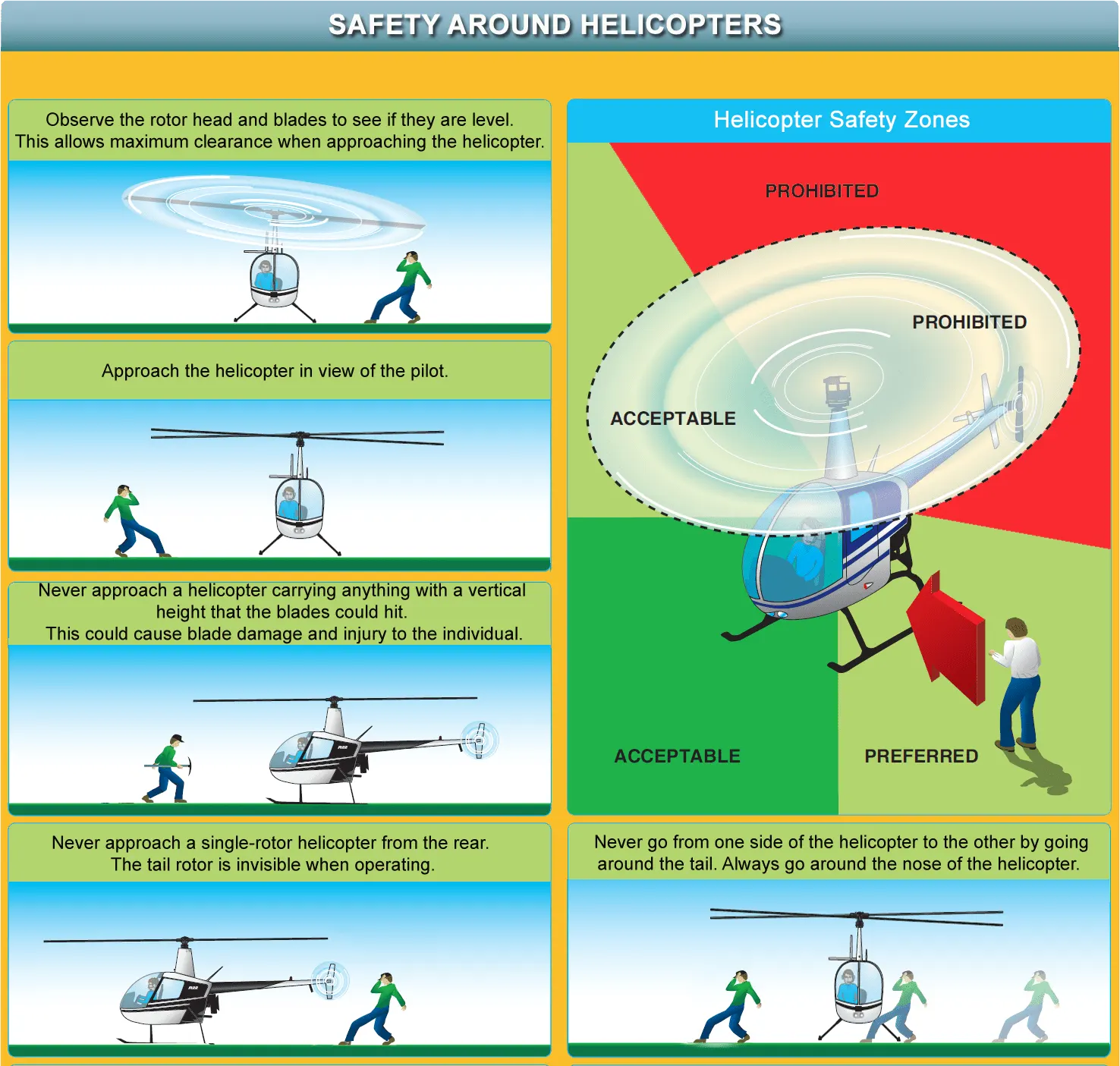
The helicopter safety illustration shows acceptable and prohibited approach areas around a helicopter, along with precautions for maintaining clearance from the main rotor and tail rotor. It emphasizes approaching within the pilot’s field of view, keeping carried objects below rotor height, and avoiding the rear of a single-rotor helicopter.
When securing the rotor on helicopters equipped with elastomeric bearings, consult the applicable aircraft maintenance manual for the correct securing method. Using an incorrect method can damage the elastomeric bearing.
Fire Safety
Aircraft maintenance involves the use of electrical tools that may produce sparks, heat-producing tools and equipment, and flammable or explosive liquids and gases. These conditions create a significant potential for fire. Therefore, appropriate measures must be taken to prevent fires and ensure that personnel are prepared to respond if a fire occurs.
The key to fire safety is understanding what causes a fire, how to prevent it, and how to extinguish it safely. This knowledge must be understood by every technician and reinforced by supervisors through effective safety programs and periodic training exercises.
Airport fire departments and other local fire departments can normally be called upon to assist with personnel training and the development of fire-safety programs for hangars, maintenance shops, and flight line areas.
Technicians must also be familiar with the location and proper use of fire-extinguishing equipment and follow established emergency procedures.