
Aircraft cabin pressurization systems allow aircraft to operate at high altitudes while maintaining a cabin environment suitable for passengers and crew. At altitude, atmospheric pressure and air density decrease, creating challenges related to oxygen availability, temperature, and passenger comfort. Pressurization helps overcome these conditions by maintaining the cabin at a pressure altitude that supports safe and comfortable flight.
Understanding atmospheric pressure, temperature variations with altitude, pressurization terminology, and the structural requirements of a pressurized aircraft is essential to understanding how cabin environmental systems operate.
Pressure of the Atmosphere
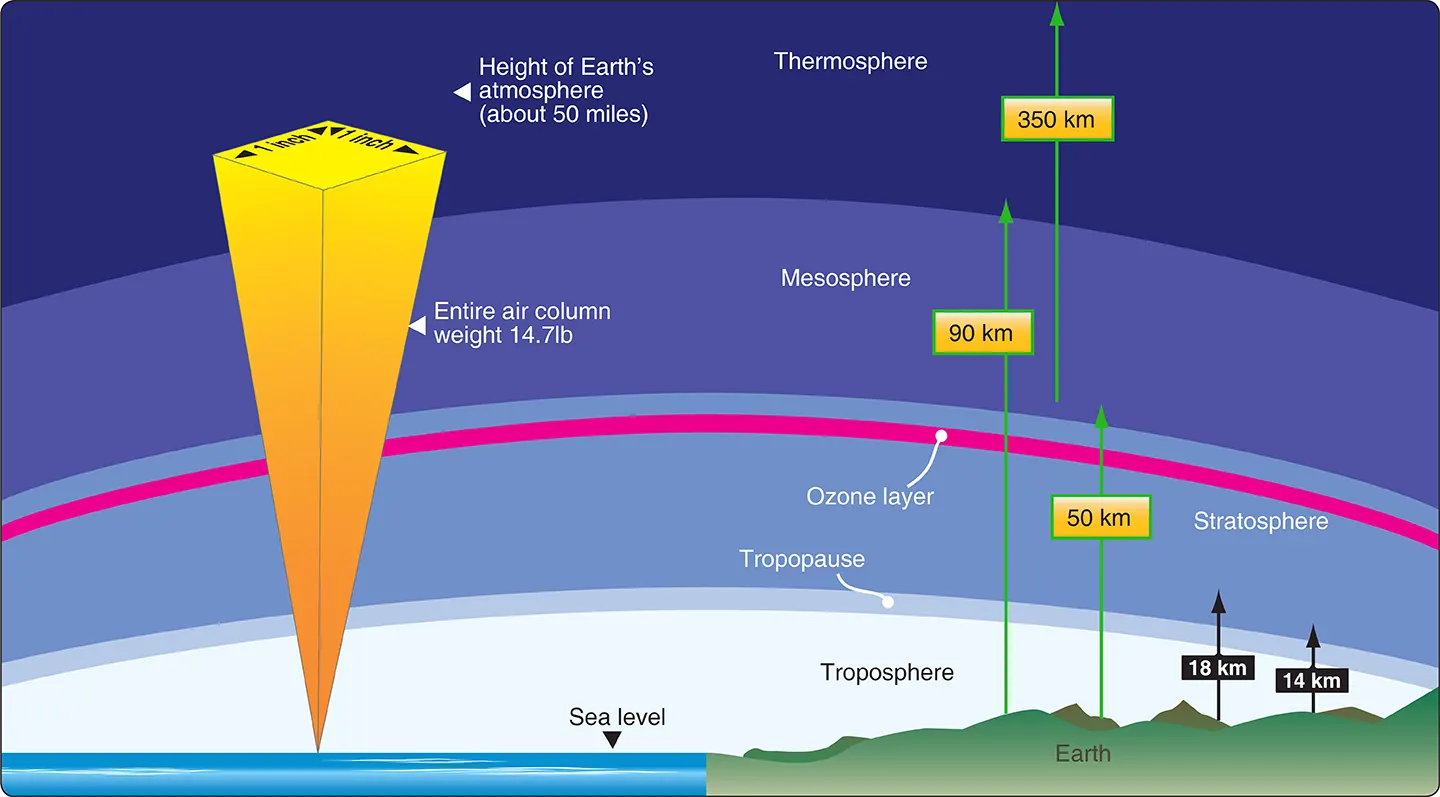
The gases of the atmosphere (air), although invisible, have weight. A one-square-inch column of air extending from sea level into space weighs approximately 14.7 pounds.
Therefore, the atmospheric pressure at sea level is approximately 14.7 pounds per square inch (psi). [Figure 1]
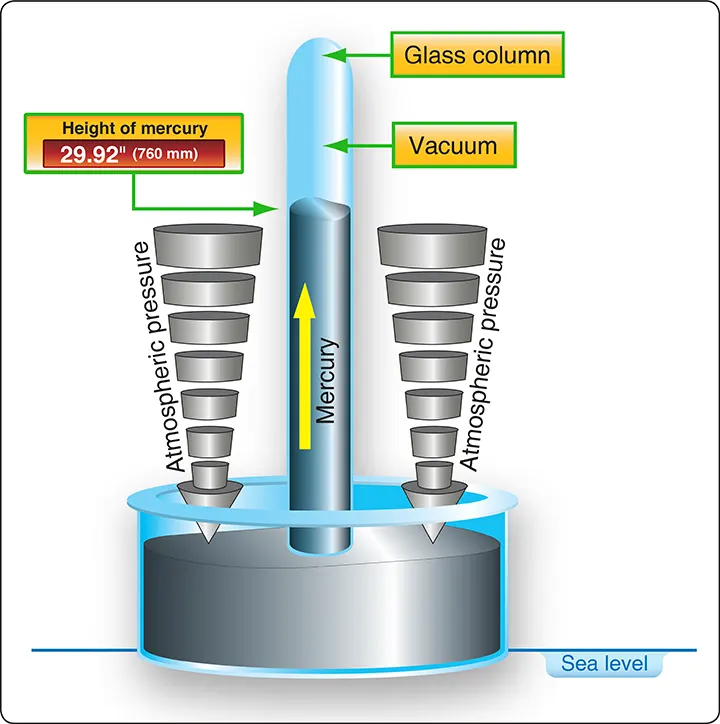
Atmospheric pressure is also known as barometric pressure and is measured with a barometer. [Figure 2]
Measuring Atmospheric Pressure
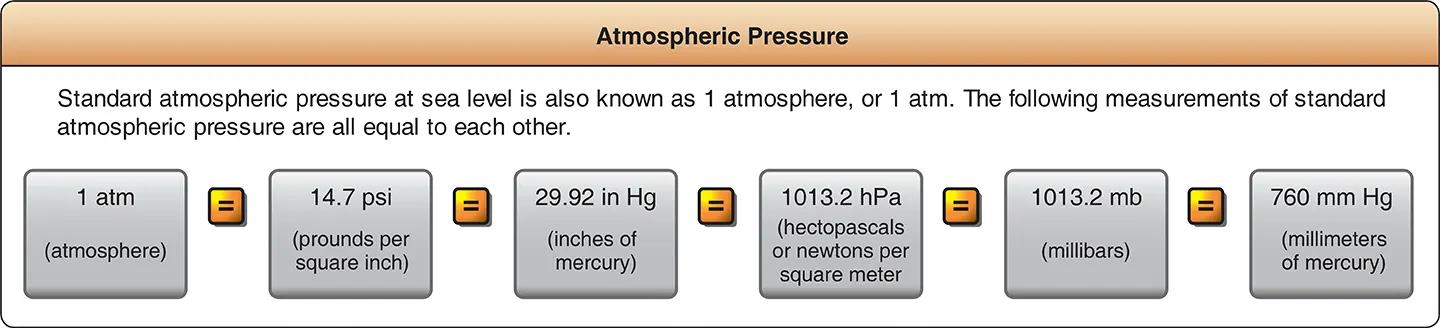
Atmospheric pressure can be expressed in different units, such as inches of mercury (in. Hg) or millimeters of mercury (mm Hg). These measurements are based on observing the height of a mercury column when atmospheric pressure acts on a mercury reservoir into which the column is placed.
The column must be evacuated so that air inside it does not act against the rising mercury. A column of mercury 29.92 inches high weighs the same as a column of air extending from sea level to the top of the atmosphere, provided both columns have the same cross-sectional area.
Aviators often interchange references to atmospheric pressure expressed as linear displacement (such as inches of mercury) and units of force (such as psi).
Over the years, meteorology has shifted from representing atmospheric pressure by linear displacement to using units of force. However, the unit nearly universally used today to represent atmospheric pressure in meteorology is the hectopascal (hPa).
A hectopascal is a metric (SI) unit that expresses force in newtons per square meter. A standard sea-level atmospheric pressure of 1,013.2 hPa is equal to 14.7 psi. [Figure 3]
Atmospheric Pressure and Altitude
Atmospheric pressure decreases as altitude increases. The simplest explanation is that the column of air being weighed becomes shorter.
The change in atmospheric pressure with altitude is illustrated in Figure 4. The decrease is rapid; at 50,000 feet, atmospheric pressure has dropped to almost one-tenth of its sea-level value.

Temperature and Altitude
Temperature variations in the atmosphere are important to aviators. Weather systems produce changes in temperature near Earth’s surface, and temperature also changes as altitude increases.
The troposphere is the lowest layer of the atmosphere. On average, it extends from Earth’s surface to approximately 38,000 feet. Over the poles, the troposphere extends to only about 25,000–30,000 feet, while at the equator it may extend to around 60,000 feet.
This variation in the height of the troposphere is illustrated in Figure 5.

Temperature Changes in the Atmospheric Layers
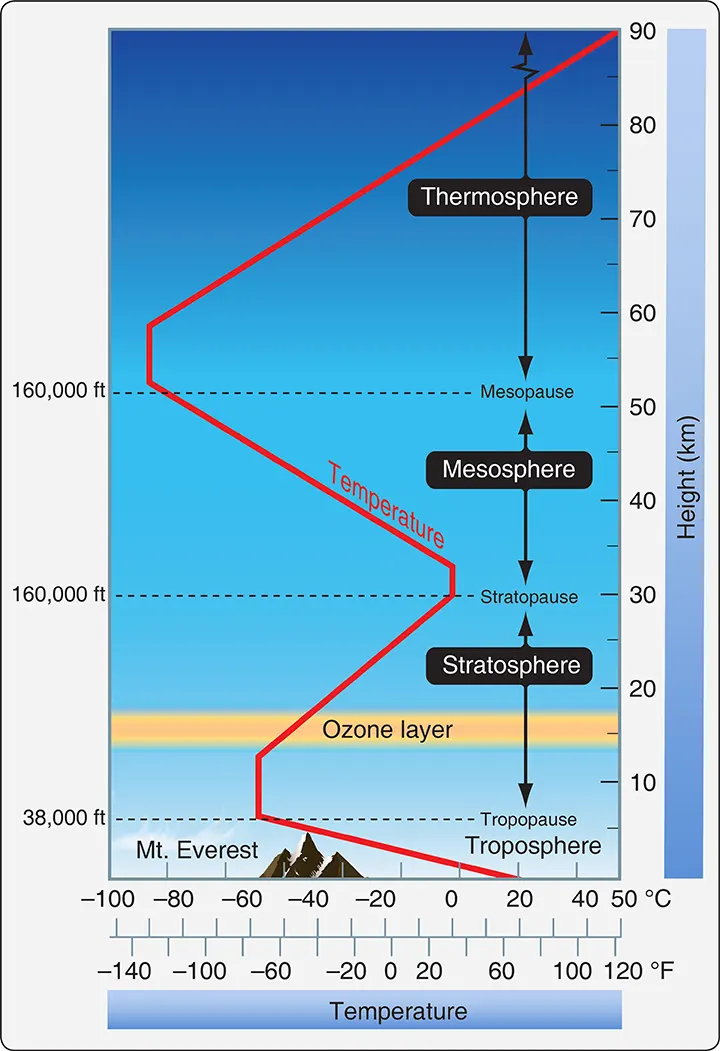
Most civilian aviation takes place in the troposphere, where temperature generally decreases as altitude increases. The rate of change is relatively constant at approximately –2 °C or –3.5 °F for every 1,000 feet of altitude increase.
The upper boundary of the troposphere is the tropopause. It is characterized by a zone of relatively constant temperature of approximately –57 °C or –69 °F.
Above the tropopause lies the stratosphere. In this layer, temperature increases with altitude to near 0 °C before decreasing again in the mesosphere, which lies above it.
The stratosphere contains the ozone layer, which protects Earth’s inhabitants from harmful ultraviolet (UV) rays. Some civilian flights and numerous military flights take place in the stratosphere.
Figure 6 diagrams the temperature variations in the different layers of the atmosphere.
High-Altitude Flight and Environmental Systems
When an aircraft flies at high altitude, it burns less fuel for a given airspeed than it does at the same speed at a lower altitude. This is due to decreased drag resulting from the reduction in air density.
Bad weather and turbulence can also be avoided by flying in the relatively smooth air above storms and convective activity that occur in the lower troposphere.
To take advantage of these efficiencies, aircraft are equipped with environmental systems that overcome extreme temperature and pressure levels. While supplemental oxygen and a means of staying warm may be sufficient in some circumstances, aircraft pressurization and air conditioning systems have been developed to make high-altitude flight more comfortable.
Figure 7 illustrates the temperatures and pressures at various altitudes in the atmosphere.

Pressurization Terms
The following terms are used in discussions of aircraft pressurization and cabin environmental systems.
Cabin Altitude
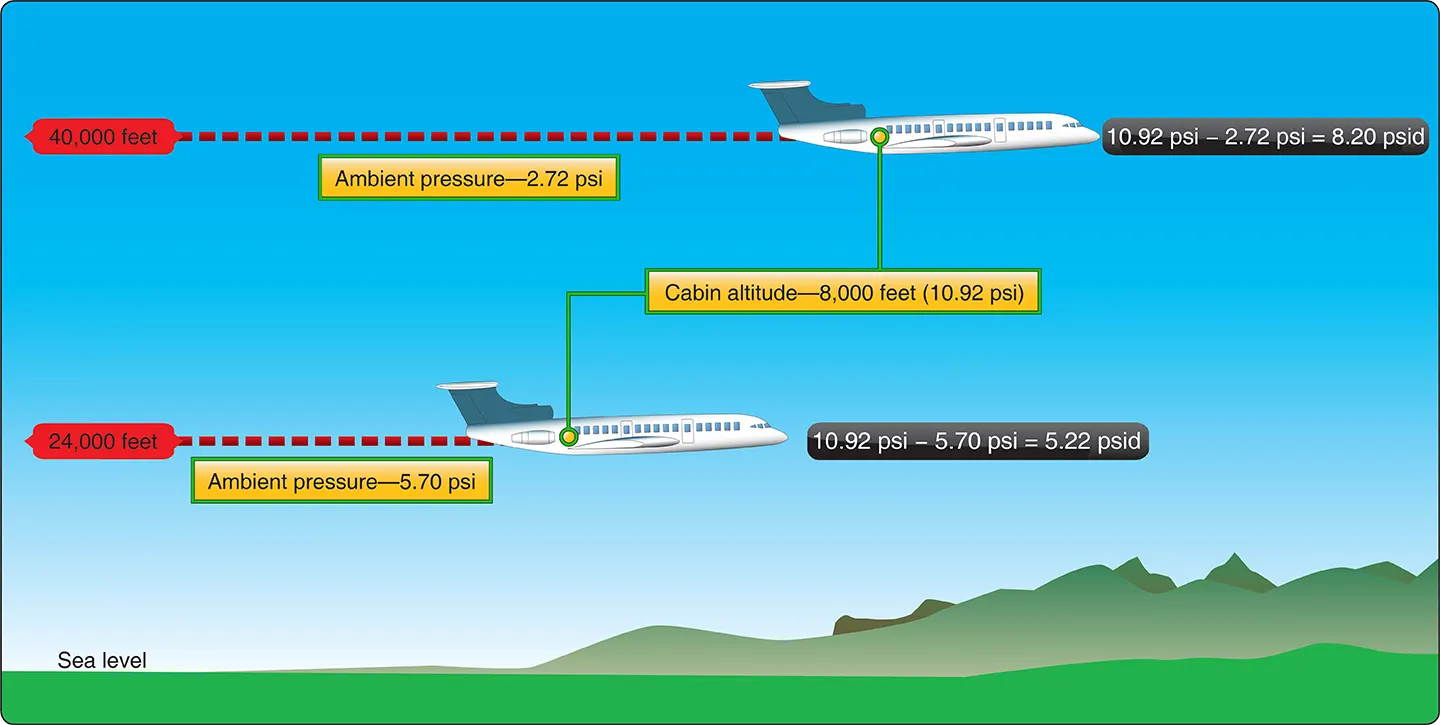
Cabin altitude is the altitude on a standard day that has the same air pressure as the pressure inside the aircraft cabin.
For example, rather than stating that the pressure inside the cabin is 10.92 psi, it can be stated that the cabin altitude is 8,000 feet above mean sea level (MSL).
Cabin Differential Pressure
Cabin differential pressure is the difference between the air pressure inside the cabin and the air pressure outside the cabin.
It is calculated as:
Cabin Differential Pressure = Cabin Pressure – Ambient Pressure
The result is expressed in pounds per square inch differential (psid or Δ psi).
Cabin Rate of Climb
Cabin rate of climb is the rate of change of air pressure inside the cabin. It is expressed in feet per minute (fpm) of cabin-altitude change.
Pressurization Issues
Pressurizing an aircraft cabin helps make flight possible in the hostile environment of the upper atmosphere. The degree of pressurization and the operating altitude of any aircraft are limited by critical design factors.
A cabin pressurization system must perform several functions to ensure passenger comfort and safety.
Cabin Pressure and Passenger Comfort
The system must be capable of maintaining a cabin pressure altitude of approximately 8,000 feet or lower, regardless of the aircraft’s cruising altitude. This helps ensure that passengers and crew have sufficient oxygen at an adequate pressure to facilitate full blood saturation.
A pressurization system must also prevent rapid changes in cabin pressure, which can be uncomfortable or injurious to passengers and crew.
Additionally, the system should circulate air from inside the cabin to the outside at a rate that quickly eliminates odors and removes stale air. Cabin air must also be heated or cooled in pressurized aircraft. Typically, these functions are incorporated into the pressurization air source.
Sealing the Pressurized Aircraft
To pressurize an aircraft, a portion of the structure designed to contain air at a pressure higher than the outside atmospheric pressure must be sealed.
A wide variety of materials are used to achieve this. Compressible seals around doors, along with other seals, grommets, and sealants, establish an essentially airtight pressure vessel.
This usually includes the cabin, flight compartment, and baggage compartments.
Air is then pumped into this area at a constant rate sufficient to raise the pressure slightly above the required level. Control is maintained by adjusting the rate at which air is allowed to flow out of the aircraft.
Fuselage Differential Pressure
A key factor in pressurization is the ability of the fuselage to withstand the forces associated with the increased pressure inside the structure compared with the ambient pressure outside.
This differential pressure can range from approximately 3.5 psi for a single-engine reciprocating aircraft to approximately 9 psi for high-performance jet aircraft. [Figure 8]
Structural Strength and Weight Considerations
If aircraft structural weight were not a concern, pressurization would be less of a challenge. However, designing an aircraft that is strong enough to withstand pressurization while remaining lightweight has been an engineering challenge for many years, beginning in the 1930s.
The development of jet aircraft and their ability to take advantage of low-drag flight at higher altitudes made this challenge even more pronounced. Today, the increasing use of composite materials in aircraft structures continues this engineering challenge.
In addition to being strong enough to withstand the pressure differential between the air inside and outside the cabin, the airframe must also withstand metal fatigue caused by repeated pressurization and depressurization cycles.
Some early pressurized aircraft structures failed due to fatigue, resulting in fatal accidents. The FAA’s aging aircraft program was instituted to increase inspection scrutiny of older airframes that may show signs of fatigue caused by pressurization cycles.
Aircraft Types and Pressurization
Aircraft of any size may be pressurized. However, weight considerations associated with making the fuselage strong enough to withstand pressurization usually limit its use to high-performance light aircraft and larger aircraft.
A few pressurized single-engine reciprocating aircraft exist, as well as many pressurized single-engine turboprop aircraft.