
Aircraft oxygen systems provide supplemental oxygen to pilots, crew members, and passengers when the oxygen available in the surrounding atmosphere is insufficient to support normal physiological functions. As an aircraft climbs, atmospheric pressure decreases, reducing the partial pressure of oxygen available for transfer into the bloodstream.
Aircraft oxygen systems help compensate for this reduction by supplying oxygen at an appropriate pressure or concentration. They are commonly installed in non-pressurized aircraft and serve as an emergency backup in pressurized aircraft if cabin pressurization is lost.
Aircraft oxygen may be supplied in gaseous, liquid, or chemical form. Some aircraft also use onboard oxygen generating systems (OBOGS), which produce oxygen-enriched breathing gas from the air supplied to the system.
Understanding the characteristics, operation, and limitations of these oxygen sources is essential for pilots and aviation maintenance personnel.
Forms of Oxygen and Characteristics
Gaseous Oxygen
Oxygen is a colorless, odorless, and tasteless gas under normal atmospheric conditions. It becomes a liquid at approximately −183 °C (its boiling point at atmospheric pressure).
Oxygen readily combines with many elements and compounds in a process called oxidation. Oxidation often produces heat. When a substance burns, it is undergoing rapid oxidation.
Oxygen itself is not combustible; however, it supports combustion. Pure oxygen can cause materials to ignite more readily and burn more intensely. Oxygen also reacts dangerously with petroleum products, oils, and greases, creating a significant hazard when these materials are handled near oxygen equipment.
Pure or nearly pure gaseous oxygen is stored and transported in high-pressure cylinders. These cylinders are often painted green, although cylinder colors can vary according to applicable standards and jurisdictions.
Technicians must keep oxygen equipment free from fuel, oil, grease, and other contaminants to prevent fires or explosions.
Not all oxygen supplied in containers is suitable for aviation breathing use. Aviator’s breathing oxygen is tested for moisture content to reduce the possibility of ice forming in the small passages of valves and regulators. Ice formation could restrict or prevent oxygen delivery, particularly when aircraft operate in subzero temperatures.
The original material specifies a maximum water content of 0.02 mL per liter of oxygen. Cylinders intended for this purpose should be clearly marked “Aviator’s Breathing Oxygen.” Applicable specifications and servicing requirements must be followed. [Figure 1]
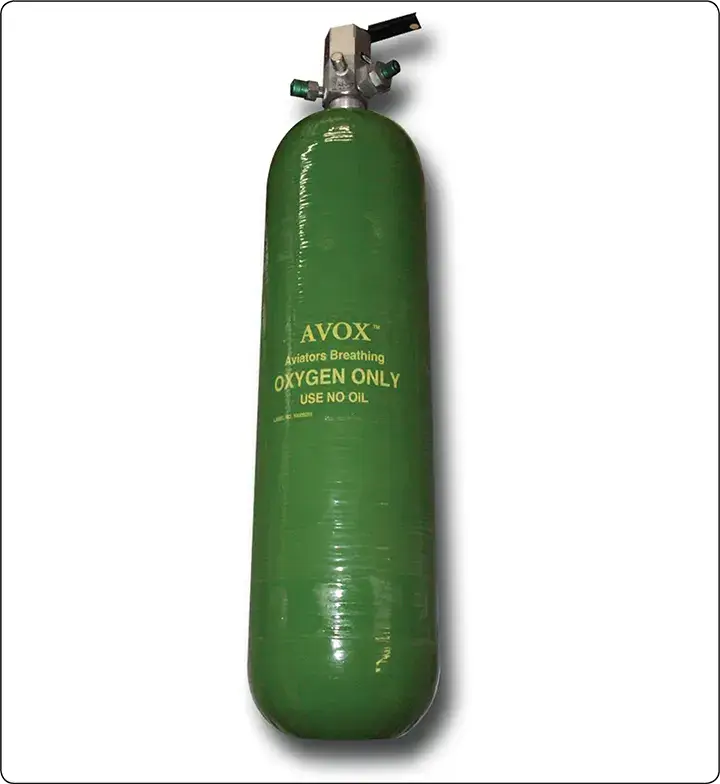
Gaseous oxygen for commercial and aircraft cylinders is commonly produced by liquefying air and separating its components through controlled temperature and pressure. Nitrogen is separated from the air, leaving oxygen of the required purity.
Oxygen can also be produced by electrolysis of water, in which an electric current separates water into hydrogen and oxygen.
Another method uses molecular sieve technology to separate oxygen from other gases in the air. These systems remove much of the nitrogen and other gases, producing oxygen-enriched gas. Oxygen concentrators using molecular sieve technology are used in some aviation applications.
The use of portable pulse oximeters has become more common in aviation. These devices estimate the oxygen saturation of the blood by measuring the light absorption of tissues, usually at a finger. They may also display heart rate. [Figure 2]
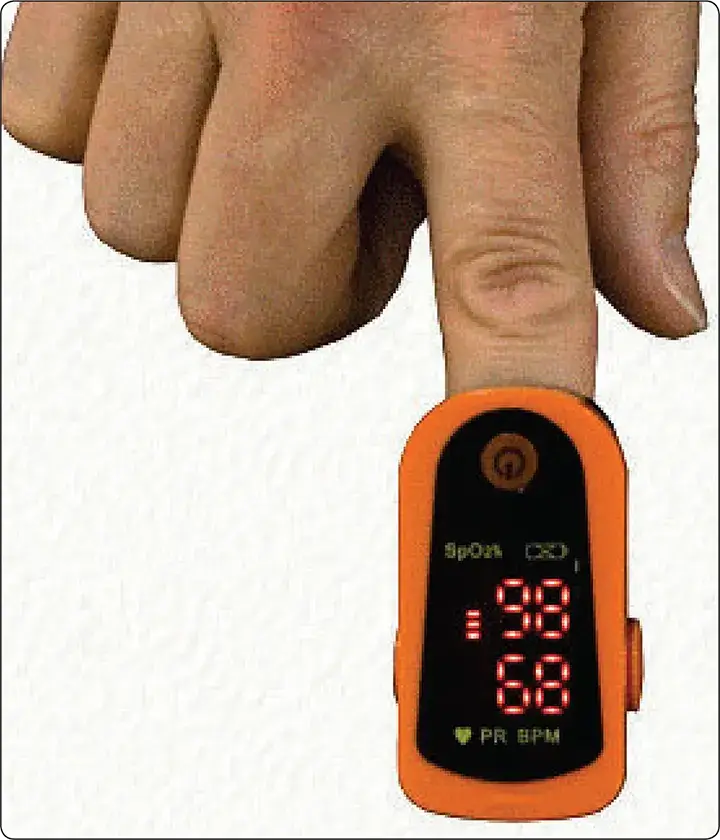
Pulse oximeter readings can help pilots monitor oxygen saturation and recognize possible hypoxia. However, readings can be affected by factors such as movement, poor circulation, and environmental conditions. They should not replace approved oxygen procedures or be relied upon as the sole indicator of adequate oxygen supply.
Liquid Oxygen
Liquid oxygen (LOX) is a pale blue, transparent liquid. Oxygen can be liquefied by cooling it below its critical temperature and applying suitable pressure. At atmospheric pressure, oxygen boils at approximately −183 °C.
A special container called a Dewar bottle is used to store and transport liquid oxygen. It uses an evacuated, double-walled insulation design to reduce heat transfer and maintain the oxygen at a very low temperature.
As liquid oxygen warms, it vaporizes into gaseous oxygen. The LOX container assembly includes a converter that changes the liquid oxygen into gas for delivery to the oxygen system. A controlled quantity of gaseous oxygen is supplied to the downstream delivery system. [Figure 3]
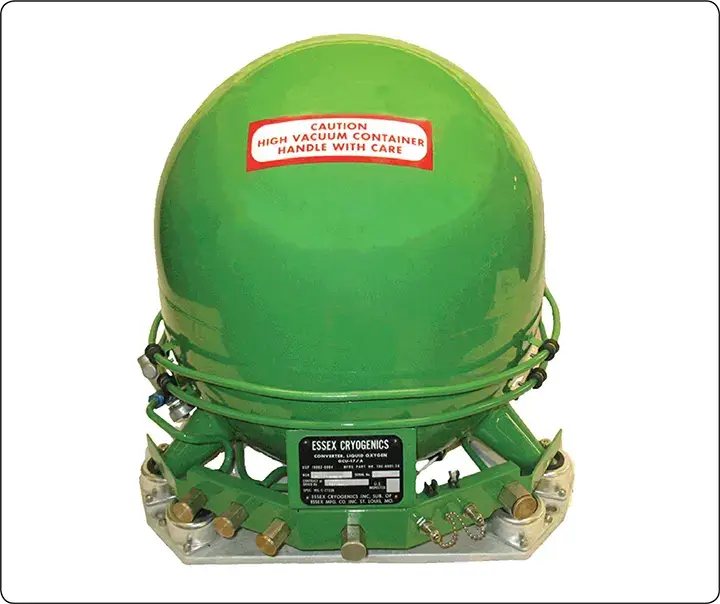
A relatively small quantity of liquid oxygen can produce a large volume of gaseous oxygen. This allows LOX systems to occupy less storage space than high-pressure gaseous oxygen cylinders containing an equivalent amount of oxygen.
However, LOX requires specialized handling because of its extremely low temperature and the hazards associated with oxygen-enriched environments. The cost and complexity of handling liquid oxygen have contributed to the widespread use of gaseous oxygen systems in civilian aviation.
LOX is used in military aviation and in some medical helicopter applications for patient oxygen supply.
Chemical or Solid Oxygen
Sodium chlorate is used in some chemical oxygen generators. When activated, the chemical reaction releases oxygen, which can be filtered and delivered through a hose to a breathing mask.
These devices are commonly called solid oxygen candles. The sodium chlorate material is formed into a solid block and enclosed in an insulated stainless-steel housing. The housing helps control the heat produced during the chemical reaction.
The chemical oxygen supply is often activated by a spring-loaded firing mechanism. When the activation pin is pulled, a hammer strikes an ignition cap, producing a spark that initiates the reaction. Some systems use electrical ignition through a current-induced hot wire.
Once activated, a sodium chlorate oxygen generator cannot normally be extinguished. It continues producing oxygen until the chemical reaction is complete. The duration of oxygen production depends on the generator design; the original material gives a typical duration of 10–20 minutes. [Figure 4]
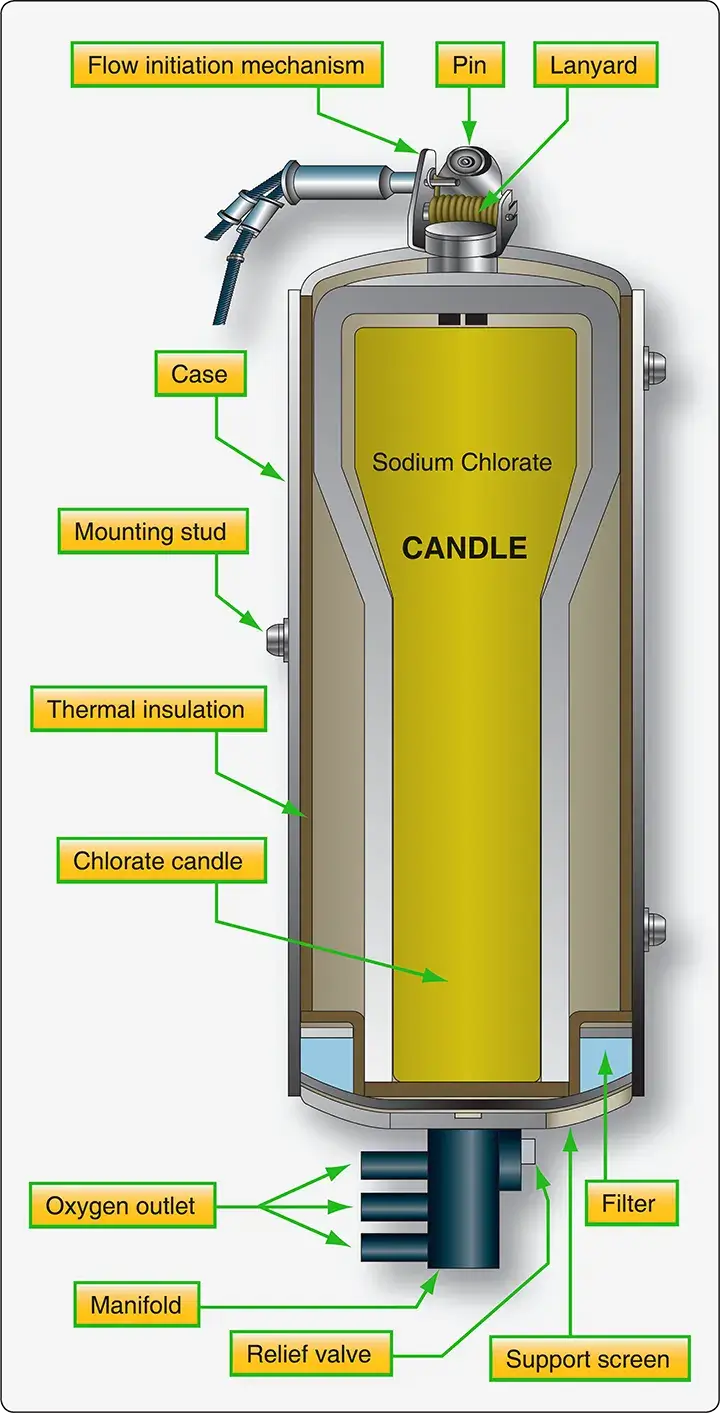
Solid oxygen generators are primarily used as backup oxygen devices in pressurized aircraft. They can be lighter than gaseous oxygen systems for a comparable quantity of oxygen, particularly where heavy storage cylinders would otherwise be required.
Chemical oxygen generators also have a long shelf life, making them suitable for standby oxygen applications. However, they must be inspected, maintained, and replaced in accordance with the manufacturer’s instructions and applicable requirements.
The fact that a chemical oxygen generator cannot be extinguished once activated limits its use. It provides oxygen for a predetermined period and must be replaced after activation.
Chemical oxygen candles must be handled and transported with extreme caution because they are hazardous materials. They must be properly packaged, and their activation devices must be secured in accordance with applicable procedures.
Onboard Oxygen Generating Systems (OBOGS)
Molecular sieve technology can be used to separate oxygen from other gases in the air both on the ground and in flight. These systems are relatively light and reduce the need for an aircraft to carry large quantities of stored oxygen or rely on frequent ground servicing.
Onboard oxygen generating systems (OBOGS) are used on some military aircraft. In a typical system, air supplied from a turbine engine’s bleed-air system passes through molecular sieve beds. These beds selectively remove nitrogen and other gases, producing oxygen-enriched breathing gas.
The molecular sieve beds operate in cycles. While one bed separates gases from the incoming air, another may be depressurized or purged to remove the gases that were retained. The beds then switch roles to provide a continuous supply of oxygen-enriched gas.
The concentration and delivery pressure of the breathing gas are controlled by the system design. OBOGS provides an onboard source of oxygen-enriched breathing gas without the need to store all of the oxygen in high-pressure cylinders. [Figure 5]
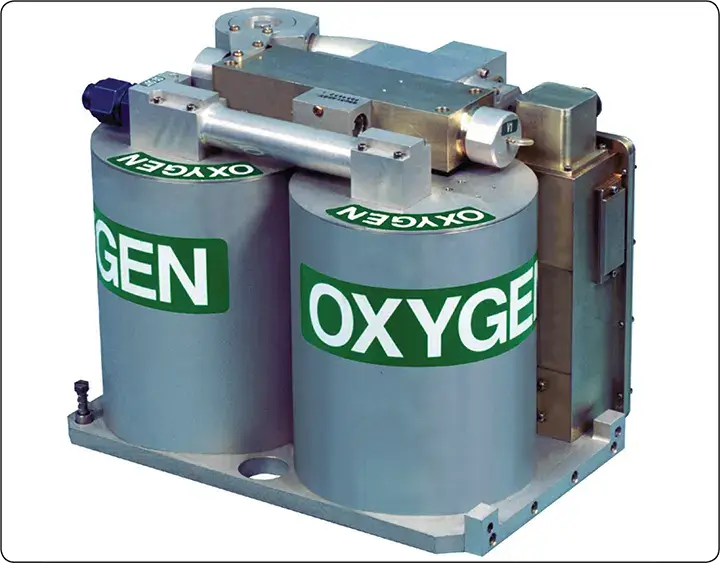
OBOGS is particularly useful in military aviation, where weight, storage capacity, and operational independence are important considerations. The technology may also be applicable to other aircraft, depending on system design, certification, and operational requirements.