
Aircraft are designed to operate at high altitudes to improve fuel efficiency and avoid adverse weather and turbulence. However, as altitude increases, atmospheric pressure decreases, making cabin pressurization or supplemental oxygen necessary to protect occupants. Understanding the principles of cabin pressurization, pressure control, and decompression is essential for pilots and aircraft maintenance personnel.
Aircraft Cabin Pressurization
Aircraft are flown at high altitudes for two primary reasons. First, an aircraft generally consumes less fuel for a given airspeed at high altitude than at a lower altitude because it operates more efficiently. Second, flying above storms may allow the aircraft to avoid bad weather and turbulence by operating in relatively smooth air.
To take advantage of these conditions, many modern aircraft are designed to operate at high altitudes. The aircraft must be pressurized, or suitable supplemental oxygen must be provided for each occupant.
In a typical pressurization system, the cabin, flight compartment, and baggage compartments form a sealed unit capable of maintaining air pressure higher than the outside atmospheric pressure.
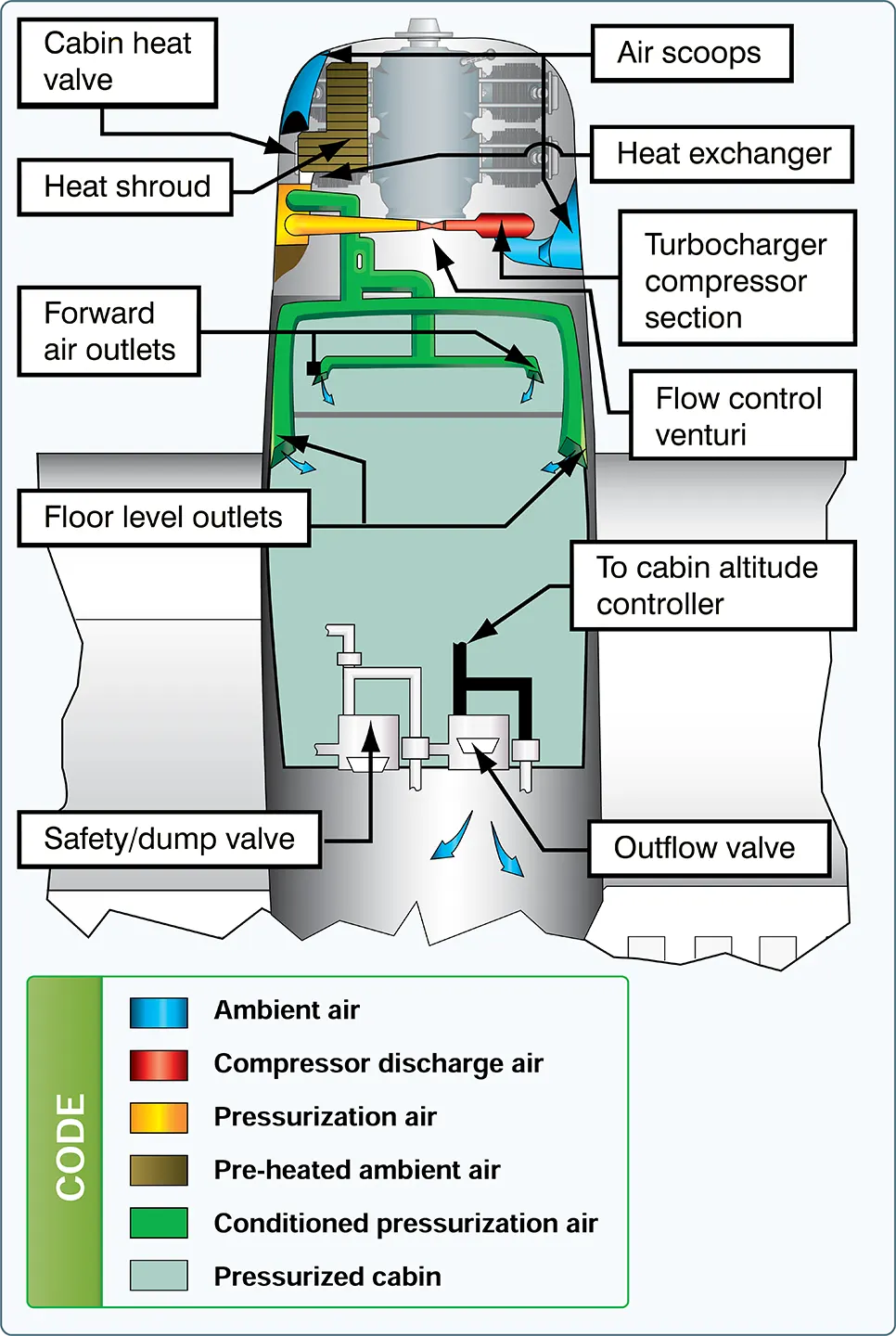
- Turbine-powered aircraft: Bleed air from the engine compressor section is commonly used to pressurize the cabin. Superchargers may be used on some older turbine-powered aircraft.
- Piston-powered aircraft: Air may be supplied from each engine turbocharger through a sonic venturi, which acts as a flow limiter.
Air is released from the fuselage through a device called an outflow valve. By regulating the amount of air leaving the pressurized area, the outflow valve allows a continuous inflow of air to maintain cabin pressure. [Figure 1]
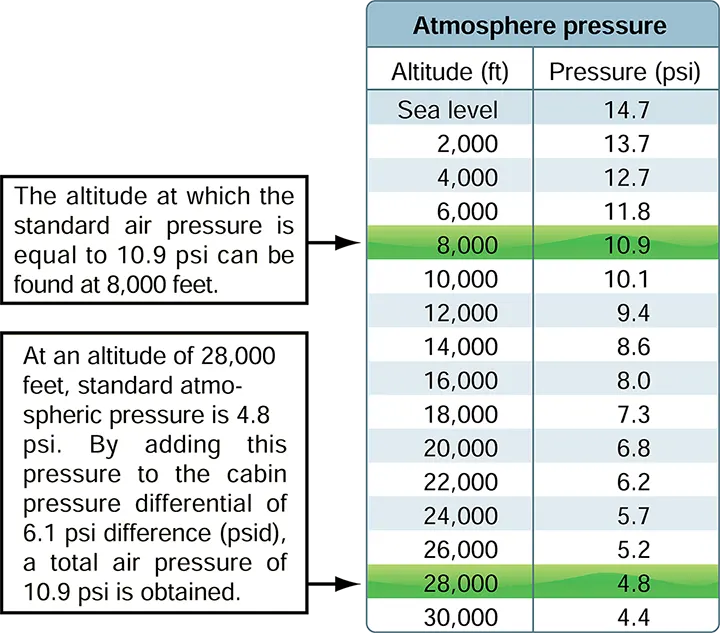
A cabin pressurization system typically maintains a cabin pressure altitude of approximately 8,000 feet at the aircraft’s maximum designed cruising altitude. This helps prevent rapid changes in cabin altitude that may cause discomfort or injury to passengers and crew.
The system also permits a reasonably rapid exchange of cabin air with outside air. This helps eliminate odors and remove stale air. [Figure 2]
Purpose of Cabin Pressurization
Cabin pressurization protects aircraft occupants against hypoxia. A pressurized cabin allows occupants to travel comfortably and safely for extended periods, particularly when cabin altitude is maintained at 8,000 feet or below, where oxygen equipment is generally not required.
Flight crews must understand the danger of an accidental loss of cabin pressure and be prepared to respond whenever such an emergency occurs.
Basic Pressurization Terms
The following terms help explain the operating principles of aircraft pressurization and air-conditioning systems.
- Aircraft altitude: The actual height above sea level at which the aircraft is flying.
- Ambient temperature: The temperature in the area immediately surrounding the aircraft.
- Ambient pressure: The pressure in the area immediately surrounding the aircraft.
- Cabin altitude: Cabin pressure expressed as the equivalent altitude above sea level.
- Differential pressure: The difference in pressure acting on opposite sides of a wall. In aircraft pressurization systems, it is the difference between cabin pressure and atmospheric pressure.
Cabin Pressure Control System
The cabin pressure control system provides cabin pressure regulation, pressure relief, vacuum relief, and the means to select the desired cabin altitude within the isobaric and differential ranges. It also provides a means of dumping cabin pressure.
The system uses a cabin pressure regulator, an outflow valve, and a safety valve to perform these functions.
Cabin Pressure Regulator
The cabin pressure regulator controls cabin pressure to a selected value in the isobaric range. In the differential range, it limits cabin pressure to a preset differential value.
When the aircraft reaches an altitude at which the pressure difference between the cabin and the outside atmosphere equals the maximum differential pressure for which the fuselage is designed, further increases in aircraft altitude result in a corresponding increase in cabin altitude.
Differential pressure control prevents the maximum allowable pressure difference from being exceeded. This limit is determined by the structural strength of the cabin and is often influenced by the relationship between cabin size and potential rupture areas, such as windows and doors.
Cabin Air Pressure Safety Valve
The cabin air pressure safety valve combines pressure relief, vacuum relief, and dump-valve functions.
- Pressure relief: Prevents cabin pressure from exceeding a predetermined differential pressure above ambient pressure.
- Vacuum relief: Allows outside air to enter the cabin when ambient pressure exceeds cabin pressure.
- Dump function: The flight deck control switch actuates the dump valve. When the switch is positioned to RAM, a solenoid valve opens, allowing cabin air to discharge into the atmosphere.
Pressurization Design Limits
The degree of pressurization and the operating altitude of an aircraft are limited by several design factors. The primary limitation is the maximum cabin differential pressure that the fuselage structure is designed to withstand.
Cabin Pressure Instruments
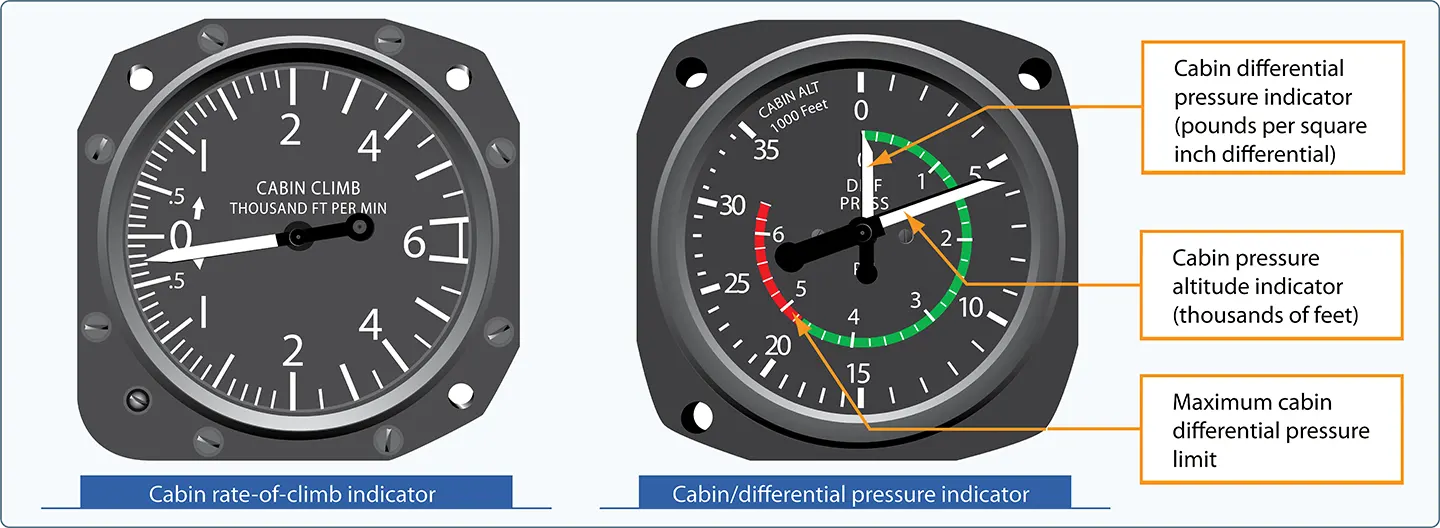
Several instruments are used with the pressurization controller:
- Cabin differential pressure gauge: Indicates the difference between cabin pressure and outside pressure. It should be monitored to ensure the cabin does not exceed the maximum allowable differential pressure.
- Cabin altimeter: Indicates cabin altitude and provides a check of pressurization system performance.
- Cabin rate-of-climb or descent indicator: Shows the rate at which cabin altitude is increasing or decreasing.
In some aircraft, the cabin differential pressure gauge and cabin altimeter are combined into one instrument. [Figure 3]
Decompression
Decompression is the inability of an aircraft’s pressurization system to maintain its designed pressure differential. It may result from a malfunction in the pressurization system or structural damage to the aircraft.
Types of Decompression
Physiologically, decompression is classified into two categories.
Explosive decompression occurs when cabin pressure changes faster than the lungs can decompress, potentially causing lung damage. Normally, the lungs can release air without restriction in approximately 0.2 seconds. Many authorities consider a decompression occurring in less than 0.5 seconds to be explosive and potentially dangerous.
Rapid decompression occurs when cabin pressure changes in such a way that the lungs decompress faster than the cabin.
Effects of Explosive Decompression
During an explosive decompression, occupants may hear a loud noise and feel dazed momentarily. The cabin may fill with fog, dust, or flying debris.
Fog forms because of the rapid temperature drop and changes in relative humidity. The ears normally clear automatically. Some occupants may also notice air rushing from their mouth and nose as air escapes from the lungs.
Physiological Effects of Rapid Decompression
Rapid decompression reduces the period of useful consciousness because oxygen in the lungs is rapidly exhaled. This lowers the partial pressure of oxygen in the blood and reduces the pilot’s effective performance time to approximately one-third to one-fourth of its normal duration.
For this reason, an oxygen mask should be worn when flying at very high altitudes, particularly at 35,000 feet or higher. If the aircraft is equipped with a demand or pressure-demand oxygen system, crewmembers are advised to select the 100 percent oxygen setting at high altitude.
Dangers of Decompression
Hypoxia
The primary danger of decompression is hypoxia. Rapid and proper use of oxygen equipment is necessary to prevent unconsciousness.
Decompression Sickness
Another potential danger during high-altitude decompression is evolved gas decompression sickness. When pressure on the body drops sufficiently, nitrogen comes out of solution and forms bubbles within the body. These bubbles can adversely affect body tissues.
Structural Damage and Cabin Openings
Decompression caused by structural damage presents additional dangers. Pilots, crew, and passengers near openings may be tossed or blown out of the aircraft. Individuals seated near openings should wear safety harnesses or seatbelts whenever the aircraft is pressurized.
Structural damage may also expose occupants to strong wind blasts and extremely cold temperatures.
Emergency Descent and Warning Systems
A rapid descent from altitude is necessary to minimize the effects of decompression. Pressurized aircraft are equipped with automatic visual and aural warning systems to alert the crew to cabin pressure problems.