Aircraft oxygen systems are essential life-support systems that must be maintained to ensure a reliable supply of breathing oxygen when required. Servicing involves leak testing, draining, filling, purging, and inspecting oxygen-system components. Because oxygen supports rapid combustion and can react dangerously with contaminants, all servicing and maintenance must be performed using approved procedures and oxygen-compatible equipment.
The procedures and requirements for servicing gaseous oxygen and liquid oxygen (LOX) systems, inspecting masks and hoses, replacing components, and preventing oxygen fires or explosions are discussed in this section. Always follow the applicable aircraft maintenance manual and component manufacturer’s instructions.
Table of Contents
Table of Contents
Servicing Gaseous Oxygen
Gaseous oxygen systems are widely used in general, corporate, and airline aviation. The use of lightweight aluminum and composite storage cylinders has improved these simple and reliable life-support systems.
All gaseous oxygen systems require regular servicing and maintenance. The following sections describe common procedures.
Leak Testing Gaseous Oxygen Systems
Leaks in a continuous-flow oxygen system may be difficult to detect because the system is open at the user end. Blocking the oxygen flow allows pressure to build so that leak-check procedures similar to those used in the high-pressure sections of the system can be performed.
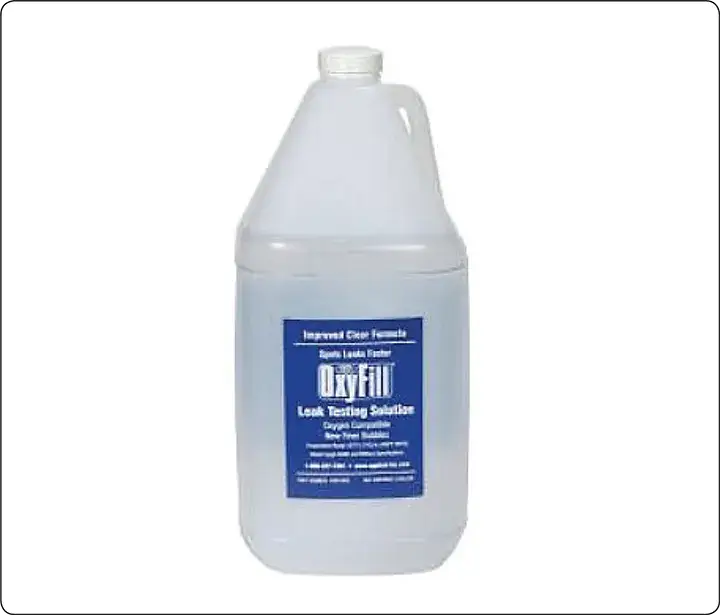
Leaks must be detected using oxygen-safe leak-check fluid. This is a soapy liquid free from substances that might react with pure oxygen or contaminate the system. The solution is applied to the outside of fittings and mating surfaces, much like checking an inflated tire or tube assembly. The formation of bubbles indicates a leak. [Figure 1]
Oxygen components and fittings must be assembled carefully, without overtightening or undertightening. If a leak is found at a fitting, check that it has been tightened to the correct torque. Tightening may not always stop the leak.
If the fitting is correctly torqued and the leak remains, release the system pressure and examine the fitting for flaws or contamination. Replace the fitting if necessary. All replacement components, lines, and fittings must be the correct parts and must be thoroughly cleaned and inspected before installation.
Follow the manufacturer’s instructions and repeat the leak check after completing the work.
High-Pressure System Precautions
Use caution when maintaining the high-pressure portion of a gaseous oxygen system. Opening a cylinder valve can pressurize the lines and components to as much as 1,850 psi.
The high-pressure section is the portion upstream of the reducer or regulator, which typically uses stainless-steel tubing.
Never attempt to tighten a leaking oxygen fitting while the system is being charged. Isolate the oxygen supply at the cylinder and depressurize the system. This reduces the risk of a spark and minimizes oxygen release or injury if a fitting fails completely.
Draining an Oxygen System
Safety is the most important consideration when draining an oxygen system. Oxygen must be released into the atmosphere without creating a fire, explosion, or other hazard. Draining the system outdoors is highly recommended.
The exact procedure varies, but the basic method is to establish a continuous flow in a safe area until the system is empty.
If the cylinder valve is operational, close it to isolate the oxygen supply. The remaining oxygen in the lines and components can then be released through the delivery points without disassembling the system.
- For a demand-flow regulator, selecting the emergency setting may provide continuous oxygen flow to a connected mask. Position the mask outside the aircraft, such as through an open window, where it is safe to discharge the oxygen.
- For a continuous-flow system, connect the masks to allow the oxygen to drain.
- Systems without check valves may be drained by opening the refill valve, where permitted by the applicable procedure.
Always follow the aircraft manufacturer’s instructions for draining the system.
Filling an Oxygen System
Oxygen-system filling procedures vary by aircraft. Many general aviation aircraft use removable cylinders that are exchanged for fully charged units. Portable oxygen systems are often serviced in the same way.
High-performance and transport-category aircraft may have built-in oxygen systems with plumbing that allows cylinders to be refilled while installed. The following is a general description of servicing this type of installation.
Before charging an oxygen system, consult the aircraft manufacturer’s maintenance manual. The specified oxygen type, safety precautions, servicing equipment, filling procedures, and testing requirements must be followed.
General precautions include:
- Open oxygen valves slowly.
- Fill slowly to avoid overheating.
- Purge air from the refill hose before transferring oxygen into the aircraft system.
- Check pressure frequently during refilling.
- Ensure that all equipment used with oxygen is free of grease and oil, which can cause a fire.
Oxygen Refill Carts
Airline and fixed-base operator maintenance shops often use oxygen filler carts. These carts contain several large oxygen supply cylinders connected to a fill-cart manifold. The manifold supplies a hose that attaches to the aircraft. [Figure 2]

Valves and pressure gauges allow the technician to monitor and control the oxygen transfer process.
Ensure that all cylinders on the cart contain aviator’s breathing oxygen and have at least 50 psi of pressure. Each cylinder must also be within its hydrostatic-test interval.
After a cart cylinder has dispensed oxygen, record its remaining pressure. This is commonly marked on the cylinder with chalk or entered in a pressure log kept with the cart. This allows the technician to identify the status of each cylinder.
No pump or mechanical device is used to transfer oxygen from the refill-cart manifold to the aircraft. Oxygen flows from a higher-pressure source to a lower-pressure vessel. By connecting the cart to the aircraft and opening the cart cylinders in order of increasing pressure, the technician can manage a gradual increase in oxygen flow.
General Procedure for Filling an Aircraft Oxygen System
The following steps describe a typical procedure for filling an aircraft oxygen system from an oxygen refill cart. The applicable aircraft maintenance manual takes precedence.
1. Check hydrostatic-test dates. Inspect the dates on all cylinders, particularly those installed in the aircraft. If a cylinder is out of date, remove it and replace it with an approved, serviceable unit.
2. Check cylinder pressures. Check the pressure of all cylinders on the cart and in the aircraft. If a cylinder is below 50 psi, replace it. Replacing a low-pressure aircraft cylinder may require purging the system afterward. Best practice also calls for removing and replacing any low-pressure or empty cylinders on the cart.
3. Prepare the servicing area. Observe all oxygen-handling precautions to ensure a safe environment around the aircraft.
4. Ground the refill cart. Connect the grounding lead between the refill cart and the aircraft.
5. Connect and purge the refill hose. Attach the cart hose from the manifold to the aircraft fill port. Purge the air from the hose with oxygen before opening the aircraft refill valve. Some hoses have purge valves that allow this to be done while the hose is securely attached. Other procedures may require purging with the hose attached to the refill fitting but not fully tightened. Follow the applicable instructions.
6. Select the initial cart cylinder. Observe the pressure in the aircraft cylinder to be filled. Open the aircraft cylinder as required. On the refill cart, open the cylinder whose pressure is closest to, but higher than, the aircraft cylinder pressure.
7. Open the aircraft refill valve. Oxygen flows from the cart cylinder, through the manifold, into the aircraft cylinder.
8. Transfer oxygen in stages. When the pressures equalize, close the cart cylinder. Open the next cart cylinder with a higher pressure and allow oxygen to flow into the aircraft cylinder until the pressures equalize again. Continue with successively higher-pressure cart cylinders.
9. Continue until the desired pressure is reached. Repeat the staged transfer procedure until the aircraft cylinder reaches the required pressure.
10. Close the valves. Close the aircraft refill valve and all cart cylinders.
11. Set the aircraft cylinder valves. Leave the aircraft oxygen cylinder valves in the correct position for normal operation. Remotely mounted cylinders are usually left open, but follow the aircraft-specific procedure.
12. Disconnect the refill hose. Remove the hose from the aircraft refill port and cap or cover both connections.
13. Remove the grounding strap. Disconnect the grounding lead after servicing is complete.
Temperature and Pressure Compensation
Temperature has a significant effect on the pressure of gaseous oxygen. Manufacturers typically provide a fill chart or placard at the aircraft oxygen refill station to help technicians compensate for temperature and pressure variations.
Consult the chart and fill the cylinders to the maximum pressure specified for the prevailing ambient temperature.
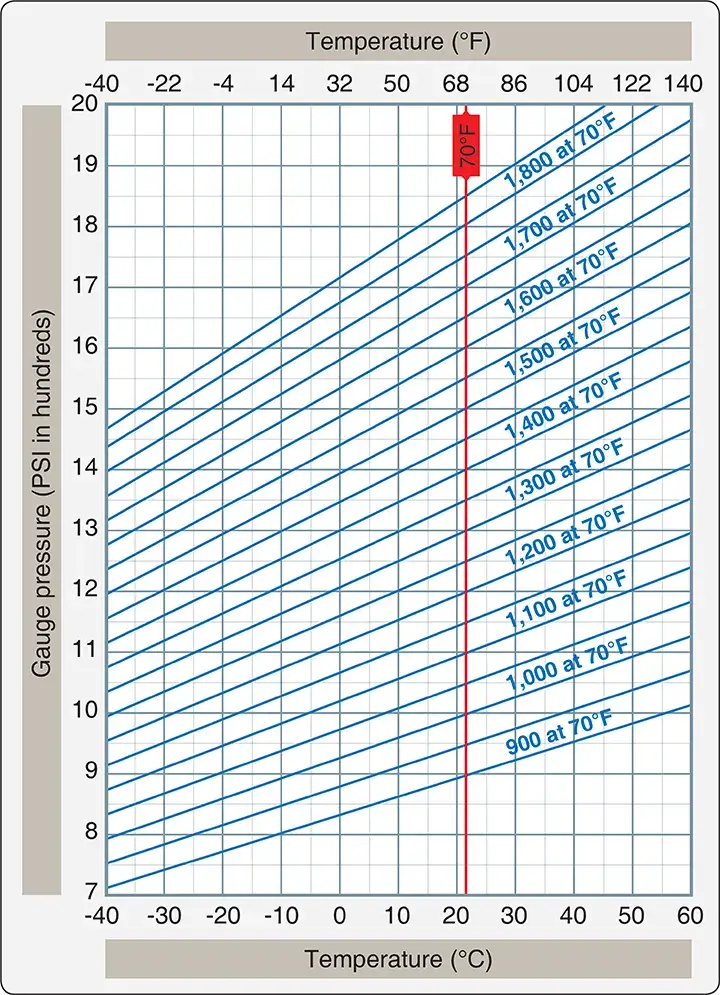
When ambient temperatures are high, oxygen cylinders may be filled to a pressure above the standard maximum ratings of many high-pressure aircraft oxygen cylinders, commonly 1,800 or 1,850 psi. This temperature-compensated filling accounts for the reduction in oxygen temperature and pressure that may occur at altitude.
On a cold day, the cylinder must be filled to a pressure below its maximum rated capacity to allow for pressure increases as the temperature rises.
Strict adherence to the applicable temperature/pressure compensation chart is essential for safe oxygen storage.
Some aircraft incorporate temperature-compensation features into the refill valve. After the ambient temperature is set on the valve dial, the valve closes when the correct oxygen pressure has been established in the aircraft cylinder. A chart may also be used to verify the proper servicing pressure.
Purging an Oxygen System
During normal use, the interior of an oxygen system becomes saturated with oxygen. This helps deliver clean, odor-free oxygen to users and prevents corrosion caused by contamination.
An oxygen system generally requires purging if it has been opened, has been depleted for more than two hours, or is suspected of being contaminated. Purging removes contaminants and restores oxygen saturation inside the system.
Causes of Oxygen-System Contamination
Moisture is the main cause of contamination in an oxygen system. In very cold weather, the small amount of moisture present in breathing oxygen can condense. Repeated charging can cause a significant amount of moisture to accumulate.
Moisture can also enter the system when:
- The system is opened and exposed to atmospheric air.
- Damp charging equipment is used.
- Refilling procedures are performed incorrectly.
Always follow the manufacturer’s instructions when maintaining, refilling, or purging an oxygen system.
Purging Procedure
Cumulative condensation cannot be entirely avoided, so oxygen systems require periodic purging. The procedure varies by aircraft model.
In general, oxygen is passed through a serviceable system for a specified period and at a specified pressure. Some systems may require as little as 10 minutes at normal delivery pressure, while others may require up to 30 minutes of flow at an elevated pressure.
The purpose is to remove contaminants and restore oxygen saturation within the system.
Nitrogen or dry air may be used to blow through lines and components during maintenance, where permitted. However, a final purge with pure oxygen is required before the system is returned to service.
Ensure that any storage cylinders used during purging are refilled as necessary. Before returning the aircraft to service, confirm that all lines are closed and all safety caps are installed.
Filling LOX Systems
The use of liquid oxygen (LOX) in civilian aviation is rare. The most common and safest method of servicing a LOX system is to exchange the storage unit for a fully charged one. However, filling a LOX system while installed in the aircraft is also possible.
A portable fill cart is used, and the precautions required for servicing high-pressure gaseous oxygen systems must also be observed. In addition, protection against cold burns is necessary.
Because a significant amount of gaseous oxygen may be released during the process, refilling should be performed outdoors.
The servicing cart is connected to the aircraft system through a fill valve. The buildup/vent valve on the LOX container assembly is placed in the vent position, and the valve on the service cart is opened.
LOX flows into the aircraft system. Some of the liquid vaporizes, cooling the entire setup. The resulting gaseous oxygen flows overboard through the vent valve while the system fills.
When a steady stream of LOX flows from the vent valve, the system is full. The valve is then switched to the buildup position. The aircraft refill valve and cart supply valves are closed, and the hose is removed.
LOX servicing precaution: Back-seated valves may freeze in the open position because of the low temperatures involved in transferring LOX. Valves should be opened fully and then closed slightly to avoid back-seating them.
Inspection of Masks and Hoses
The wide variety of oxygen masks used in aviation requires periodic inspection. The integrity of masks and hoses ensures that oxygen can be delivered effectively when needed, including during emergencies.
Leaks, holes, and tears are unacceptable. Most discrepancies of this type are corrected by replacing the damaged unit.
Some continuous-flow masks are designed for disposal after use. Ensure that a mask is available for each potential user aboard the aircraft.
Reusable masks must be clean and functional. This reduces the risk of infection and helps prolong the life of the mask. Mild cleaners and antiseptics that are free of petroleum products may be used. Individually wrapped alcohol swabs are often kept in the flight deck.
Mask and Hose Condition
Built-in microphones must be operational. Donning straps and fittings must be in good condition and function correctly so that the mask is held securely against the user’s face.
The hose diameter of a continuous-flow mask is considerably smaller than that of a demand-flow mask. In continuous-flow systems, the hose’s inside diameter helps control the flow rate. Masks designed for each system are made to connect only to the appropriate hose.
Smoke Masks
Smoke masks are required on transport aircraft and are also used on some other aircraft. They cover the eyes, nose, and mouth, and are usually positioned within easy reach of crew members.
Smoke masks are used when flight-deck conditions require the additional protection they provide. Their hoses connect to demand regulators through the same port used for regular demand-type masks and operate in the same manner. Most smoke masks include a built-in microphone.

Some portable oxygen systems are also equipped with smoke masks.
Replacing Tubing, Valves, and Fittings
Replacing aircraft oxygen-system tubing, valves, and fittings is similar to replacing components in other aircraft systems. However, oxygen systems require particular attention to cleanliness and the use of compatible sealants.
Cleaning Oxygen-System Components
Any oxygen-system component must be thoroughly cleaned before installation. Tubing may contain residue left over from bending or flaring operations.
Cleaning must be performed using nonpetroleum-based cleaners. Trichloroethylene, acetone, and similar cleaners may be used to flush new tubing where approved by the manufacturer. Tubing must be blown or baked dry before installation.
Always follow the manufacturer’s procedures for cleaning oxygen-system components.
Thread Sealants and Fittings
Some oxygen-system components use tapered pipe fittings. These connections are usually sealed with a thread lubricant or sealant.
Typical thread sealants are petroleum-based and must not be used. Only oxygen-compatible thread lubricants or sealants are permitted. Teflon® tape may also be used on oxygen pipe-fitting connections.
When using Teflon® tape, begin wrapping at least two threads from the end of the fitting. This prevents loose tape from entering the oxygen system.
Prevention of Oxygen Fires or Explosions
Precautions must be observed when working with or around pure oxygen. Oxygen readily combines with other substances, and some reactions can be violent or explosive.
It is especially important to keep pure oxygen away from petroleum products. An explosion can occur when oxygen and incompatible materials combine. Care must also be taken during inspection and maintenance to ensure safe working conditions. Whenever possible, maintenance should be performed outdoors.
When working on an oxygen system:
- Carefully observe all warnings and precautions in the aircraft maintenance manual.
- Have an adequate fire extinguisher available before beginning work.
- Cordon off the work area and post “NO SMOKING” placards.
- Ensure that all tools and servicing equipment are clean.
- Avoid power-on checks and use of the aircraft electrical system unless specifically required by the approved procedure.
Oxygen System Inspection and Maintenance
Cleanliness is essential to safe oxygen-system maintenance. Hands, clothing, and tools must be clean and free of grease. A good practice is to use tools dedicated exclusively to oxygen-system work.
There must be absolutely no smoking or open flames within a minimum of 50 feet of the work area. Always use protective caps and plugs when handling oxygen cylinders, system components, or plumbing. Do not use adhesive tape.
Oxygen cylinders should be stored in a designated, cool, ventilated area of the hangar, away from petroleum products and heat sources.
Maintenance Precautions
Oxygen-system maintenance must not begin until the oxygen supply cylinder valve is closed and system pressure has been released. Fittings must be unscrewed slowly to allow residual pressure to dissipate.
All oxygen lines must be marked and have at least two inches of clearance from:
- Moving parts
- Electrical wiring
- Fluid lines
- Hot ducts and other heat sources
A pressure check and leak check must be performed whenever the system is opened for maintenance.
Do not use lubricants, sealants, cleaners, or other substances unless they are specifically approved for oxygen-system use.