
Force, work, power, and torque are fundamental concepts in physics that explain how objects move and how machines operate. These principles are important in aviation because they help explain aircraft movement, engine operation, friction, and the mechanical forces involved in aircraft maintenance. Understanding the relationship between these concepts provides a foundation for studying aircraft engines, mechanical systems, and other aircraft components.
Table of Contents
Table of Contents
Force
Before the concepts of work, power, or torque can be discussed, we need to understand what force means. According to the dictionary, force is the intensity of an impetus or an applied effort. For example, if we apply a force to an object, there is a tendency for the object to move or change its state of motion. Another way to look at it is that force is involved in producing or changing motion and is essential to understanding work, power, and torque.
The unit for force in the English system of measurement is pounds, and in the metric system it is newtons. One pound of force is equal to 4.448 newtons.
When calculating the thrust of a turbine engine, we use Newton’s second law of motion, expressed by the formula:
Force = Mass × Acceleration
The thrust of an engine is expressed in pounds-force. The GE90-115 turbofan engine, used on the Boeing 777-300ER, for example, produces approximately 115,000 pounds of thrust.
Work
The study of machines, both simple and complex, can be viewed as a study of the energy involved in mechanical work. This is because all machines transfer input energy, or the work done on the machine, into output energy, or the work done by the machine.
Work, in the mechanical sense of the term, is done when a resistance is overcome by a force acting through a measurable distance. Two factors are involved: (1) force and (2) movement through a distance.
As an example, suppose a small aircraft is stuck in the snow. Two men push against it for a period of time, but the aircraft does not move. According to the technical definition, no mechanical work is done on the aircraft by the pushing force because there is no displacement. By definition, work is accomplished only when an object is displaced by a force. To calculate work when the force acts in the direction of movement, the following formula is used:
Work = Force (F) × Distance (d)
In the English system, force is expressed in pounds-force and distance in feet or inches, so the resulting units are foot-pounds (ft-lb) or inch-pounds (in-lb). Notice that these are the same units used for potential and kinetic energy.
In the metric system, force is expressed in newtons (N) and distance in meters, with the resulting unit being the joule (J). One pound-force is equal to approximately 4.448 N, and one meter is equal to approximately 3.28 feet. One joule is equal to approximately 0.738 ft-lb.
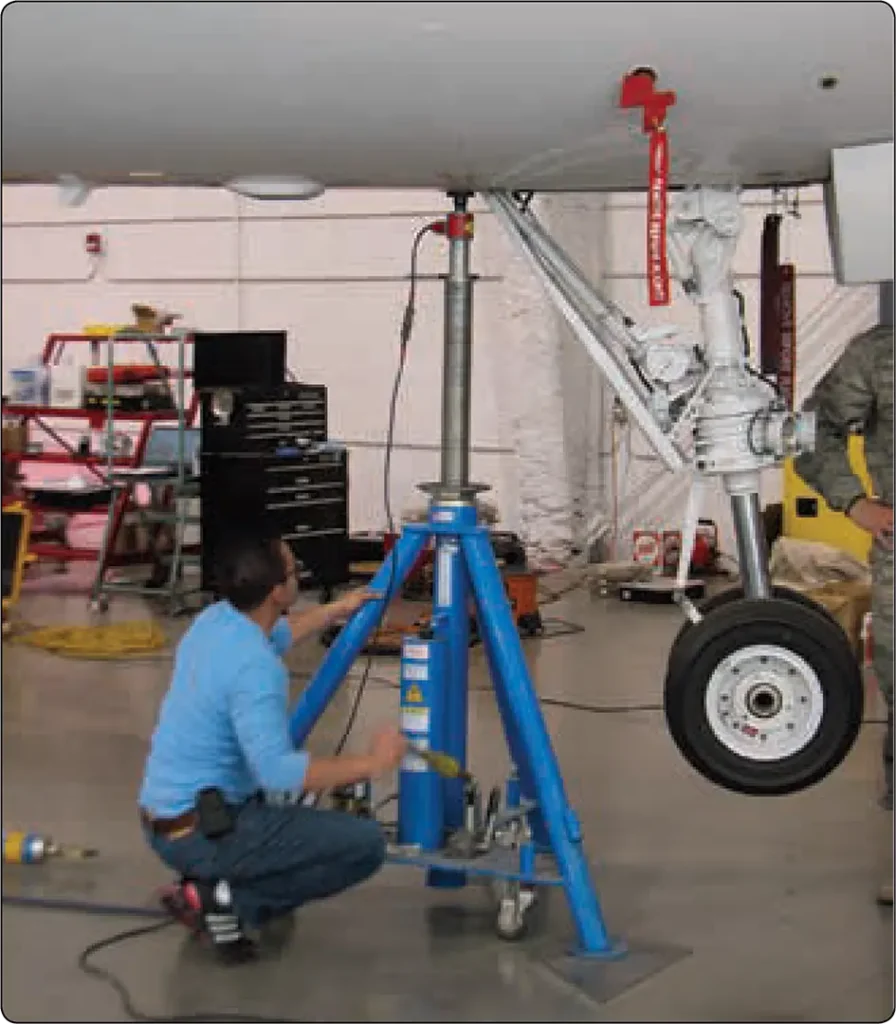
Example: How much work is accomplished by jacking a 150,000-lb Airbus A-320 airplane a vertical height of 4 ft? [Figure 1]
Work = Force × Distance
= 150,000 lb × 4 ft
= 600,000 ft-lb
Example: How much work is accomplished when a tow tractor is hooked up to a tow bar and a Boeing 737-800 airplane weighing 130,000 lb is pushed 80 ft into the hangar? The force on the tow bar is 5,000 lb.
Work = Force × Distance
= 5,000 lb × 80 ft
= 400,000 ft-lb
In this last example, notice that the force does not equal the weight of the airplane. This is because the airplane is being moved horizontally rather than lifted vertically. In almost all cases, it takes less force to move something horizontally than it does to lift it vertically. Most people can push their car a short distance if it runs out of gas, but they cannot get under their car and lift it off the ground.
Friction and Work
In calculating work done, the actual resistance overcome is measured. This is not necessarily the weight of the object being moved. [Figure 2]
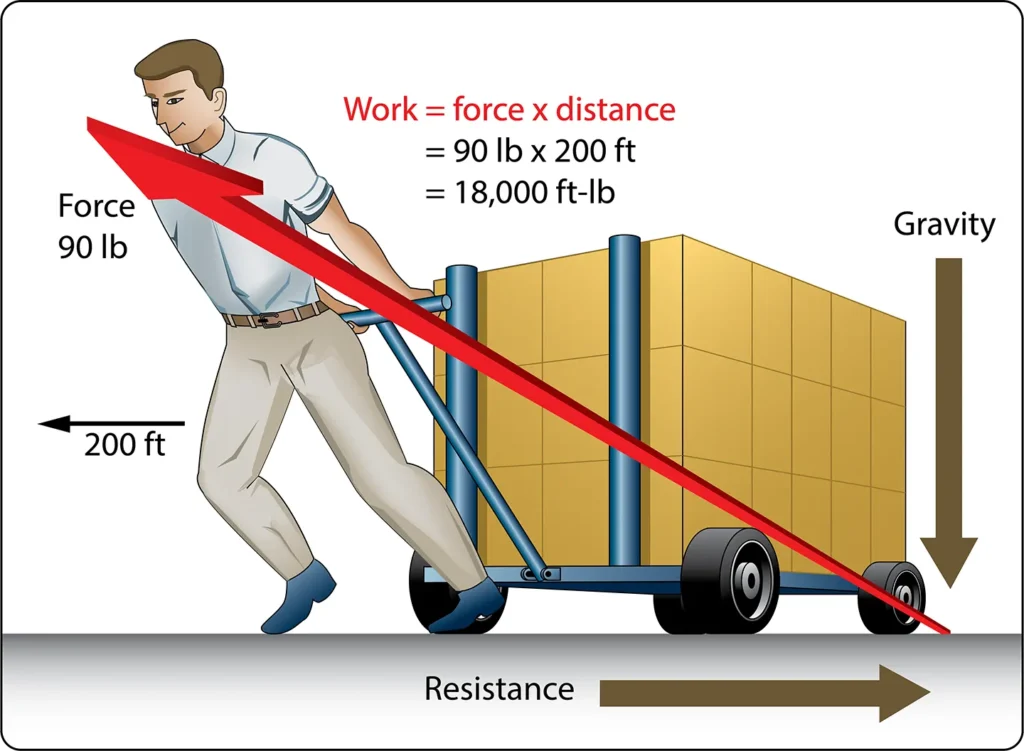
A 900-lb load is being pulled a distance of 200 ft. This does not mean that the work done (force × distance) is 180,000 ft-lb (900 lb × 200 ft). This is because the person pulling the load is not working against the total weight of the load, but rather against the rolling friction of the cart, which may be no more than 90 lb.
Friction is an important aspect of work. Without friction, it would be impossible to walk. One would have to push oneself from place to place and bump against an obstacle to stop at a destination. Yet friction is a liability as well as an asset and requires consideration when dealing with any moving mechanism.
In experiments relating to friction, measurements of the applied forces reveal three main types of friction. One force is required to start a body moving, while another is required to keep the body moving at a constant speed. Also, after a body is in motion, a smaller force is generally required to keep it rolling than to keep it sliding.
Thus, the three kinds of friction may be classified as: (1) starting or static friction, (2) sliding friction, and (3) rolling friction.
Static Friction
When an attempt is made to slide a heavy object along a surface, the object must first be broken loose or started. Once in motion, it generally slides more easily. The force required to start the body moving is proportional to the normal force acting between the surfaces.
The force necessary to start the body moving is designated “F,” and “F'” is the normal force pressing the body against the surface, which is usually equal to its weight on a horizontal surface.
Since the nature of the surfaces rubbing against each other is important, they must be considered. The nature of the surfaces is indicated by the coefficient of starting friction which is designated by the letter “k.” This coefficient can be established for various materials and is often published in tabular form. Thus, when the load (weight of the object) is known, starting friction can be calculated by using the following formula:
F = kF’
For example, if the coefficient of static friction of a smooth iron block on a smooth, horizontal surface is 0.3, the maximum force required to start a 10-lb block moving would be 3 lb; for a 40-lb block, it would be 12 lb.
Starting friction for objects equipped with wheels and roller bearings is much smaller than that for sliding objects. For example, a locomotive would have difficulty getting a long train of cars in motion all at once. Therefore, the couplings between the cars are purposely made to have a few inches of play.
When starting the train, the engineer backs the engine until all the cars are pushed together. Then, with a quick start forward, the first car is set in motion. This technique helps overcome the resistance to starting each car in motion. It would be difficult for the engine to start all the cars simultaneously because the combined starting resistance would be greater than the force available at the wheels. However, once the cars are in motion, the resistance is reduced, and a smaller force is required to keep the train moving than was required to start it.
Sliding Friction
Sliding friction is the resistance to motion offered by an object sliding over a surface. It pertains to friction produced after the object has been set in motion and is generally less than the maximum static friction. The amount of sliding resistance depends on the nature of the surface of the object, the surface over which it slides, and the normal force between the object and the surface.
This resistive force may be computed using the following formula:
F = mN
In the formula above, “F” is the resistive force due to friction expressed in pounds; “N” is the force exerted on or by the object perpendicular (normal) to the surface over which it slides; and “m” (mu) is the coefficient of sliding friction.
On a horizontal surface, N is equal to the weight of the object in pounds. The area of the sliding object exposed to the sliding surface has no effect on the results. A block of wood, for example, will not slide any easier on one of the broad sides than it will on a narrow side, assuming all sides have the same smoothness. Therefore, area does not enter into the equation above.
Rolling Friction
Resistance to motion is greatly reduced if an object is mounted on wheels or rollers. The resistance to motion for objects mounted on wheels or rollers is called rolling friction or rolling resistance.
This force may be computed by the same equation used in computing sliding friction, but the values of “m” will be much smaller. For example, the value of “m” for rubber tires on concrete or macadam is about 0.02. The value of “m” for roller bearings is very small, usually ranging from 0.001 to 0.003 and is often disregarded.
Example: An aircraft with a gross weight of 79,600 lb is towed over a concrete ramp. What force must be exerted by the towing vehicle to keep the airplane rolling after it has been set in motion?
F = mN
= 0.02 mu × 79,600 lb
= 1,592 lb
Power
The concept of power involves the previously discussed topic of work, which is a force being applied through a measured distance, but adds one more consideration—time. In other words, power describes how quickly work is accomplished.
If someone asked the average person if they could lift one million pounds 5 feet off the ground, the answer most assuredly would be no. This person would probably assume that they had to lift it all at once. What if they were given 365 days to lift it and could lift small amounts of weight at a time?
The total work involved would be the same, regardless of how long it took to lift the weight, but the power required would be different. If the weight is to be lifted in a shorter period of time, more power will be required. The formula for power is as follows:
Power = Force × Distance ÷ Time
The units for power will be foot-pounds per minute, foot-pounds per second, inch-pounds per minute or second, and possibly mile-pounds per hour. The units depend on how distance and time are measured.
Many years ago, there was a desire to compare the power of the newly evolving steam engine to that of horses. People wanted to know how many horses the steam engine was equivalent to. The value we currently know as one horsepower (hp) was developed as a result of this comparison. It is equal to 550 foot-pounds per second (ft-lb/s). It was based on the traditional horsepower definition of lifting a weight of 550 lb one foot off the ground in one second.
The values we use today to convert power to horsepower are as follows:
1 hp = 550 ft-lb/s
1 hp = 33,000 ft-lb/min.
1 hp = 375 mile-lb/hr
1 hp = 746 watts
To convert power to horsepower, divide the power by the appropriate conversion value based on the units being used.
Example: What power would be needed, and how many horsepower would be required, to raise the GE90 turbofan engine into position for installation on a Boeing 777-300ER airplane? The engine weighs 19,000 lb, and it must be lifted 4 ft in 2 minutes.
Power = Force × distance ÷ time
= 19,000 lb × 4 ft ÷ 2 min.
= 38,000 ft-lb/min.
hp = 38,000 ft-lb/min. ÷ 33,000 ft-lb/min.
hp = 1.15
The hoist used to raise this engine into position will need to be powered by an electric motor because the required lifting operation involves a substantial amount of work in a relatively short period of time. The hoist and motor must also be selected to account for mechanical losses and the appropriate safety factors.
Torque
Torque is a very interesting concept and occurrence, and it is definitely something that needs to be discussed in conjunction with work and power. Whereas work is described as force acting through a distance, torque is described as force acting along a distance. Torque is something that creates twisting and tries to make something rotate.
If we push on an object with a force of 10 lb and it moves 10 inches in a straight line, we have done 100 in-lb of work.
By comparison, if we have a wrench 10 inches long that is on a bolt, and we push down on it with a force of 10 lb, a torque of 100 lb-in is applied to the bolt. If the bolt was already tight and did not move as we pushed down on the wrench, the torque of 100 lb-in would still exist. The formula for torque is:
Torque = Force × distance
Even though this formula looks the same as the other formula for calculating work, recognize that the distance value in this formula is not the linear distance an object moves, but rather the distance along which the force is applied.
Notice that with torque nothing had to move, because the force is being applied along a distance and not through a distance. Notice also that although the units of work and torque appear to be the same, they are not. The units of work were inch-pounds and the units of torque were pound-inches, and that is what differentiates the two.
Torque is very important when thinking about how engines work, both piston engines and gas turbine engines. Both types of engines create torque in advance of being able to create work or power.
With a piston engine, a force in pounds pushes down on the top of the piston and tries to make it move. The piston is attached to the connecting rod, which is attached to the crankshaft at an offset. That offset would be like the length of the wrench discussed earlier, and the force acting along that length is what creates torque. [Figure 3]
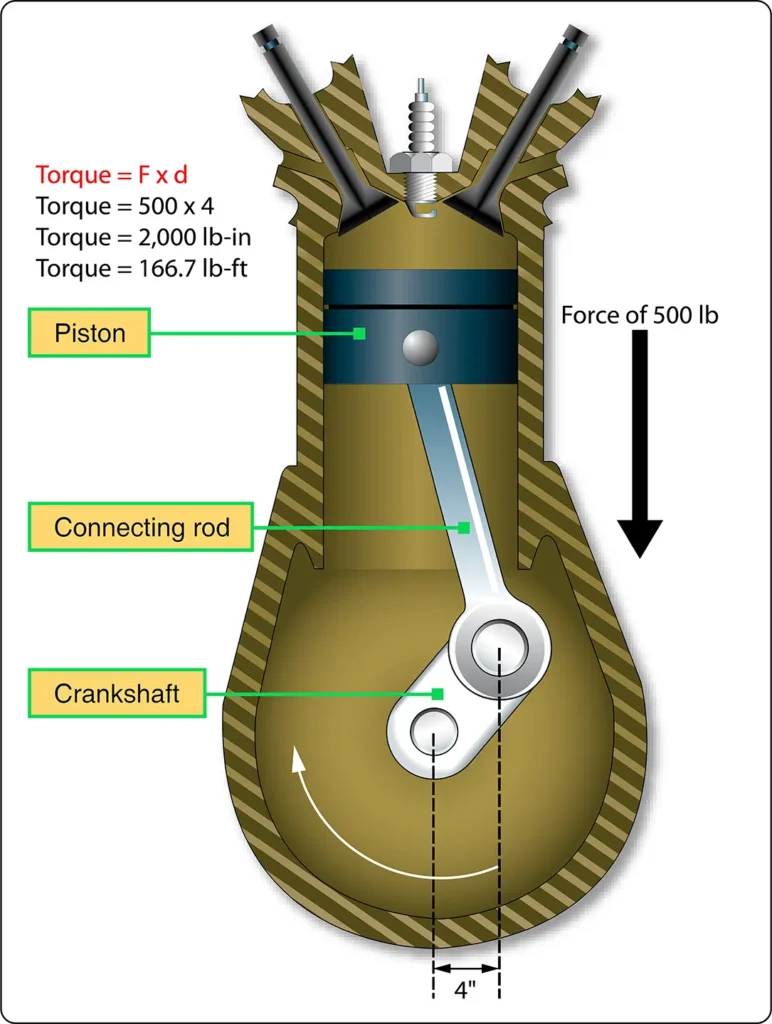
For the cylinder in Figure 3, there is a force of 500 lb pushing down on the top of the piston. The connecting rod attaches to the crankshaft at an offset distance of 4 in. The product of the force and the offset distance is the torque, in this case 2,000 lb-in.
In a turbine engine, the turbine blades at the back of the engine extract energy from the high velocity exhaust gases. The energy extracted becomes a force in pounds pushing on the turbine blades, which happen to be a certain number of inches from the center of the shaft they are trying to make rotate. The number of inches from the turbine blades to the center of the shaft would be like the length of the wrench discussed earlier.
Mathematically, there is a relationship between the horsepower of an engine and the torque of an engine. The formula that shows this relationship is as follows:
Torque = Horsepower × 5,252 ÷ rpm
Example: A Cessna 172R has a Lycoming IO-360 engine that produces 180 horsepower at 2,700 rpm. How many pound-feet of torque is the engine producing?
Torque = 180 × 5,252 ÷ 2,700
= 350 lb-ft.