
Motion is a fundamental concept in physics and aviation. Aircraft are constantly changing position, speed, and direction during flight. Understanding motion and the forces that affect it helps explain aircraft acceleration, engine thrust, flight dynamics, and the movement of objects along straight and curved paths.
Motion and Uniform Motion
The study of the relationship between the motion of bodies or objects and the forces acting on them is often called the study of force and motion. In a more specific sense, the relationship between velocity, acceleration, and distance is known as kinematics.
Motion may be defined as a continuing change of position or place, or as the process in which a body undergoes displacement. When an object is at different points in space at different times, that object is said to be in motion.
If an object travels equal distances during equal periods of time, its motion may be described as uniform. Thus, an object in uniform motion has a constant speed.
Speed and Velocity
In everyday conversation, speed and velocity are often used as if they mean the same thing. In physics, however, they have definite and distinct meanings.
Speed refers to how fast an object is moving, or how far the object travels in a specific period of time. Speed tells nothing about the direction in which an object is moving.
For example, if an airplane leaves New York City and travels for 8 hours at a speed of 150 mph, this information tells nothing about the direction in which the airplane is moving. At the end of 8 hours, it might be in Kansas City, or, if it traveled along a circular route, it could be back in New York City.
Velocity is the quantity in physics that describes both the speed of an object and the direction in which it moves. Velocity can be defined as the rate of motion in a particular direction.
Velocity is also described as a vector quantity. A vector is represented by a line of specific length with an arrow on one end. The length of the line indicates the numerical value, or magnitude, and the arrow indicates the direction in which that quantity acts.
Two velocity vectors, such as one representing the velocity of an airplane and another representing the velocity of the wind, can be added together through a process called vector analysis.
Figure 5-25 demonstrates this, with vectors A and B representing the velocity of the airplane and the wind, respectively, and vector C representing the resultant velocity. With no wind, the speed and direction of the airplane would be those shown by vector A. When the wind’s direction and speed are taken into account, the airplane’s resulting velocity is represented by vector C.

Imagine that an airplane is flying in a circular pattern at a constant speed. The airplane is constantly changing direction because of the circular pattern, which means its velocity is constantly changing. This is because velocity includes direction, even when speed remains constant.
To calculate the average speed of an object, the distance it travels is divided by the elapsed time.
- If distance is measured in miles and time in hours, the unit of speed is miles per hour (mph).
- If distance is measured in feet and time in seconds, the unit of speed is feet per second (fps).
To convert mph to fps, multiply by 1.467. To convert fps to mph, divide by 1.467.
Average velocity is calculated using displacement divided by elapsed time. Unlike speed, velocity must also account for direction.
Acceleration
Acceleration is defined as the rate of change of velocity. If the velocity of an object is increased from 20 mph to 30 mph, the object has been accelerated. If the increase in velocity is 10 mph in 5 seconds, the rate of change in velocity is 10 mph in 5 seconds, or 2 mph per second. If this were multiplied by 1.467, it could also be expressed as an acceleration of 2.93 feet per second per second (fps/s). By comparison, the acceleration due to gravity is 32.2 fps/s.
To calculate acceleration, the following formula is used.
Example: An Air Force F-15 fighter is cruising at 400 mph. The pilot advances the throttles to full afterburner and accelerates to 1,200 mph in 20 seconds. What is the average acceleration in mph/s and fps/s?
Converting to feet per second per second:
A = 40 × 1.467
A = 58.7 fps/s
In the example just shown, the acceleration was found to be 58.7 fps/s. Since 32.2 fps/s is approximately equal to the acceleration due to gravity, divide the F-15’s acceleration by 32.2 to find the acceleration expressed in Gs.
58.7 ÷ 32.2 = 1.82 G
Therefore, the F-15 experiences an average acceleration of approximately 1.82 G during this acceleration.
Newton’s Law of Motion
Newton’s three laws of motion describe the relationship between the forces acting on an object and its motion.
First Law
When a magician snatches a tablecloth from a table and leaves a full setting of dishes undisturbed, the magician is not displaying a mystical art; the action demonstrates the principle of inertia.
Inertia is responsible for the discomfort felt when an airplane is brought to a sudden halt in the parking area and passengers are thrown forward in their seats. Inertia is a property of matter. This property is described by Newton’s first law of motion, which states:
Objects at rest tend to remain at rest, and objects in motion tend to remain in motion at the same speed and in the same direction, unless acted upon by an external force.
More precisely, an object’s motion remains unchanged unless a net external force acts on it.
Second Law
Bodies in motion have a property called momentum. A body that has great momentum has a strong tendency to remain in motion and is therefore difficult to stop.
For example, a train moving at even a low velocity is difficult to stop because of its large mass. Newton’s second law applies to this property. It states:
When a force acts upon a body, the momentum of that body changes. The rate of change of momentum is proportional to the applied force.
For a body of constant mass, Newton’s second law is expressed by the formula:
Force = Mass × Acceleration
F = MA
Based on Newton’s second law, the formula for calculating thrust can be derived. It was determined that mass equals weight divided by gravity, and acceleration equals final velocity minus initial velocity divided by time.
Combining these concepts gives the following formula:
Example: A turbojet engine is moving 150 lb of air per second through the engine. The air enters at 100 fps and leaves at 1,200 fps. How much thrust, in pounds, is the engine creating?
In this example, the air’s weight flow rate is 150 lb per second, and the time interval used is one second.
Third Law
Newton’s third law of motion is often called the law of action and reaction. It states that for every action, there is an equal and opposite reaction.
This means that if one object applies a force to another object, the second object applies an equal force in the opposite direction to the first object.
It is easy to see how this applies to objects at rest. For example, as a man stands on the floor, the floor exerts an upward force against his feet equal to his weight, assuming he is standing still on a level surface.
This law is also applicable when a force is applied to an object in motion.
Forces always occur in pairs. The term “acting force” means the force one body exerts on a second body, and “reacting force” means the force the second body exerts on the first.
When an aircraft propeller pushes a stream of air backward with a force of 500 lb, the air pushes the propeller blades forward with an equal force of 500 lb. This forward force helps propel the aircraft forward.
A turbofan engine exerts a force on the air entering the inlet duct, causing it to accelerate through the fan duct and the engine’s exhaust. The air accelerating toward the rear produces an equal and opposite force on the engine, resulting in thrust.
Circular Motion
Circular motion is the motion of an object along a circular path with a constant radius.
For example, if one end of a string is tied to an object and the other end is held in the hand, the object can be swung in a circle. The object is constantly deflected from a straight (linear) path by the pull exerted on the string, as shown in Figure 2.
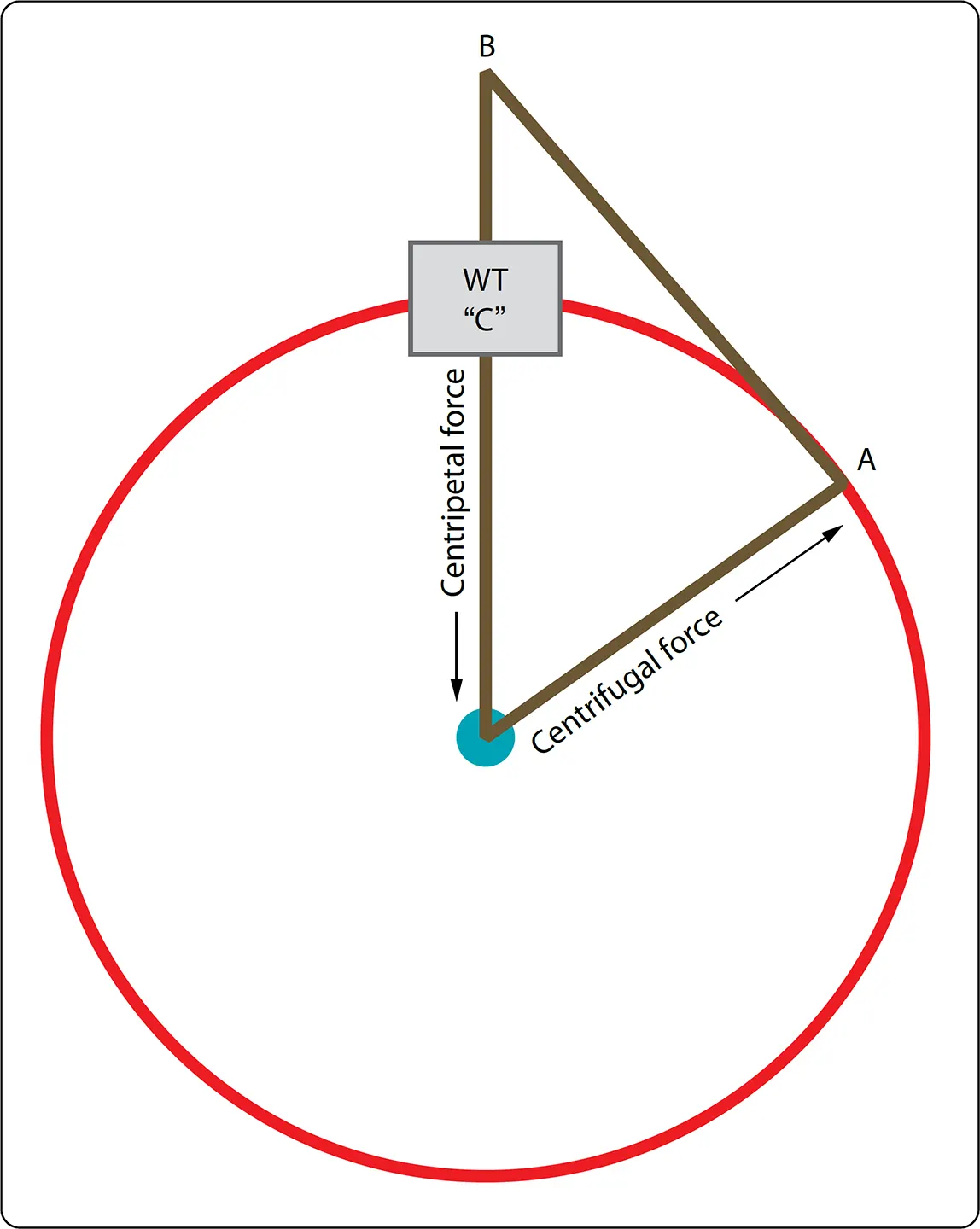
When the weight is at point A, due to inertia, it tends to continue moving in a straight line toward point B. However, the force exerted by the string continuously changes the direction of its motion, causing it to follow the circular path toward point C.
The string exerts a centripetal force on the object, which is directed toward the center of the circular path. The object exerts an equal and opposite force on the string, obeying Newton’s third law of motion.
The term centrifugal force is used for the apparent outward force experienced when describing motion from a rotating reference frame. It is not the reaction force to centripetal force; the actual reaction force is the outward force that the object exerts on the string.
Centripetal force is directly proportional to the mass of the object in circular motion. Thus, if the mass of the object in Figure 2 is doubled, the pull on the string must also be doubled to keep the object in its circular path, provided the speed and radius remain constant.
Centripetal force is inversely proportional to the radius of the circle in which an object travels. If the string in Figure 2 is shortened and the speed remains constant, the pull on the string must increase because the radius is decreased.
Using the same reasoning, the pull on the string must increase if the object is swung more rapidly in its orbit. Centripetal force is directly proportional to the square of the velocity of the object.
The formula for centripetal force is:
Centripetal Force = Mass × Velocity² ÷ Radius
For the formula above, mass would typically be converted to weight divided by gravity, velocity would be in feet per second, and the radius would be in feet.
Example: What would the centripetal force be if a 10-pound weight was moving in a 3-ft radius circular path at a velocity of 500 fps?
Centripetal Force = Mass × Velocity² ÷ Radius
Centripetal Force = 10 × 500² ÷ (32.2 × 3)
Centripetal Force = 25,880 lb
In the condition identified in the example, the object experiences a centripetal force equivalent to approximately 2,588 times its weight. It can also be said that the object is experiencing approximately 2,588 Gs of centripetal acceleration.
The fan blades in a large turbofan engine, when the engine is operating at maximum rpm, experience many thousands of Gs for the same reason.