Aircraft components are subjected to different types of stress during operation. Wings, engine shafts, landing gear, fasteners, and other structural components must withstand these forces without experiencing excessive deformation or failure. Understanding the different forms of stress is essential when studying aircraft structures, materials, and maintenance.
What Is Stress?
Whenever a machine is in operation, whether it is a simple machine like a lever or a screw, or a more complex machine like an aircraft piston engine or a hydraulically operated landing gear, its parts and components experience stress.
Whenever an external force is applied to an object, such as a weight pushing on the end of a lever, internal forces develop within the object to resist the applied force. The internal force distributed over an area is known as stress.
Stress is typically measured in pounds per square foot (lb/ft²) or pounds per square inch (psi). It is calculated by dividing the applied force by the area over which the force acts.
External forces cause stress to develop in one or more of five forms. The five forms are tension, compression, torsion, bending, and shear.
Tension
Tension is a force that tries to pull an object apart.
In the block and tackle system discussed earlier in the Simple Machines section, the upper block, which houses the two fixed pulleys, is secured to an overhead beam. The movable lower block and its two pulleys hang from ropes, and the weight is suspended below the entire assembly.
The weight being lifted causes the ropes and supporting components to experience tension. The weight is effectively trying to pull the rope apart. If the tension becomes too great, the rope will ultimately break.
Compression
Compression is a force that tries to crush an object.
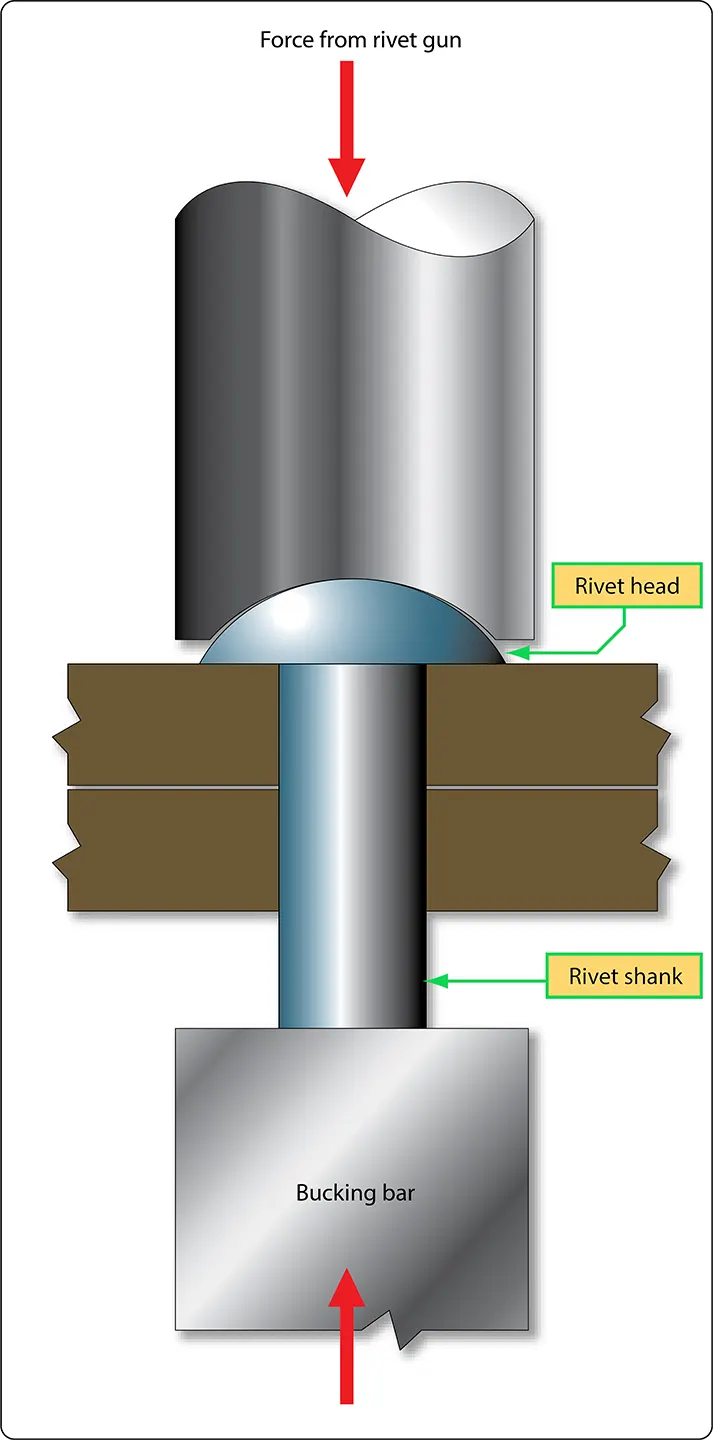
An excellent example of compression occurs when a sheet-metal airplane is assembled using a fastener known as a rivet. The rivet passes through holes drilled in the aluminum pieces. A rivet gun on one side and a bucking bar on the other apply force to the rivet.
This applied force compresses the rivet, causing its shank to expand and fill the hole. The expanded rivet securely holds the aluminum pieces together. [Figure 1]
Torsion
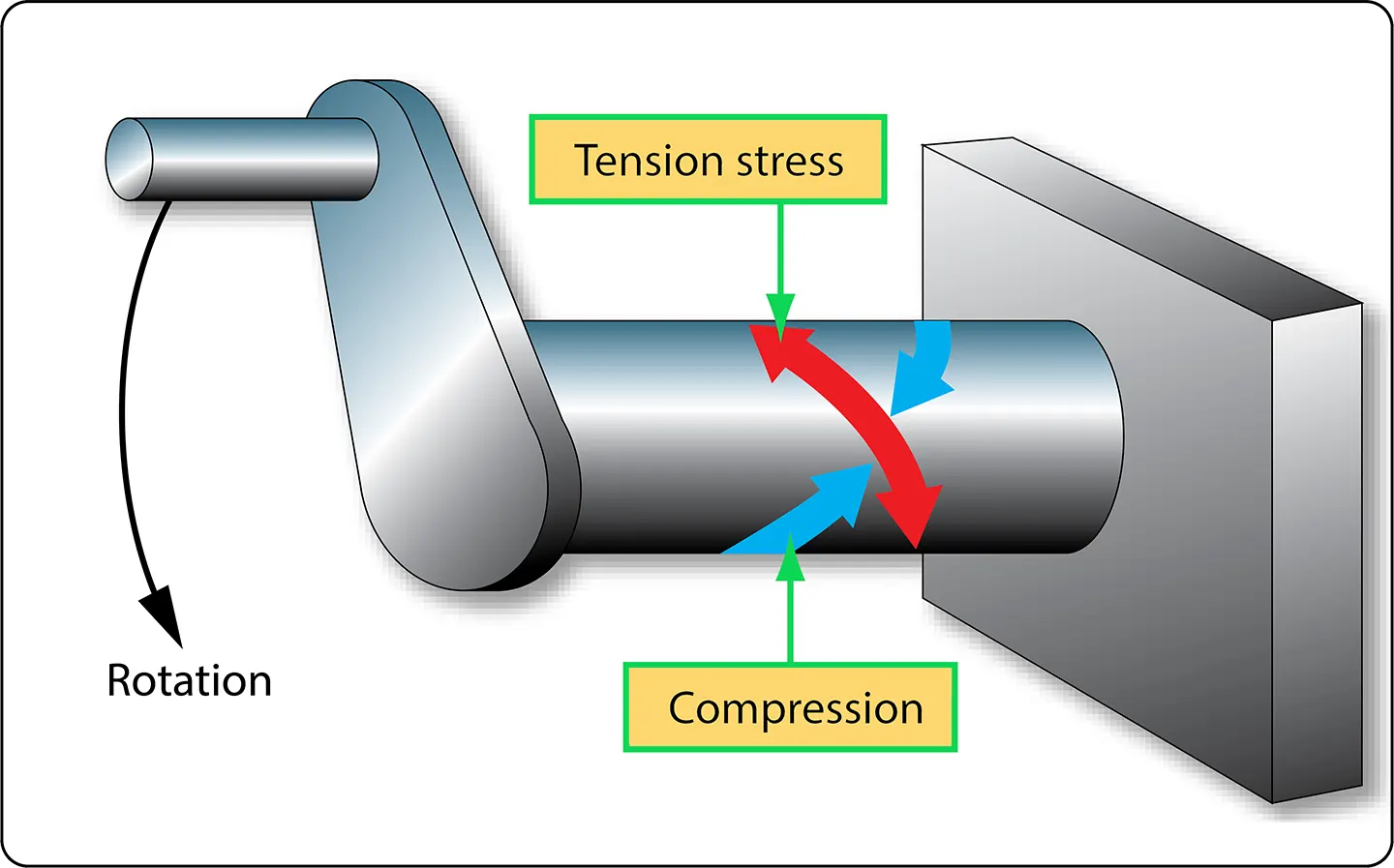
Torsion is the stress an object experiences when it is twisted, which happens when torque is applied to a shaft.
When a shaft is subjected to torque, it experiences shear stress across its cross-section. Torsion also produces tensile and compressive stresses on diagonal planes within the shaft. These stresses act in directions approximately 90 degrees to each other. [Figure 2]
The turbine shaft on a turbofan engine, which connects to the compressor to drive it, is subjected to torsional stress. The turbine blades extract energy from the high-velocity gases flowing through the engine. The force exerted by the gases on the turbine blades produces torque about the shaft’s axis, causing the shaft to rotate and drive the compressor. [Figure 3]

Bending
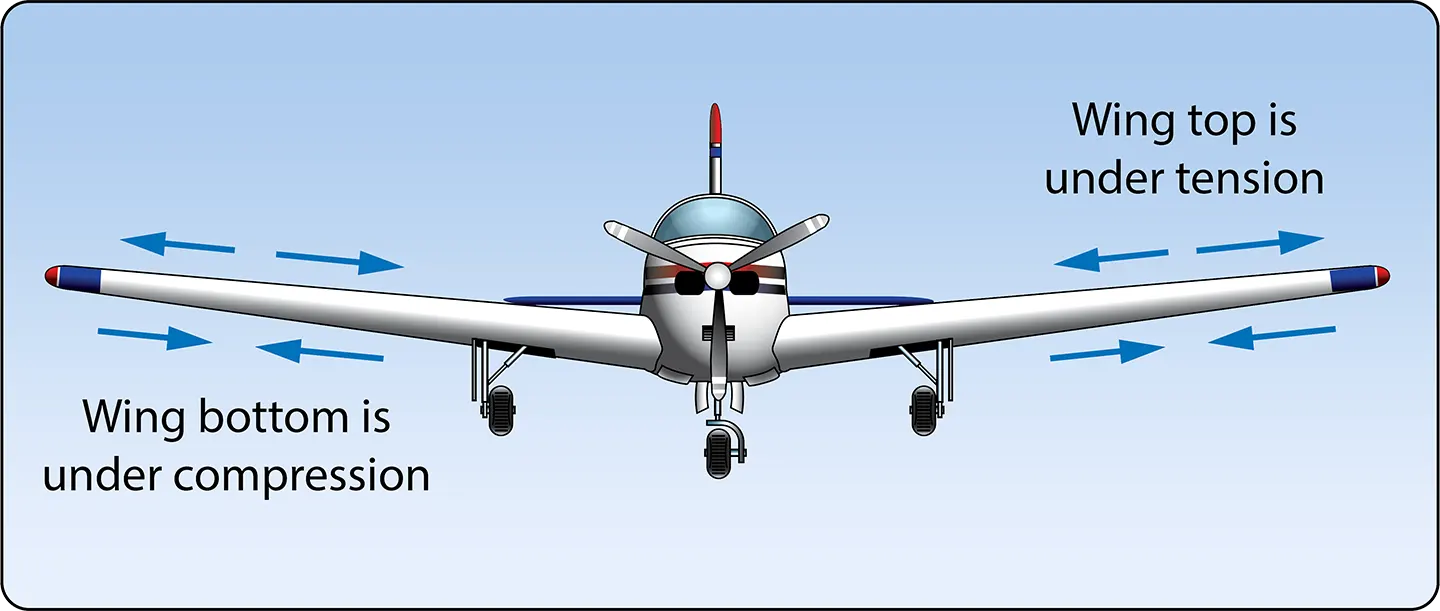
An airplane in flight experiences a bending force on its wings as aerodynamic lift tries to raise them. This upward bending causes the skin on the top of the wing to experience compression and the skin on the bottom of the wing to experience tension.
When the airplane is on the ground, the weight of the wings and their associated components produces a downward bending load. This subjects the bottom of the wing to compression and the top of the wing to tension. [Figure 4]
During testing that occurs prior to FAA certification, an airplane manufacturer intentionally bends the wings up and down to make sure they can withstand the required loads without failing.
Shear
When shear stress is applied to an object, the force tries to cut or slice through it, much like a knife cutting through butter.
A clevis bolt, which is often used to secure a cable to a part of the airframe, experiences shear stress. As shown in Figure 5, a fork fitting is secured to the end of the cable, and the fork attaches to an eye on the airframe with a clevis bolt.

When the cable is put under tension, the fork tries to slide off the eye. This produces opposing forces on the clevis bolt that tend to shear it. The bolt is designed to withstand high shear loads.
Strain
If the stress acting on an object is great enough, it can cause the object to change its shape or become distorted. One characteristic of matter is that it tends to be elastic, meaning it can be forced out of shape when a force is applied and then return to its original shape when the force is removed.
When an object changes its dimensions or shape under an applied load, it experiences strain. More precisely, strain is the amount of deformation relative to the object’s original dimension.
On turbine engine test cells, the thrust of the engine is typically measured using devices called strain gauges (also known as strain gages). As the engine produces thrust, the load causes a small deformation in the structure or measuring element. The strain gauges detect this deformation, which is measured and converted into the appropriate thrust reading.
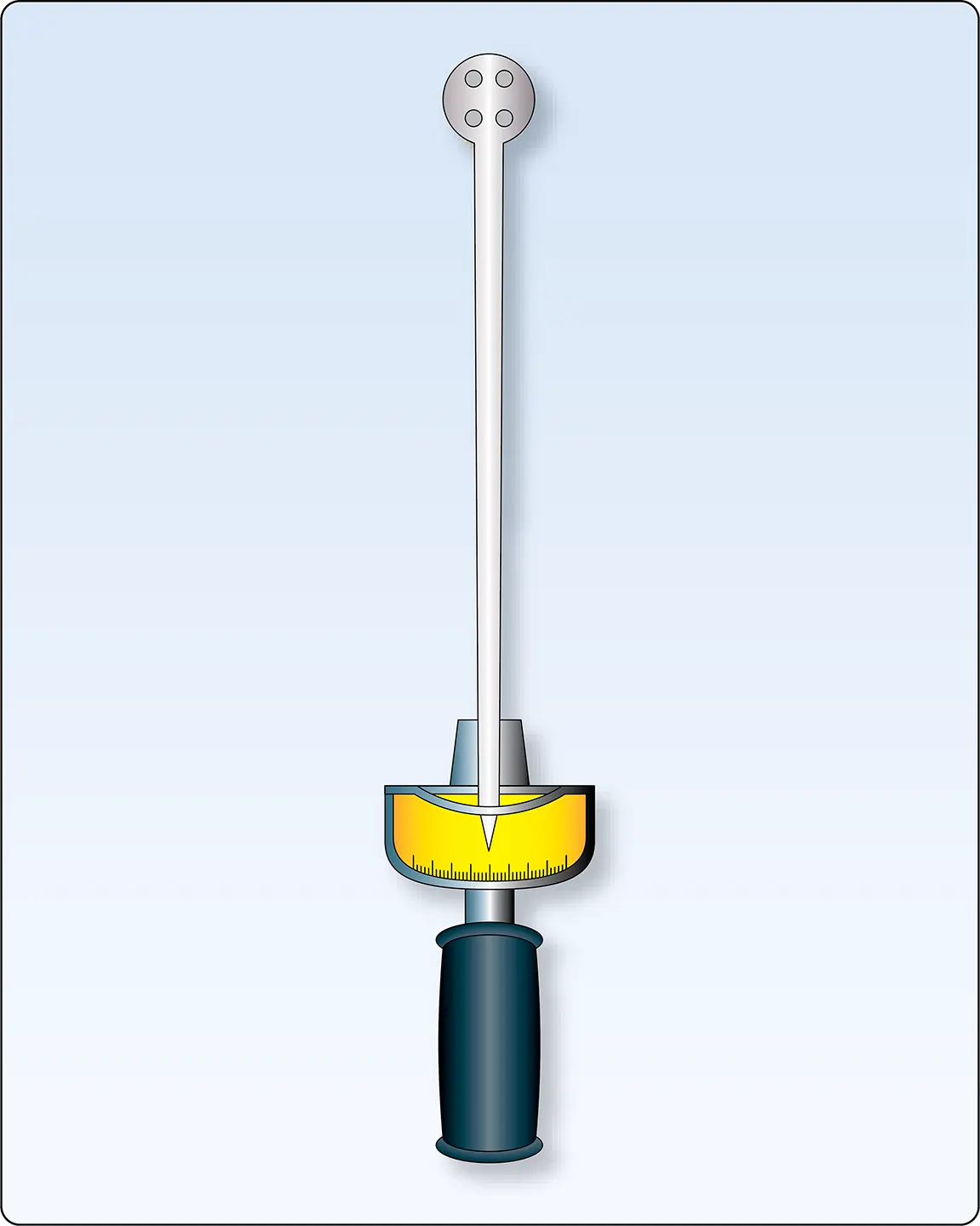
A deflecting-beam-style torque wrench uses the strain produced in the drive end of the wrench. The resulting distortion of the beam indicates the amount of torque applied to a bolt or nut. [Figure 6]