
Sound is an important part of aviation. Aircraft engines, propellers, airflow, and mechanical components all produce sound and vibration. Understanding how sound is generated and transmitted helps explain aircraft noise, engine vibration, the Doppler effect, sonic booms, and resonance.
Production and Transmission of Sound
Sound has been defined as a series of disturbances in matter that the human ear can detect. This definition can also be applied to disturbances that are beyond the range of human hearing.
There are three elements that are necessary for the transmission and reception of sound. These are the source, a medium for carrying the sound, and the detector. Anything that moves back and forth, or vibrates, and disturbs the medium around it may be considered a sound source.
An example of the production and transmission of sound is the ring of a bell. When the bell is struck and begins to vibrate, the particles of the medium, or the surrounding air, in contact with the bell also vibrate.
The vibrational disturbance is transmitted from one particle of the medium to the next, and the vibrations travel in a wave through the medium until they reach the ear. The eardrum, acting as the detector, is set in motion by the vibrating particles of air, and the brain interprets the eardrum’s vibrations as the characteristic sound associated with a bell.
Sound requires a medium through which to travel. It can travel through solids, liquids, and gases, but it cannot travel through a vacuum.
Wave Motion
Since sound is a wave motion in matter, it can best be understood by first considering water waves, such as a series of circular waves traveling away from the disturbance of an object thrown into a pool.
In Figure 1, such waves are seen from a top perspective, with the waves traveling outward from the center.

In the cross-sectional perspective in Figure 1, notice that the water waves are a succession of crests and troughs. The wavelength is the distance from the crest of one wave to the crest of the next.
Water surface waves are commonly described as transverse waves because the motion of the water particles is primarily up and down, or at right angles to the direction in which the waves travel. This can be seen by observing a cork on the water, bobbing up and down as the waves pass by.
Sound travels through matter in the form of longitudinal wave motion. These waves are called longitudinal waves because the particles of the medium vibrate back and forth in the direction of propagation. [Figure 2]
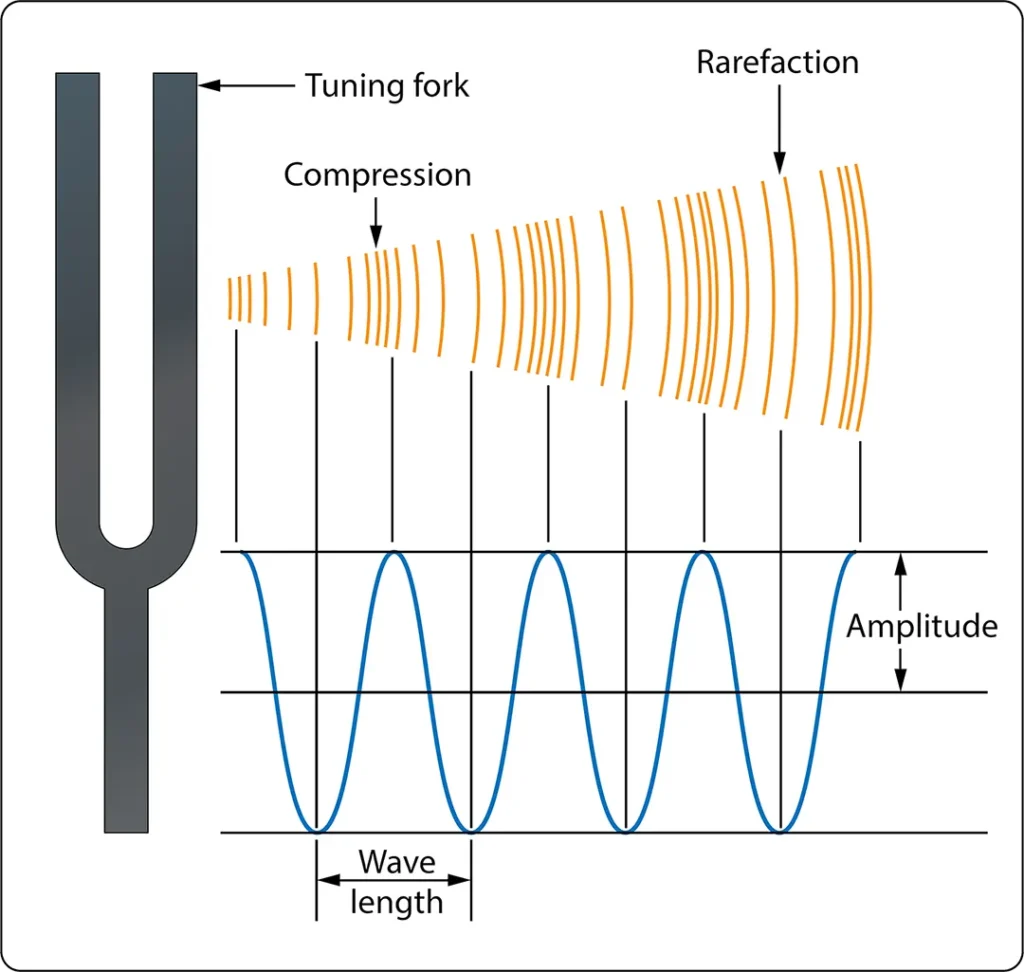
When the tine of a tuning fork moves in an outward direction, the air immediately in front of the tine is compressed so that its momentary pressure is raised above that at other points in the surrounding medium. Because air is elastic, this disturbance is transmitted progressively in an outward direction from the tine in the form of a compression wave.
When the tine returns and moves in an inward direction, the air in front of the tine is rarefied so that its momentary pressure is reduced below that at other points in the surrounding medium. This disturbance is transmitted in the form of a rarefaction, or expansion, wave, and follows the compression wave through the medium.
The progress of any wave involves two distinct motions:
- The wave itself moves forward through the medium at a particular speed.
- Simultaneously, the particles of the medium that convey the wave vibrate back and forth.
Examples of harmonic motion include the motion of a clock pendulum, the balance wheel in a watch, and the piston in a reciprocating engine.
Speed of Sound
In any uniform medium, under given physical conditions, sound travels at a definite speed. In some substances, the velocity of sound is higher than in others. Even in the same medium, under different conditions of temperature, pressure, and so forth, the velocity of sound varies.
The density and elasticity of a medium are two basic physical properties that govern the velocity of sound.
In general, a difference in density between two substances is not sufficient by itself to determine which one will transmit sound faster. The elasticity of the material must also be considered.
For example, sound travels faster through water than it does through air at the same temperature. However, there are some surprising exceptions to simple comparisons based on density.
An outstanding example involves a comparison of the speed of sound in lead and aluminum at the same temperature. Sound travels at 16,700 fps in aluminum at 20 °C, and only 4,030 fps in lead at 20 °C, despite the fact that lead is much denser than aluminum.
The reason for such exceptions is found in the fact, mentioned above, that sound velocity depends on elasticity as well as density.
As a general rule, sound travels fastest in solid materials, slower in liquids, and slowest in gases.
The velocity of sound in air at 0 °C (32 °F) is approximately 1,087 fps and increases by approximately 2 fps for each Celsius degree of temperature rise, or 1.1 fps for each degree Fahrenheit.
Mach Number
In the study of aircraft that fly at supersonic speeds, it is customary to discuss aircraft speed in relation to the velocity of sound, which is approximately 761 miles per hour (mph) at 59 °F under standard sea-level conditions.
The term Mach number has been given to the ratio of the speed of an aircraft to the speed of sound, in honor of Ernst Mach, an Austrian scientist.
Mach number is calculated using the following relationship:
Mach Number = Aircraft Speed ÷ Speed of Sound
If the speed of sound at sea level is 761 mph, an aircraft flying at a Mach number of 1.2 at sea level would be traveling at a speed of:
761 mph × 1.2 = 913 mph
The speed of sound changes with atmospheric temperature. Therefore, the speed represented by a particular Mach number also changes with atmospheric conditions.
Frequency of Sound
The term pitch is used to describe the frequency of a sound as perceived by the human ear. The outstanding recognizable difference between the tones produced by two different keys on a piano is a difference in pitch.
The pitch of a tone is related to the number of compressions and rarefactions received per second, which in turn is determined by the vibration frequency of the sounding source.
Frequency is measured in hertz (Hz), with one hertz representing one cycle per second.
A good example of frequency is the noise generated by a turbofan engine on a commercial airliner. The high rotational and blade-passing frequencies associated with the fan can produce high-frequency sound components, while the exhaust and combustion processes can produce lower-frequency noise components.
Loudness
When a bell rings, the sound waves spread out in all directions, and the sound can be heard in all directions.
When a bell is struck lightly, the vibrations are of small amplitude and the sound is weak. A stronger blow produces vibrations of greater amplitude in the bell, and the sound is louder.
It is evident that the amplitude of the air vibrations is greater when the amplitude of the vibrations of the source is increased. Hence, the loudness of the sound is related to the amplitude of the vibrations of the sound waves.
As the distance from the source increases, the energy in each wave spreads out, and the sound generally becomes weaker.
As the sound wave advances, variations in pressure occur at all points in the transmitting medium. The greater the pressure variations, the more intense the sound wave is.
For a sound wave traveling through the same medium under comparable conditions, sound intensity is proportional to the square of the pressure variation. Thus, by measuring pressure changes, the intensities of sounds having different frequencies can be compared.
Loudness is also affected by the frequency of the sound and by the sensitivity of the human ear. Therefore, perceived loudness is not determined by amplitude alone.
Measurement of Sound Intensity
Sound levels are commonly measured in decibels (dB). A decibel is a logarithmic unit used to express a ratio between two sound levels or sound intensities.
A faint whisper might have a sound level of approximately 20 dB, and a pneumatic drill might be around 80 dB, depending on the distance and operating conditions.
The engine on a modern jetliner, at takeoff thrust, may produce a sound level of approximately 90 dB when heard by someone standing 150 ft away.
A 110 dB noise, by comparison, is substantially louder than a 90 dB noise. An increase of approximately 10 dB is commonly perceived as roughly twice as loud, although perceived loudness depends on the sound and listening conditions.
Figure 3 shows the sound levels from a variety of different sources.

Doppler Effect
When sound is coming from a moving object, the object’s forward motion changes the frequency received by an observer. The frequency is higher when the source approaches the observer and lower when the source moves away.
This change in frequency is known as the Doppler effect, and it explains why the sound from an airplane seems different as it approaches compared with how it sounds as it flies overhead.
As the airplane approaches, the sound generally becomes louder and higher-pitched. As it flies away, the loudness and pitch both decrease noticeably.
The Doppler effect is caused by the relative motion between the sound source and the observer. The effect can occur whether the source, the observer, or both are moving.
If an airplane is flying at or above the speed of sound, pressure disturbances generated by the airplane cannot propagate ahead of it in the normal way. At supersonic speeds, the pressure disturbances combine to form shock waves.
These shock waves form a pattern that extends outward from the aircraft. When the shock wave reaches a person standing on the ground, it is heard as a sonic boom.
The sonic boom is not simply sound energy piling up and attaching itself to the airplane. It is the sound associated with the passage of the shock-wave pattern generated by the aircraft’s supersonic flight.
Resonance
All types of matter, regardless of whether they are solid, liquid, or gas, can exhibit natural frequencies at which they vibrate.
If an external vibration has a frequency close to the natural frequency of an object, the object may absorb energy from the vibration and begin to vibrate with greater amplitude. This phenomenon is known as resonance.
Some piston-engine-powered airplanes have an rpm range that they are placarded to avoid because spinning the propeller at that rpm can cause vibration problems.
The difficulty lies in the natural frequency of the metal in the propeller and the frequency of vibration that can be set up at a particular propeller speed. At that particular rpm, resonant vibration can produce high stresses that could lead to propeller damage or failure.