
As an airplane increases its speed, the airflow around it begins to behave differently. At lower speeds, air can generally be treated as an incompressible fluid because changes in its density are relatively small. At higher speeds, particularly as the airflow approaches and exceeds the speed of sound, changes in air density become important. These effects influence the airplane’s lift, drag, stability, and structural loading.
High-speed aerodynamics deals with the airflow characteristics that occur during transonic, supersonic, and hypersonic flight. Important subjects include compressibility effects, shock waves, expansion waves, high-speed airfoil design, and aerodynamic heating.
Table of Contents
Table of Contents
Compressibility Effects
When air flows at subsonic speed, it can generally be treated as an incompressible fluid for many aerodynamic calculations. As discussed in the Aircraft Theory of Flight section, when subsonic air flows through a diverging-shaped passage, its velocity decreases and its static pressure rises, while its density changes very little. In a converging-shaped passage, subsonic air speeds up and its static pressure decreases.
Supersonic airflow behaves differently. When supersonic air flows through a converging passage, its velocity decreases, while its static pressure and density increase. When it flows through a diverging passage, its velocity increases, while its static pressure and density decrease. This is the opposite of the behavior of subsonic airflow in these passages (Figure 1).
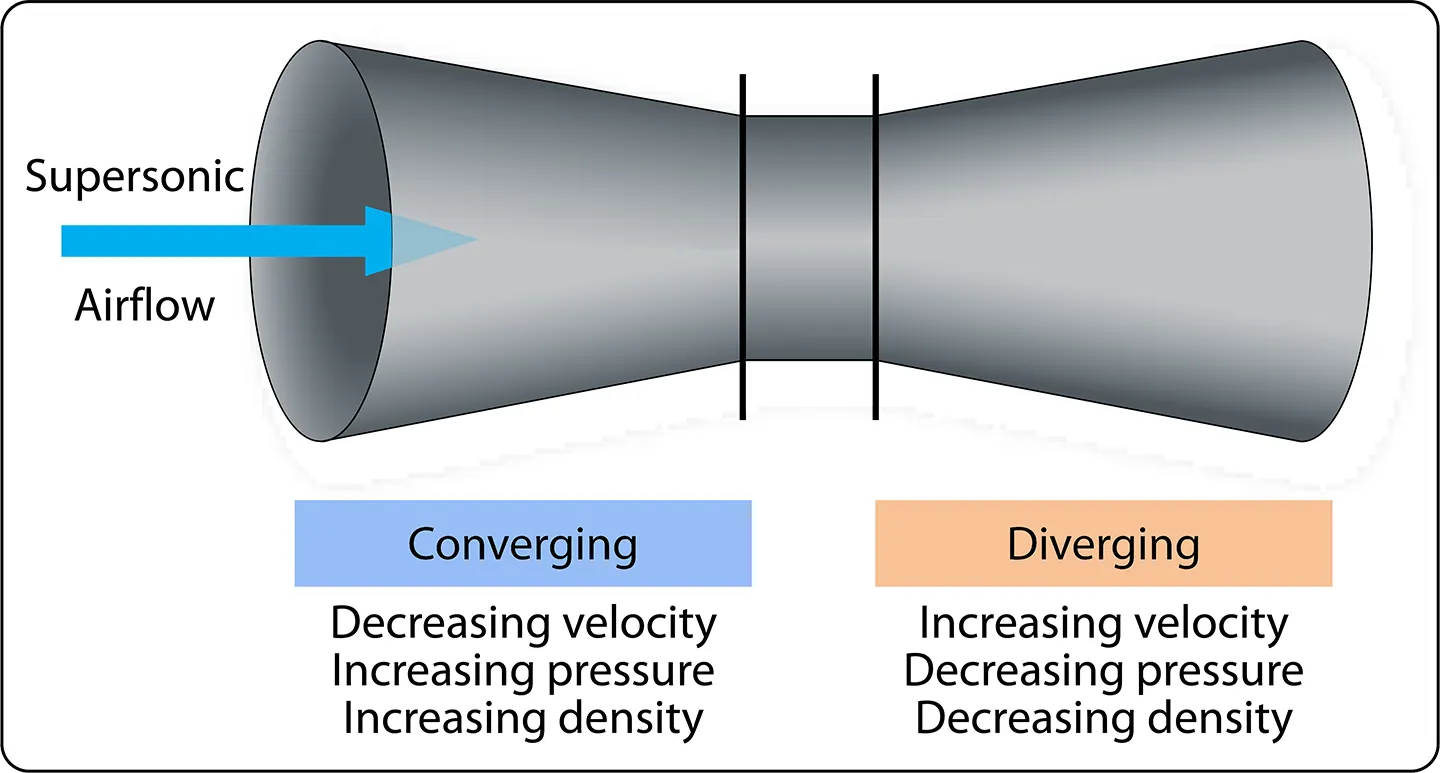
At supersonic speeds, air behaves as a compressible fluid. Because its behavior differs from that of subsonic airflow, airplanes designed to fly supersonically require different wing shapes and aerodynamic features.
The Speed of Sound
Sound, in reference to airplanes and their movement through the air, consists of pressure disturbances that travel through the air. It can be compared to dropping a rock into water and watching waves move outward from the point of impact.
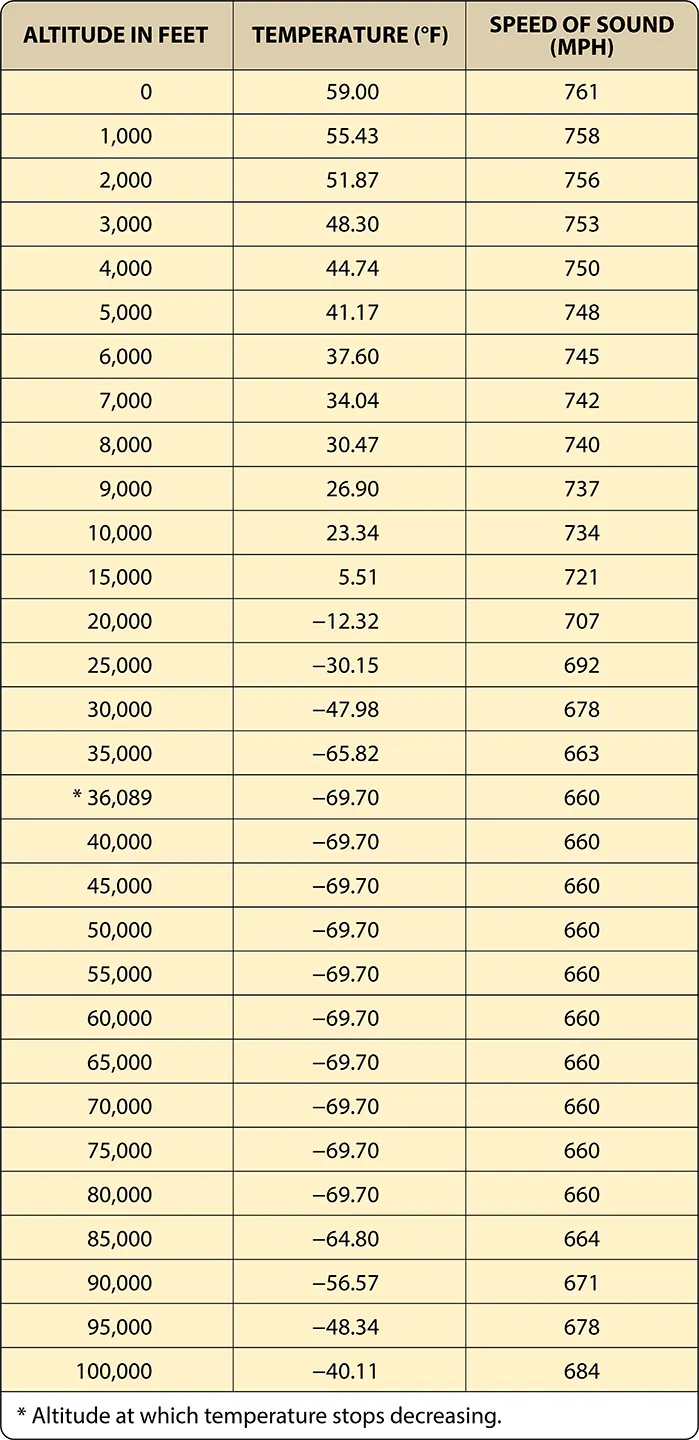
As an airplane flies through the air, different parts of the airplane create disturbances that generate pressure waves. These pressure waves travel through the surrounding air at the speed of sound. At the standard-day temperature of 59 °F, the speed of sound is approximately 761 mph. The speed of sound in air changes with temperature, increasing as temperature increases.
Figure 2 shows how the speed of sound changes with altitude as atmospheric temperature changes.
Subsonic, Transonic, and Supersonic Flight
Aircraft speeds are commonly described using Mach number, which is the ratio of the airplane’s speed to the local speed of sound.
Subsonic Flight
When an airplane is flying at subsonic speed, its forward speed is less than the speed of sound, corresponding to a Mach number below 1. However, the air accelerates as it flows over certain parts of the airplane, such as the upper surface of the wing. As a result, an airplane flying at 500 mph could have airflow over the top of its wing reaching 600 mph.
Therefore, even when the airplane itself is flying below the speed of sound, some airflow over its surfaces may reach or exceed Mach 1. The maximum speed at which an airplane can remain in the subsonic flight regime depends on its design and the airflow over its surfaces. For many conventional airplanes, significant compressibility effects begin before the airplane’s free-stream Mach number reaches 1.
Transonic Flight
When an airplane is flying at transonic speed, some regions of the airflow around it are subsonic while other regions are supersonic. For example, the airflow over the upper surface of a wing may accelerate to Mach 1 and then become supersonic. A shock wave can form where this supersonic airflow slows back to subsonic speed.
A shock wave on the wing is often approximately normal to the local airflow and is referred to as a normal shock wave. Stability and control problems can occur during transonic flight because the shock wave can cause the airflow to separate from the wing. The shock wave and associated pressure distribution can also shift the wing’s aerodynamic center and produce a nose-down pitching tendency in some aircraft. This effect is commonly known as Mach tuck.
The critical Mach number is the free-stream Mach number at which the airflow first reaches Mach 1 at some point on the airplane. Transonic flight is commonly associated with Mach numbers from approximately 0.80 to 1.20, although the exact boundaries depend on the aircraft and the definition being used.
Supersonic Flight
When an airplane is flying at supersonic speed, its free-stream speed is greater than the speed of sound, corresponding to a Mach number above 1. Shock waves form around the airplane, depending on its shape and the local airflow conditions. At supersonic speeds, the airflow pattern differs considerably from that found during subsonic and transonic flight.
Supersonic flight is commonly associated with Mach numbers from approximately 1.20 to 5.0. If an airplane flies faster than Mach 5, it is said to be in hypersonic flight.
Shock Waves
Sound from an airplane results from disturbances in the air as the airplane moves through it. These disturbances generate pressure waves that radiate away from their sources.
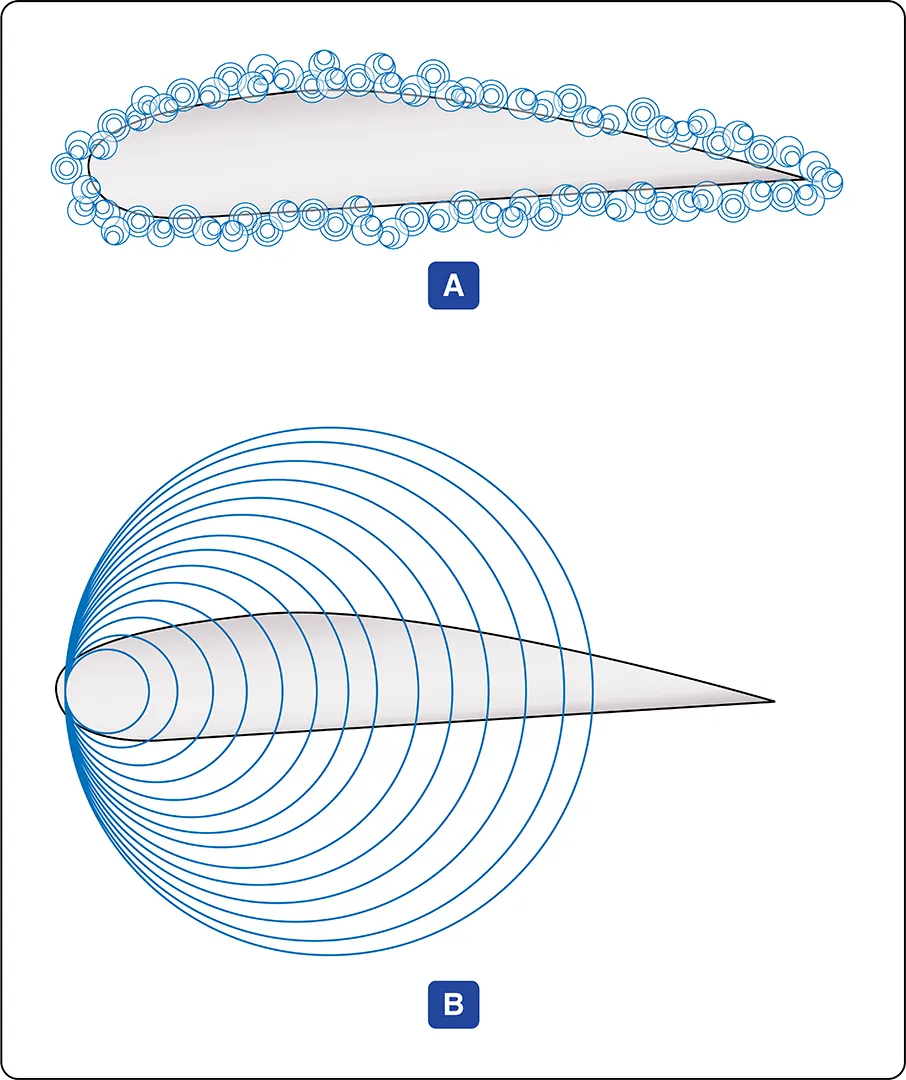
For a slow-moving airplane, pressure waves travel outward in all directions at the speed of sound. As the airplane approaches the speed of sound, it begins to catch up with the pressure waves traveling ahead of it. At supersonic speed, the airplane moves faster than these pressure disturbances can travel forward through the surrounding air. The disturbances combine along a boundary, forming a shock wave.
Shock waves produce sudden changes in pressure, temperature, and density across the wave. When the shock-wave pattern from a supersonic airplane reaches the ground and passes an observer, it may be heard as a sonic boom.
Figure 3A shows a wing in subsonic flight, with pressure waves radiating outward from the disturbances created by the wing. View B shows a wing in supersonic flight, where the pressure waves combine to form a shock-wave pattern.
Normal Shock Wave
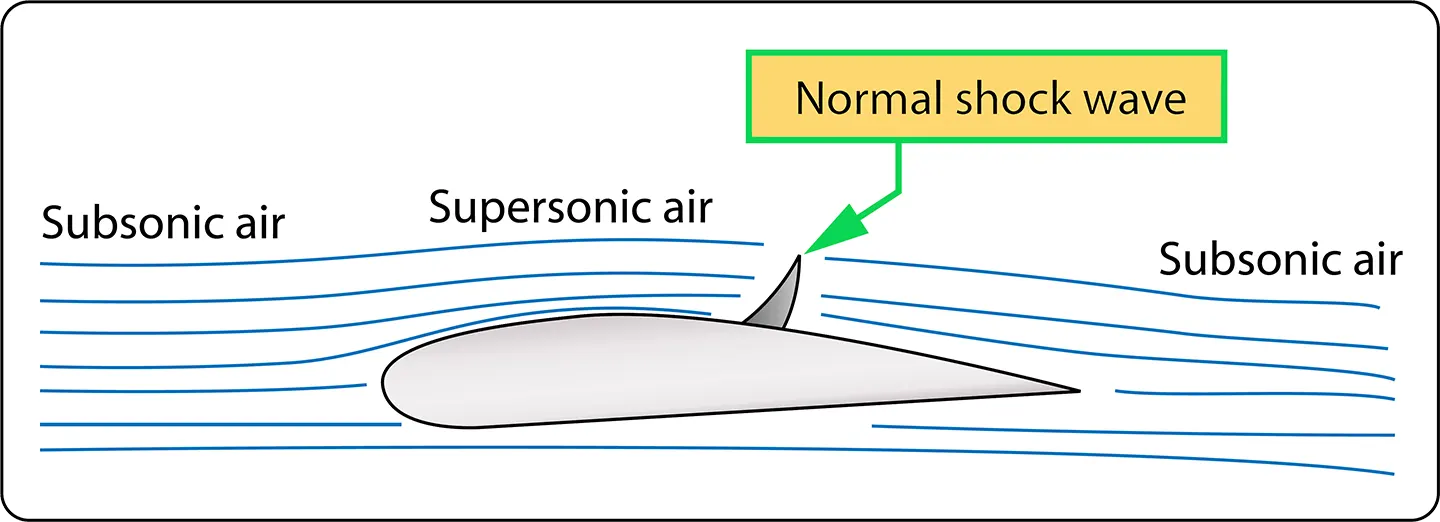
When an airplane is in transonic flight, a shock wave may form on the upper surface of the wing and, as the flight condition changes, on the lower surface as well. A shock wave that is perpendicular to the local airflow is called a normal shock wave.
A normal shock wave can also form ahead of a blunt object during supersonic flight. Normal shock waves form perpendicular to the local airstream. Behind a normal shock wave, the airflow velocity is subsonic, while static pressure, temperature, and density increase.
Figure 4 shows a normal shock wave forming on the upper surface of a wing.
Oblique Shock Wave
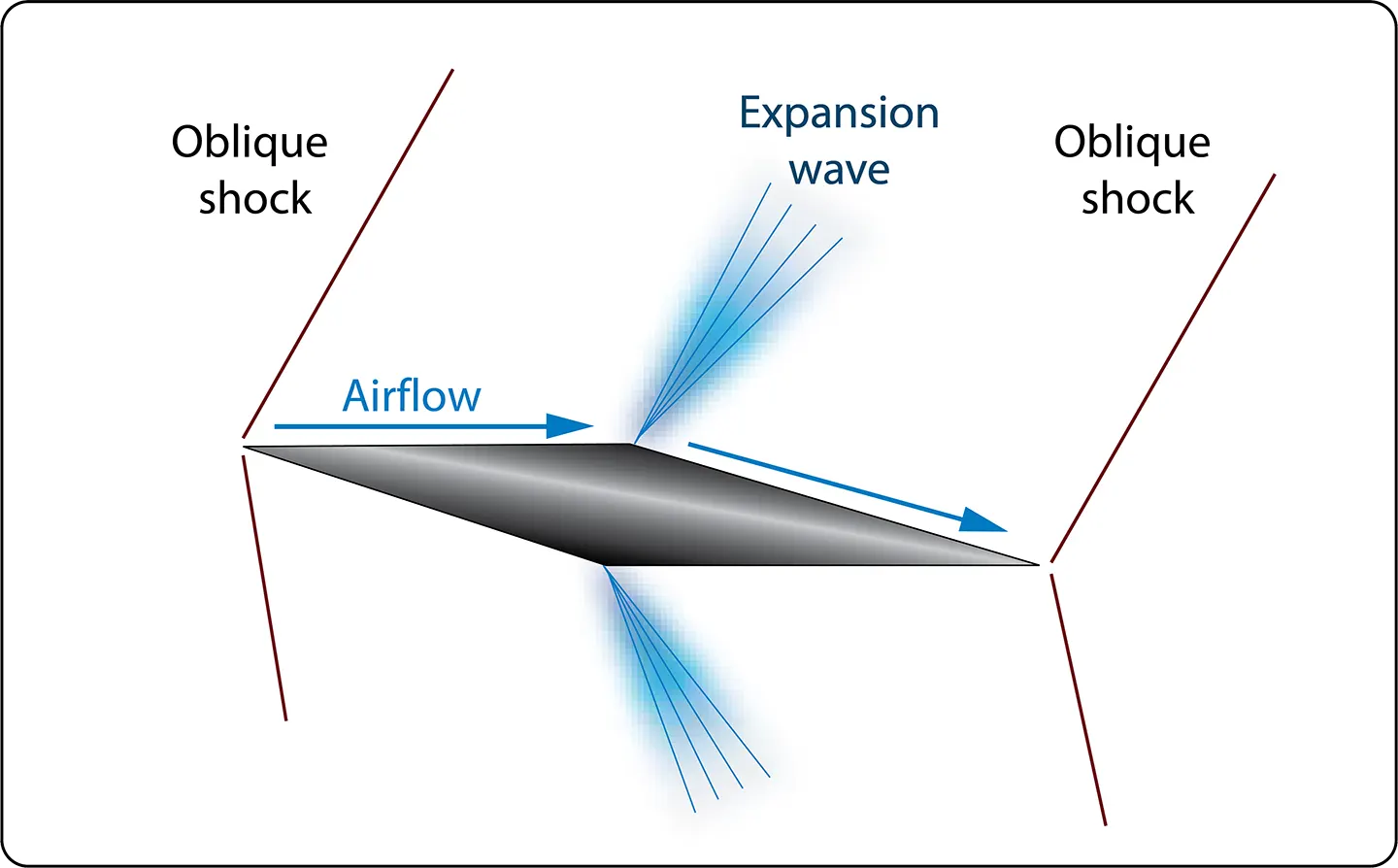
An airplane designed to fly supersonically generally has sharp-edged surfaces to reduce aerodynamic drag. When the airplane is in supersonic flight, shock waves can form at the sharp leading and trailing edges of its wings. These are known as oblique shock waves.
Behind an oblique shock wave, the airflow velocity is reduced, but it may remain supersonic. The static pressure, temperature, and density increase across the shock wave. Figure 5 shows oblique shock waves on the leading and trailing edges of a supersonic airfoil.
Expansion Wave
As discussed earlier, air at supersonic speed behaves as a compressible fluid. When supersonic airflow encounters a surface that turns away from the direction of the flow, the air expands and changes direction to follow the new surface.
An expansion wave occurs where the direction of the airflow changes in this manner. Behind the expansion wave, the airflow velocity increases, while static pressure and density decrease. Unlike a shock wave, an expansion wave produces a gradual change in the airflow rather than a sudden compression.
Figure 5 also shows an expansion wave on a supersonic airfoil.
High-Speed Airfoils
Transonic flight is a particularly challenging flight regime because part of the wing may experience subsonic airflow while another part experiences supersonic airflow.
For a conventional subsonic airfoil, the aerodynamic center is approximately 25 percent of the way back from the wing’s leading edge, measured along the chord. In supersonic flight, the aerodynamic center of a thin airfoil moves toward approximately 50 percent of the wing’s chord. This change can produce significant changes in the airplane’s pitching characteristics, control, and stability.
If an airplane designed for subsonic flight, perhaps at a Mach number of 0.80, flies too fast and enters the transonic regime, noticeable changes occur in the airflow over the wing. Figure 6 shows six views of a wing, with each view illustrating a progressively higher Mach number.
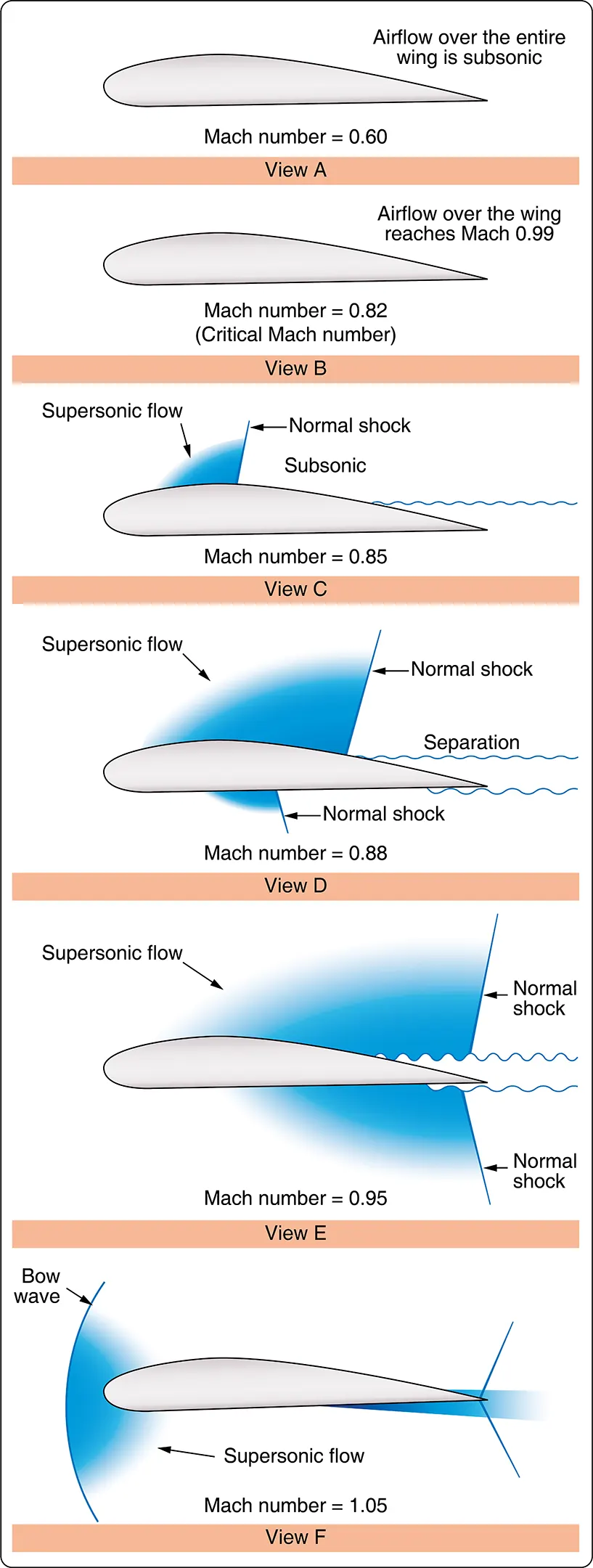
The six views are described as follows:
A. The Mach number is fairly low, and the entire wing is experiencing subsonic airflow.
B. The velocity has reached the critical Mach number, where the airflow over the top of the wing is reaching Mach 1.
C. The velocity has exceeded the critical Mach number, and a normal shock wave has formed on the top of the wing. Some airflow separation begins to occur behind the shock wave.
D. The velocity has continued to increase beyond the critical Mach number, and the normal shock wave has moved farther aft, causing serious airflow separation. A normal shock wave is also forming on the bottom of the wing. Behind the normal shock waves, the velocity of the air is subsonic and the static pressure has increased.
E. The velocity has increased to the point that both shock waves on the wing, upper and lower, have moved toward the rear of the wing and are located near the trailing edge. Some airflow separation is still occurring.
F. The free-stream velocity is greater than Mach 1, and a bow shock wave has formed ahead of the wing’s leading edge. If the wing has a sharp leading edge, an oblique shock wave can attach to the leading edge instead of forming a detached bow shock.
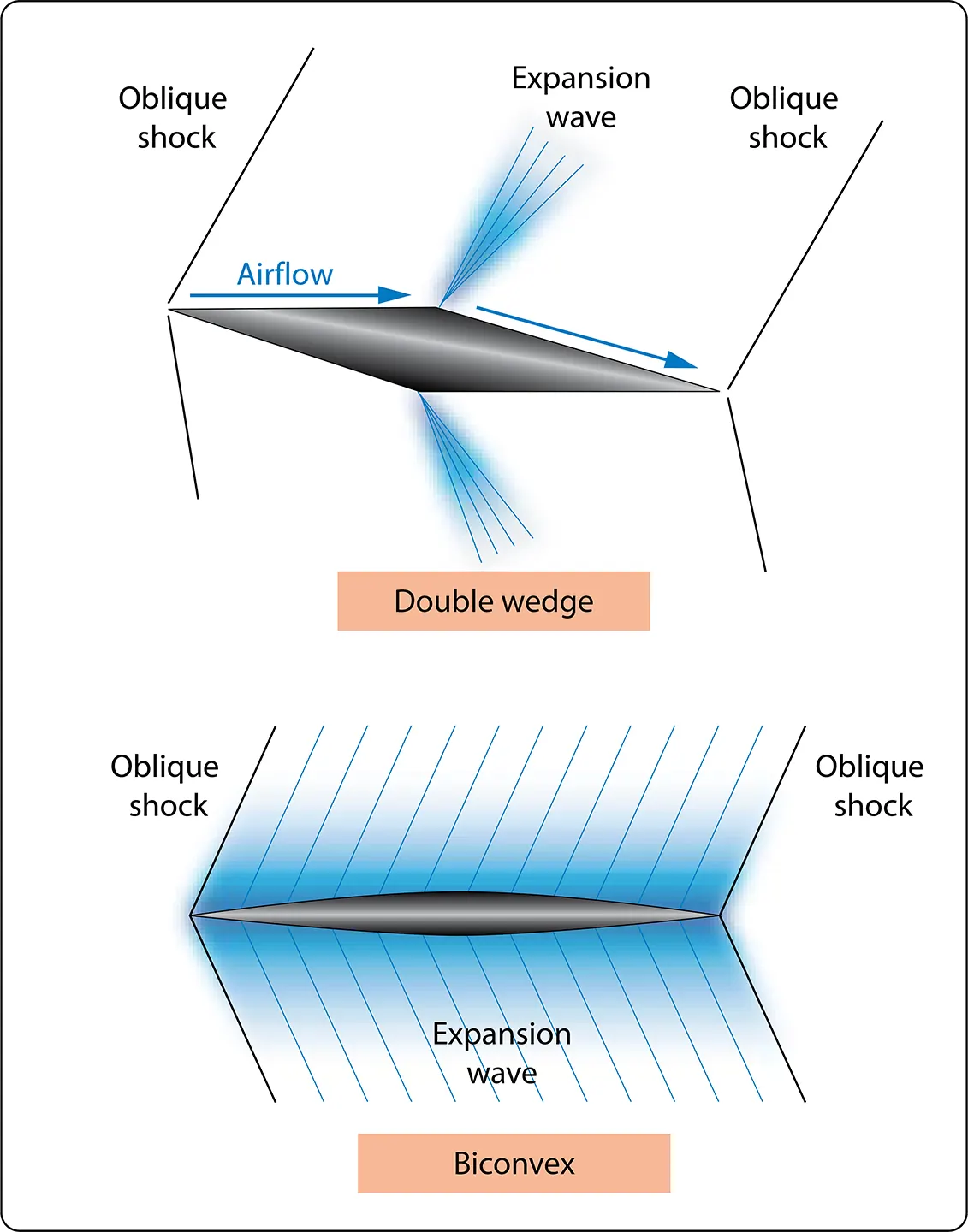
The airfoil shown in Figure 6 is not properly designed to handle supersonic airflow. The detached bow shock shown ahead of the wing in view F would be replaced by an attached oblique shock if the wing had a suitable sharp-edged double-wedge or biconvex design. These two wing designs are shown in Figure 7.
Aerodynamic Heating
One of the problems associated with airplanes flying at high speeds is the heat that builds up on the airplane’s surface. This heating results from the aerodynamic processes involved in high-speed flight, including the compression of air and the conversion of kinetic energy into thermal energy in the airflow near the aircraft’s surface.
When the SR-71 Blackbird is cruising at Mach 3.5, skin temperatures on its surface range from approximately 450 °F to over 1,000 °F. To withstand these high temperatures, the airplane was constructed using titanium alloy instead of the traditional aluminum alloy.
The supersonic transport Concorde was originally designed to cruise at Mach 2.2, but its cruise speed was reduced to Mach 2.0 because of structural and thermal limitations associated with aerodynamic heating.
If airplanes capable of hypersonic flight are to be built in the future, one of the major obstacles that must be overcome is the thermal stress placed on the airplane’s structure by the high temperatures encountered during flight.