
Aircraft stability is the tendency of an airplane to respond to a disturbance and return toward its original flight condition. When an airplane is in straight-and-level flight at a constant velocity, the forces and moments acting on it are balanced. If this condition is disrupted by an atmospheric disturbance, such as wake turbulence, the airplane may pitch up or down, yaw left or right, or roll.
An airplane’s stability determines how it responds after the disturbance. Stability is commonly divided into static stability and dynamic stability. Aircraft stability is also considered about the three principal axes: longitudinal stability, lateral stability, and directional stability.
Static Stability
Static stability describes the airplane’s initial tendency to respond after its equilibrium condition has been disturbed.
- Positive static stability: The airplane initially tends to return toward its original equilibrium condition after the disturbing force is removed.
- Negative static stability: The airplane initially tends to move farther away from its original equilibrium condition after the disturbing force is removed.
- Neutral static stability: The airplane tends to remain in its displaced position after the disturbing force is removed.
For example, if wake turbulence causes an airplane’s nose to pitch up, an airplane with positive static stability will initially tend to pitch back toward its original attitude. An airplane with negative static stability will tend to pitch farther away from its original attitude. An airplane with neutral static stability will tend to remain at the displaced attitude.
Dynamic Stability
Dynamic stability describes how an airplane’s motion changes with time after it has been displaced from equilibrium. It includes the oscillations that may occur as the airplane responds to the disturbance and attempts to return to its original position or attitude.
An airplane can have positive static stability while having positive, neutral, or negative dynamic stability.
Imagine that an airplane in straight-and-level flight is disturbed and its nose pitches up. If the airplane has positive static stability, it will initially tend to pitch back down after the disturbance is removed. It may return directly to straight-and-level flight, or it may pass through the original flight attitude and continue pitching down before pitching back up. This repeated movement is known as an oscillation.
The dynamic stability of the airplane depends on how these oscillations change over time:
- Positive dynamic stability: The oscillations become smaller with time, and the airplane gradually returns toward equilibrium.
- Negative dynamic stability: The oscillations become larger with time, and the airplane moves farther away from equilibrium.
- Neutral dynamic stability: The oscillations remain at approximately the same amplitude over time.
Figure 1 shows the concept of dynamic stability.

In view A, the displacement from equilibrium goes through three oscillations and then returns to equilibrium. In view B, the displacement from equilibrium increases after two oscillations and does not return to equilibrium. In view C, the displacement from equilibrium remains approximately the same with each oscillation.
Longitudinal Stability
Longitudinal stability concerns an airplane’s tendency to pitch its nose up or down around the lateral axis, which extends from wingtip to wingtip. If an airplane has good longitudinal stability, it tends to return toward its trimmed angle of attack after the force that disturbed its flightpath is removed.
The weight and balance of an airplane are major factors in determining its longitudinal stability. These depend on both the airplane’s design characteristics and how it is loaded.
Two important reference points are the center of gravity (CG) and the center of pressure (CP). The CG is the point at which the airplane’s total weight is considered to act. The CP is the point at which the resultant aerodynamic lift force is considered to act on the wing. The position of the CP can change as the angle of attack changes.
For longitudinal stability, the position of the CG relative to the airplane’s aerodynamic reference point is important. In a conventional airplane, the CG is normally located ahead of the airplane’s neutral point, providing a restoring pitching tendency. The horizontal stabilizer and elevator contribute the pitching moment needed to balance the airplane and maintain the desired flight attitude.
The CG must remain within the forward and aft limits specified for the airplane. If the CG is too far forward, the airplane may require excessive nose-up control force. The elevator may not have sufficient authority to raise the nose during certain phases of flight, particularly during landing and the landing flare.
If the CG is too far aft, longitudinal stability is reduced. If it is behind the approved aft limit, the airplane may become dangerously unstable. It may have a strong tendency to pitch nose up, and the pilot may have insufficient control authority to prevent the angle of attack from increasing to the stall. This can lead to a stall and possible loss of control.
Figure 2 shows the center of lift, center of gravity, and center-of-gravity limits.

The illustration also shows the elevator deflected upward, producing a downward force at the tail. This tail force contributes to the pitching moment that helps balance the airplane. The CG must remain within the approved limits; its position outside those limits can seriously affect the airplane’s stability and controllability.
Lateral Stability
Lateral stability concerns an airplane’s tendency to roll around its longitudinal axis, which extends from the nose to the tail. If one wing drops below the other, good lateral stability tends to bring the wings back toward a level-flight attitude.
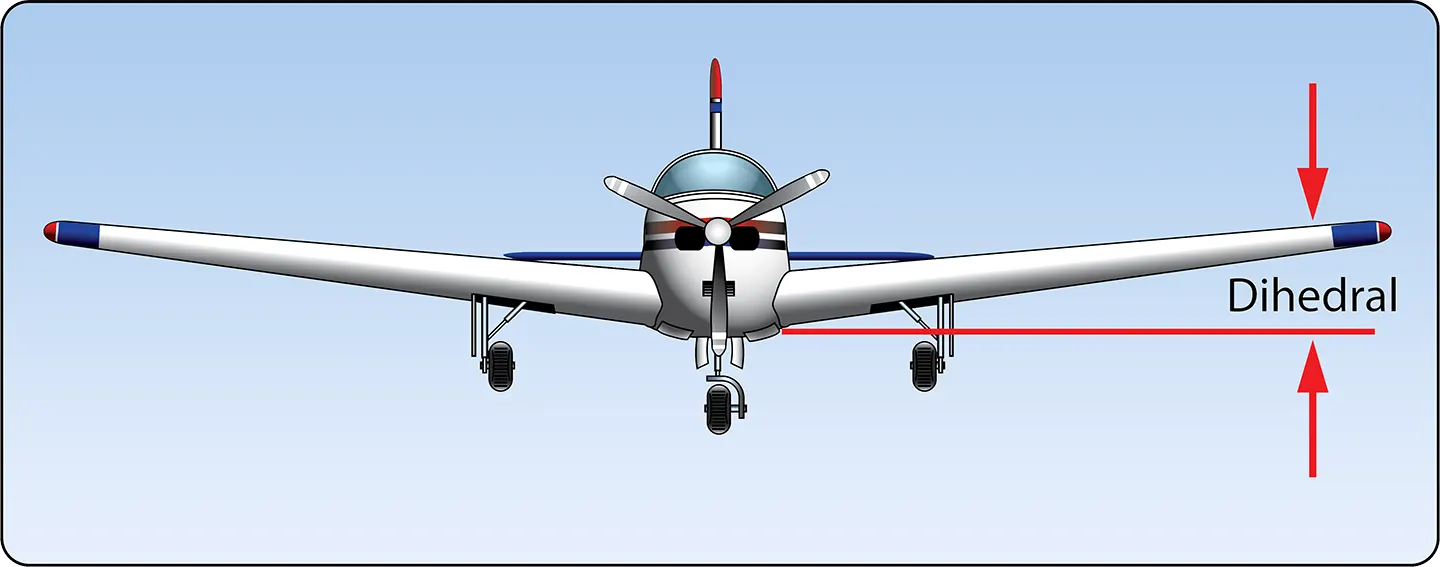
One design characteristic that contributes to lateral stability is dihedral. Dihedral is the upward angle of the wings relative to the horizontal, and it is usually only a few degrees.
Imagine a low-wing airplane with a few degrees of dihedral experiencing a disturbance that causes its left wing to drop. The airplane begins to sideslip toward the lower wing. Because of the sideslip and the wing’s dihedral angle, the lower wing experiences an increase in effective angle of attack relative to the other wing. This produces a restoring rolling tendency that helps raise the lowered wing and return the airplane toward a wings-level attitude.
The dihedral of a wing is shown in Figure 3.
Directional Stability
Directional stability concerns an airplane’s tendency to yaw around its vertical axis and its ability to resist or recover from a disturbance that causes yaw. The vertical fin, or vertical stabilizer, provides directional stability by helping the airplane align itself with the relative wind.
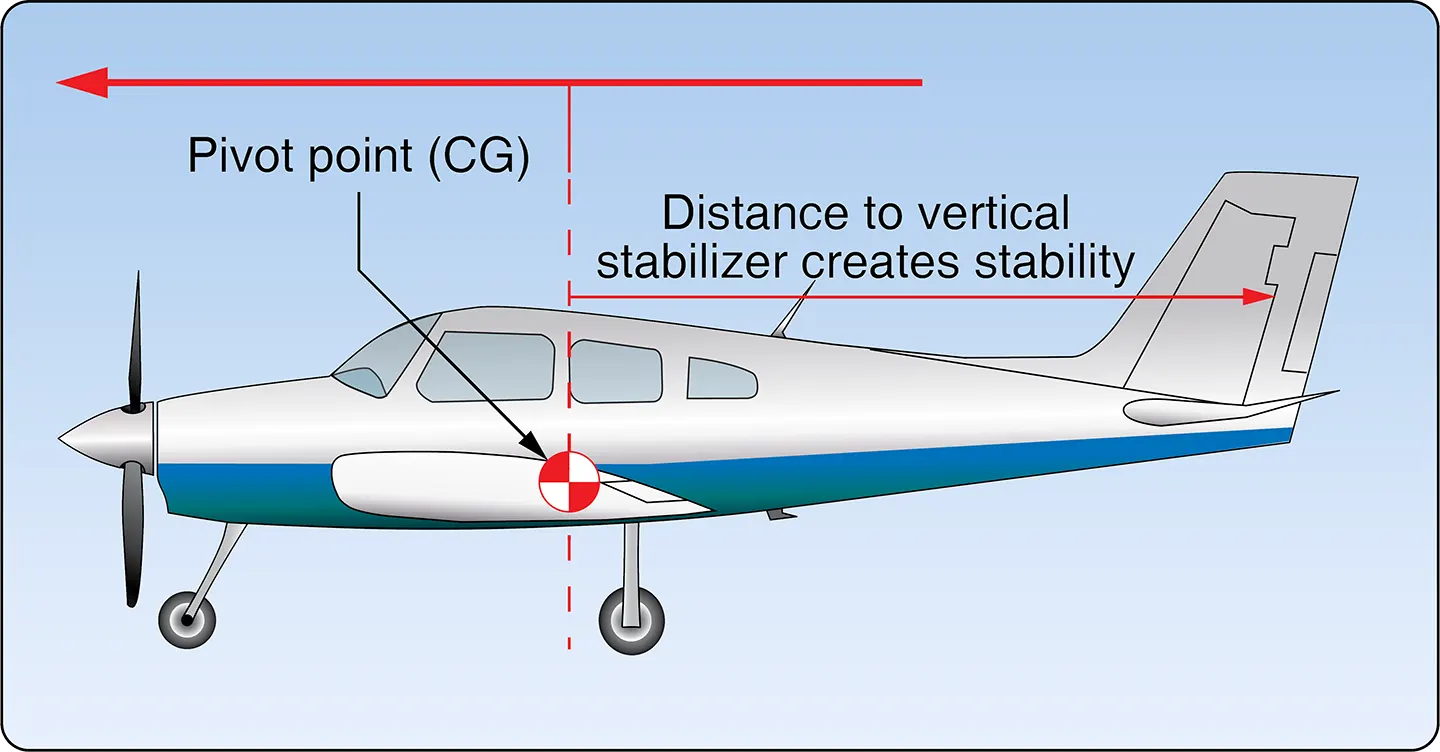
An airplane’s directional stability can be compared to the action of a weather vane. The distance from the pivot point of a weather vane to its tail is greater than the distance from the pivot point to its nose. When the wind blows, it produces a greater turning effect on the tail, causing the weather vane to align with the wind.
A similar effect occurs on an airplane. The CG acts as a reference point for the airplane’s yawing motion, and the vertical stabilizer is located behind the CG. The aerodynamic force acting on the vertical stabilizer produces a restoring yawing moment that tends to align the airplane with the relative wind.
Figure 4 illustrates how the distance from the CG to the vertical stabilizer contributes to directional stability.
Dutch Roll
The dihedral effect tends to produce a rolling response opposite to the direction of sideslip, while the vertical fin tends to yaw the airplane into the relative wind. These coupled rolling and yawing responses influence the airplane’s lateral and directional stability.
If the rolling response associated with dihedral is stronger than the directional restoring response, the airplane may experience a motion known as Dutch roll. Dutch roll is a coupled oscillation involving both roll around the longitudinal axis and yaw around the vertical axis.
Although Dutch roll is generally a damped motion in aircraft designed to control it, it can produce an uncomfortable sensation for passengers. Commercial airliners typically use yaw dampers, which detect yawing oscillations and apply rudder inputs to reduce or damp the Dutch roll motion.