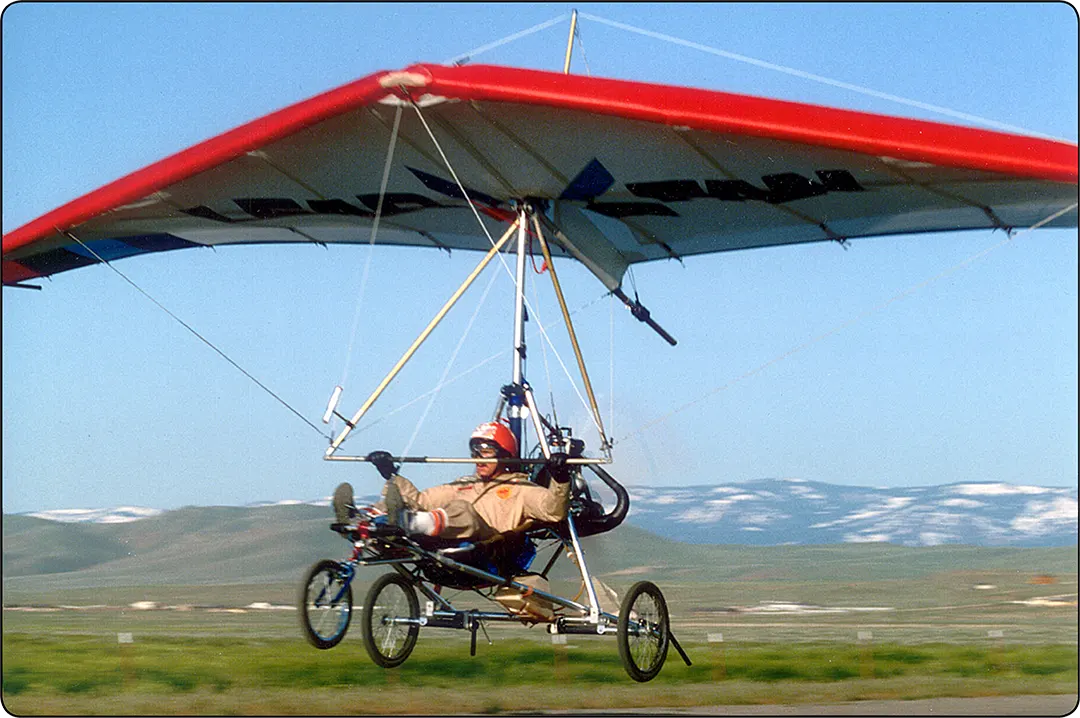
Weight-shift control aircraft, commonly known as trikes, use a flexible wing and the movement of the pilot’s weight to control the aircraft. Unlike a conventional airplane, which uses ailerons, an elevator, and a rudder, a trike changes its direction of flight by shifting the position of the wing relative to the weight of the aircraft and its occupants.
The wing is constructed around a flexible tubular frame and covered with fabric, which forms the aerodynamic airfoil shape. Understanding the structure of the wing, its control system, and the aerodynamic effects of weight shifting helps explain how these aircraft maneuver during flight.
Weight-Shift Control Aircraft Structure
A weight-shift control, flexible-wing aircraft consists of a fabric-covered wing, often referred to as the sail, attached to a tubular structure that supports the wheels, seats, engine, and propeller. The wing structure is also tubular, with the fabric covering creating the airfoil shape.
The wing shape varies among the different models of weight-shift control aircraft, but a delta-shaped wing is a popular design. Within the weight-shift control aircraft community, these aircraft are commonly referred to as trikes (Figure 1).
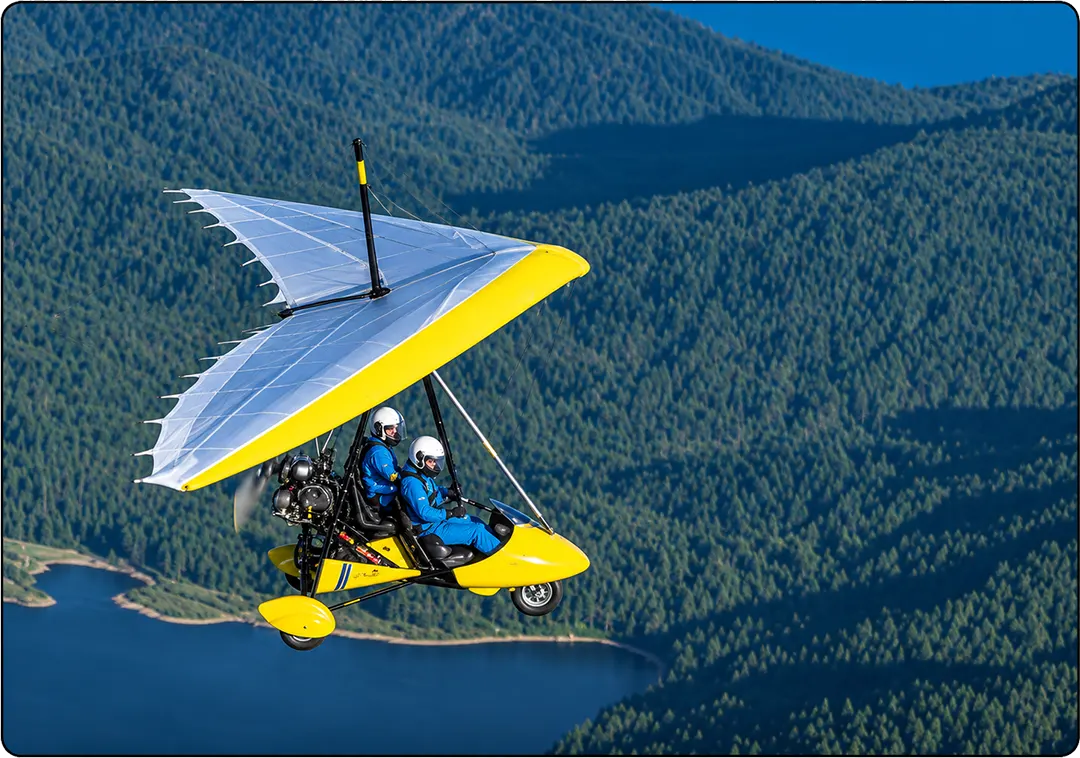
In Figure 1, the trike’s mast is attached to the wing at the hang point on the wing keel by a hang-point bolt and safety cable. A support tube, known as a king post, extends upward from the top of the wing, with cables running down and secured to the tubular wing structure.
The cables running down from the king post as part of the upper rigging support the wing when the aircraft is on the ground and help handle negative loads during flight. The lines that run from the king post to the trailing edge of the wing are known as reflex cables. These cables help maintain the wing’s reflex shape by holding the trailing edge in a slightly raised position. This reflex configuration contributes to the wing’s pitch stability and can assist the aircraft’s recovery characteristics following a disturbance. However, it does not guarantee recovery from every stall condition.
The passenger seat is centered beneath the wing’s aerodynamic center, with the pilot’s weight positioned forward of this point and the weight of the engine and propeller positioned aft.
Unlike a traditional airplane, the trike does not have a conventional rudder, elevator, or ailerons. Instead, it has a wing that can pivot forward or aft and left or right relative to the supporting structure.
In Figure 2, the pilot’s hand is on a control bar connected to a pivot point just forward of where the wing attaches to the mast.
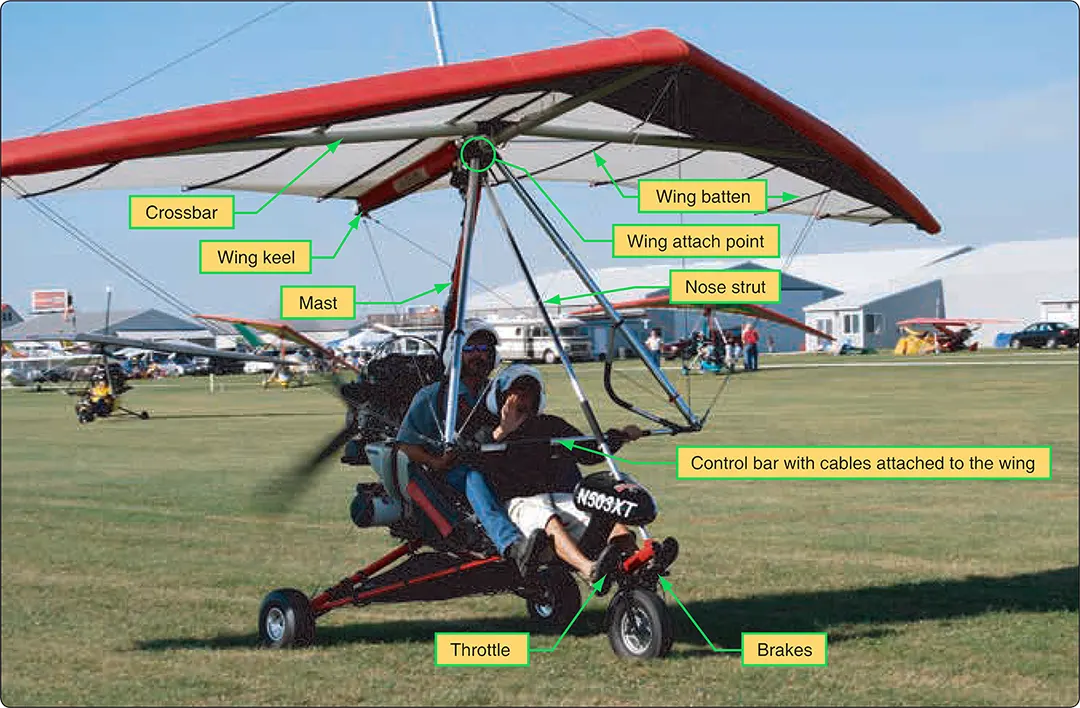
Cables are attached to the ends of the control bar and extend upward to the wing’s leading and trailing edges and to the left and right sides of the crossbar. Running from the wing’s leading edge to its trailing edge are support pieces known as battens. The battens fit into pockets in the sail and help give the wing its cambered shape.
Figure 2 identifies some of the primary parts of the trike. These components are referred to in the following discussion of its flight characteristics.
Flying a Weight-Shift Control Aircraft
To fly the trike, engine power is applied to get the aircraft moving. As the aircraft’s groundspeed reaches a point at which flight is possible, the pilot pushes forward on the control bar. This causes the wing to pivot at its attachment to the mast, tilting the leading edge upward.
When the leading edge of the wing tilts upward, the angle of attack increases, and the wing produces more lift. With sufficient lift, the trike lifts off and begins climbing.
Pulling back on the control bar reduces the wing’s angle of attack and can help stop the climb, allowing the aircraft to establish straight-and-level flight. Once the trike is in level flight, its airspeed can be increased or decreased by adding or reducing engine power with the throttle.
Stability of Weight-Shift Control Aircraft
In a typical conventional airplane, longitudinal stability is achieved partly through the horizontal stabilizer and elevator. These surfaces generate aerodynamic forces and pitching moments that help balance the airplane and provide a restoring tendency.
A trike must achieve longitudinal stability in a different way because it does not have a conventional horizontal stabilizer or elevator. It has a swept-back delta wing, with the trailing edges of the wingtips located well aft of the aircraft’s center of gravity. Aerodynamic forces acting on the wing, particularly its swept-back outer sections, contribute to the pitching moment that balances the aircraft and helps provide longitudinal stability.
The wings of weight-shift control aircraft are designed to change shape when subjected to external forces. This is possible because the frame’s leading edges and the sail are flexible, which is why these aircraft are sometimes referred to as flexible-wing aircraft.
This flexibility produces aerodynamic effects that differ from those of a conventional fixed-wing aircraft. A traditional small airplane, such as a Cessna 172, turns or banks by using its ailerons. The ailerons change the wing’s local camber and produce a difference in lift between the two wings.
By comparison, weight shifting on a trike causes the flexible wing to twist and change its aerodynamic shape. This changes the angle of attack and lift distribution across the wing, producing the differential lift needed to bank the aircraft.
The crossbar, or wing spreader, of the wing frame is allowed to move slightly relative to the keel. Together with other geometric features of the wing, this allows the sail to undergo a movement known as billow shift.
Billow shift can be demonstrated on the ground by lifting the trailing edge at one end of the wing. When this is done, the fabric on the other end of the wing becomes slightly flatter and tighter, and the wing’s angle of attack changes.
Turning by Weight Shift
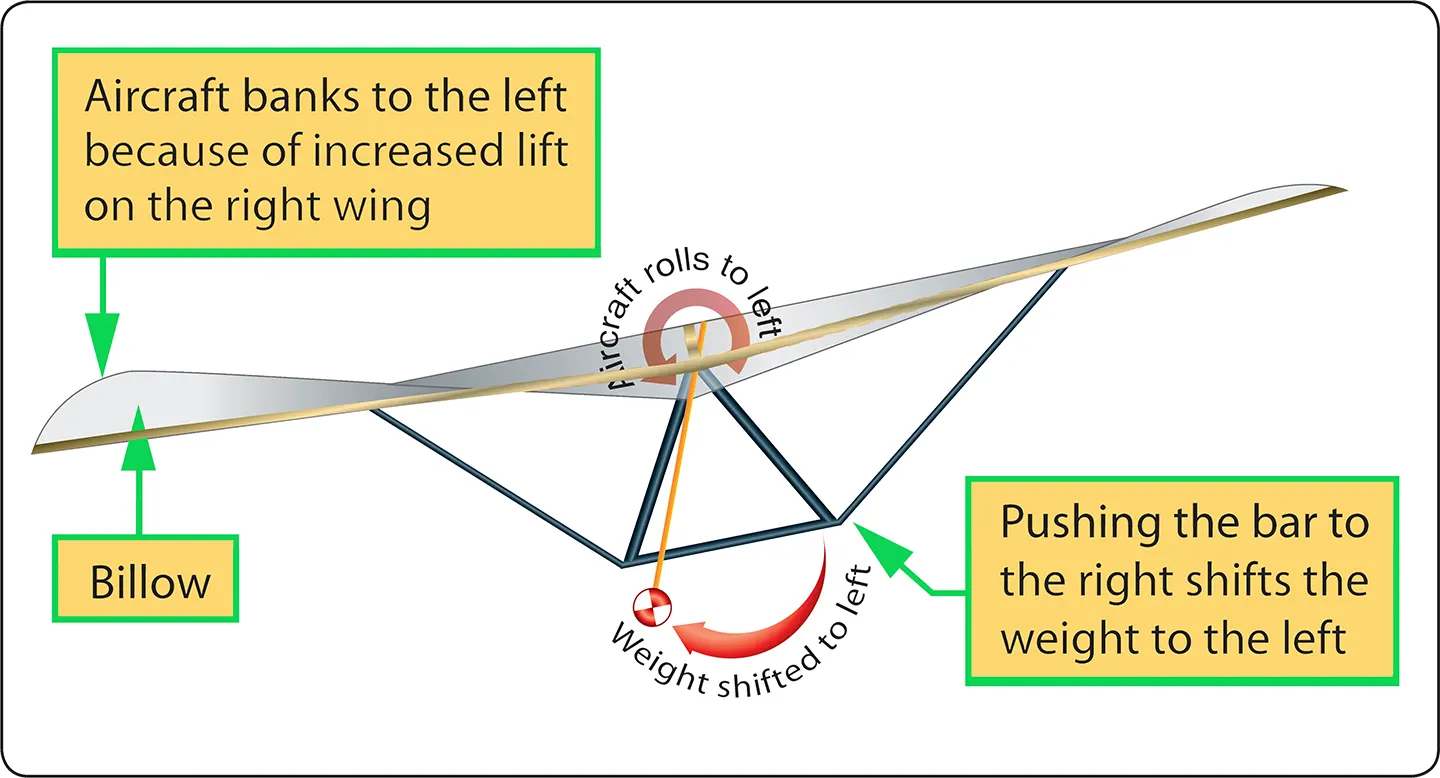
If the pilot pushes the control bar to the right, the wing pivots so that the left wingtip drops and the right wingtip rises. This causes the aircraft to bank to the left. This movement is illustrated in Figure 3, which shows a hang glider as an example.
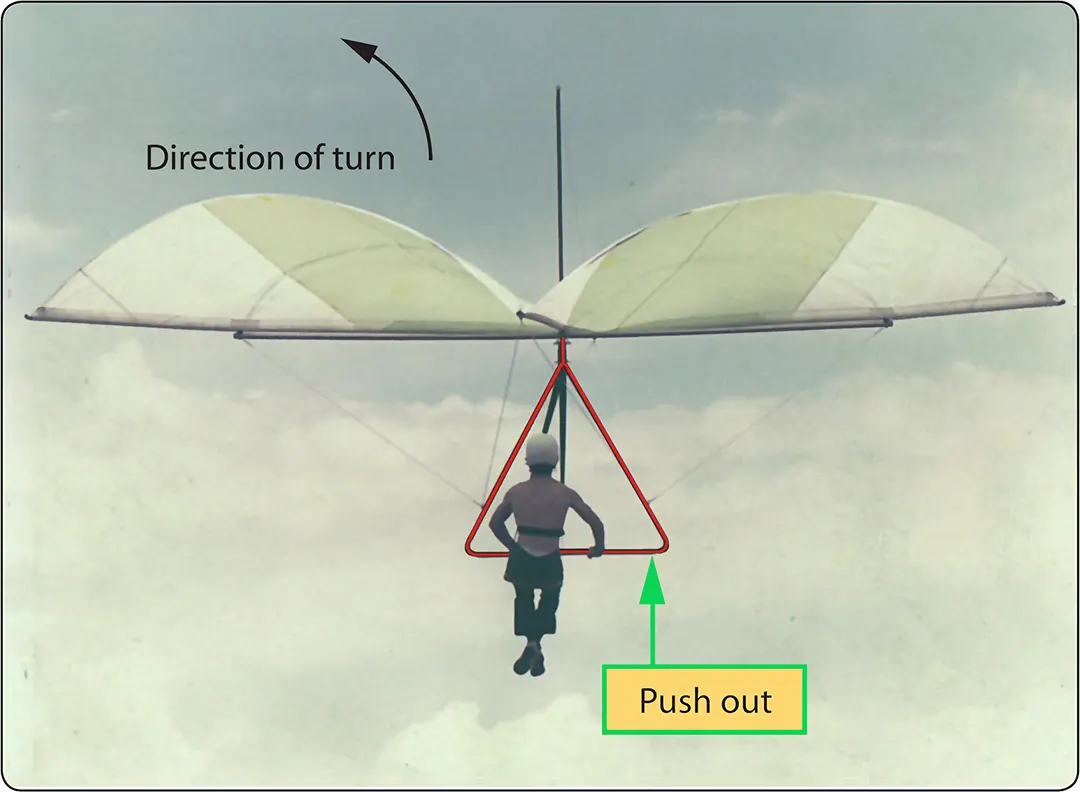
The shift in weight to the left increases the wing loading on the left side and reduces it on the right. The increased loading on the left wing increases its washout, reducing its angle of attack and lift. The increased load also causes the left wing to billow, which changes the sail’s shape and tightens the fabric on the right wing. The angle of attack and lift on the right side increase.
The difference in lift between the two sides causes the aircraft to bank to the left. The billow on the left wing is illustrated in Figure 4.
Shifting weight to the right causes the aircraft to bank to the right. The weight of the trike and its occupants acts somewhat like a pendulum suspended below the wing, contributing to the aircraft’s pendular stability.
Pushing or pulling on the control bar while in flight changes the position of the wing relative to the weight hanging below it. This is why the aircraft is referred to as a weight-shift control aircraft.
Straight-and-Level Flight
Once the trike is in flight and flying straight and level, the pilot generally needs only light pressure on the control bar to maintain the desired attitude.
If the trike is properly balanced and there is no significant air turbulence, it may remain stable with little control input. However, the pilot must continue to monitor the aircraft and make control adjustments as necessary.
Increasing engine power can cause the aircraft to climb, while decreasing power can cause it to descend, depending on the aircraft’s speed, attitude, and flight condition. The throttle is typically controlled by a foot pedal, similar to the accelerator pedal in an automobile.
Landing a Weight-Shift Control Aircraft
A trike lands in a manner similar to a conventional airplane. When it is time to land, the pilot reduces engine power using the foot-operated throttle, causing airspeed and wing lift to decrease.
As the trike descends, the pilot controls the rate of descent by adjusting the control bar and varying engine power. When the aircraft is close to touchdown, the pilot reduces engine power and increases the wing’s angle of attack as necessary to reduce the descent rate and cushion the landing.
Landing in a strong crosswind can be more challenging. The pilot may need to use a crabbed approach to maintain the required direction along the landing path, depending on the aircraft’s operating procedures and the wind conditions.
Touchdown is made with the rear wheels first, followed by lowering the front wheel onto the ground.
A trike preparing to touch down is shown in Figure 5. The control cables extending from the control bar, the support mast, and the cables on top of the wing, including the luff lines, can be seen.