
The behavior of gases is important in many areas of aviation, including engine operation, oxygen systems, tire pressure, cabin pressurization, and pneumatic systems. Changes in pressure, volume, and temperature affect how gases behave. The gas laws describe the relationships between these properties and help explain how gases respond under different conditions.
Kinetic Theory of Gases
The simple structure of gases makes them readily adaptable to mathematical analysis, from which a detailed theory of gas behavior has evolved. This is called the kinetic theory of gases.
The theory assumes that a gas is composed of molecules that behave approximately like minute elastic spheres. These molecules are spaced relatively far apart and are in continuous motion.
The degree of molecular motion depends on the temperature of the gas. Since the molecules are continuously striking against each other and against the walls of their container, an increase in temperature causes an increase in their average kinetic energy. In a sealed container of fixed volume, this results in more frequent and more forceful collisions with the walls, causing an increase in pressure.
If the container were an open vessel, the gas could expand and escape. However, if the container is sealed and flexible, such as a rubber balloon, an increase in gas pressure may cause the container to expand.
For instance, when making a long drive on a hot day, the pressure in automobile tires increases. A tire that appeared somewhat soft in the cool morning may have a higher pressure by midday as its temperature rises.
Such phenomena have been explained and set forth in the form of laws pertaining to gases. These laws help describe and support the kinetic theory of gases.
Boyle’s Law
As previously stated, compressibility is an outstanding characteristic of gases. The English scientist Robert Boyle was among the first to study this characteristic, which he called the “springiness of air.”
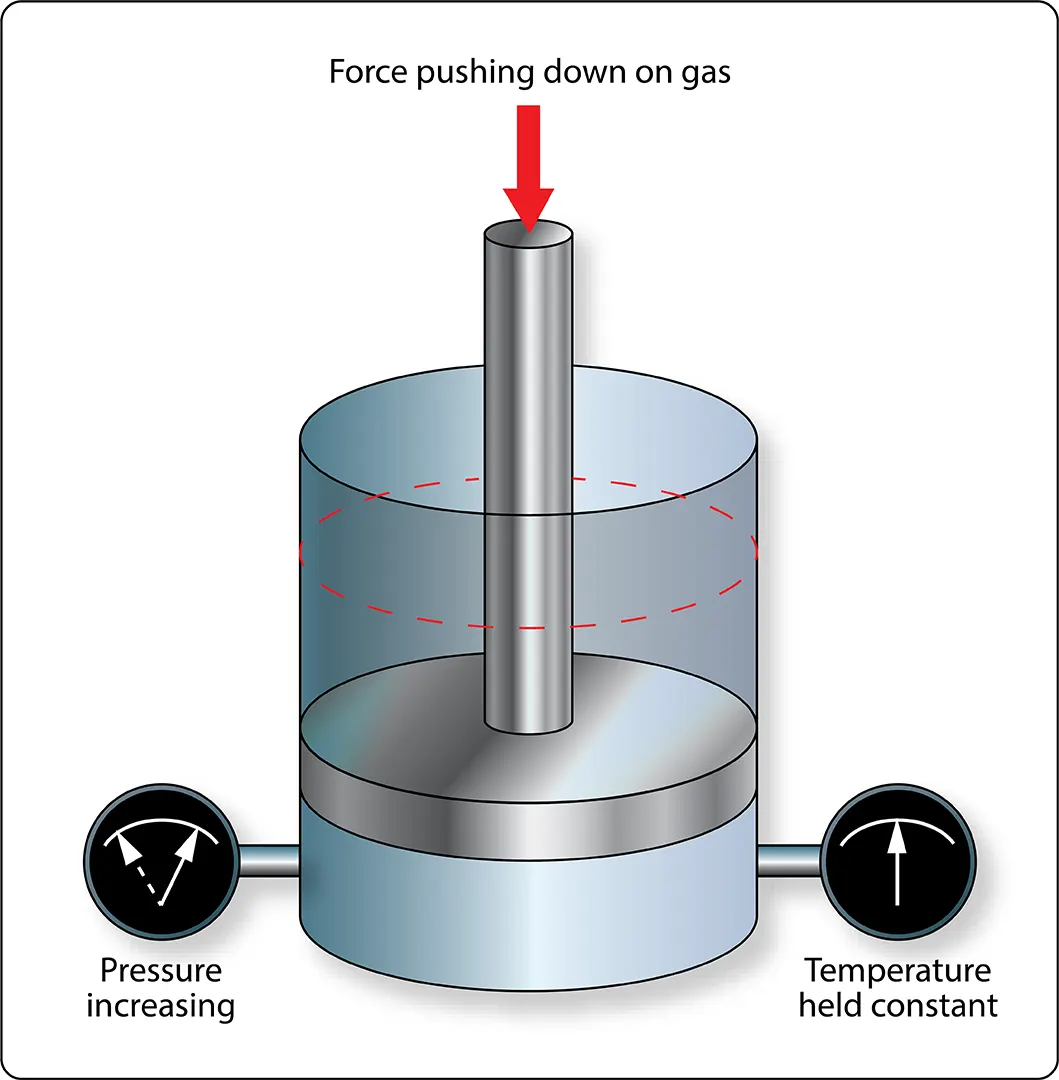
By direct measurement, he discovered that when the temperature of a fixed sample of gas was kept constant and its absolute pressure was doubled, its volume was reduced to half its former value. As the applied absolute pressure was decreased, the resulting volume increased.
From these observations, he concluded that, at a constant temperature, the product of the volume and absolute pressure of an enclosed gas remains constant.
Boyle’s Law is normally stated:
The volume of an enclosed dry gas varies inversely with its absolute pressure, provided the temperature remains constant.
The following formula is used for Boyle’s Law calculations. Remember that pressure must be expressed as absolute pressure.
Volume 1 × Pressure 1 = Volume 2 × Pressure 2
or
V₁P₁ = V₂P₂
Example: 10 ft³ of nitrogen is under a pressure of 500 psia. If the volume is reduced to 7 ft³, what will the new pressure be? [Figure 1]
V1P1 = V2P2
10 (500) = 7 (P2)
10 (500) ÷ 7 = P2
P2 = 714.29 psia
The useful applications of Boyle’s Law are many and varied. Some applications more common to aviation are:
- The carbon dioxide (CO₂) bottle used to inflate life rafts and life vests.
- The compressed oxygen and acetylene tanks used in welding.
- Compressed-air brakes and shock absorbers.
- The use of oxygen tanks for high-altitude flying and emergency use.
Charles’ Law
The French scientist Jacques Charles provided much of the foundation for the modern kinetic theory of gases. He found that gases expand and contract in direct proportion to changes in absolute temperature, provided the pressure is held constant. [Figure 2]
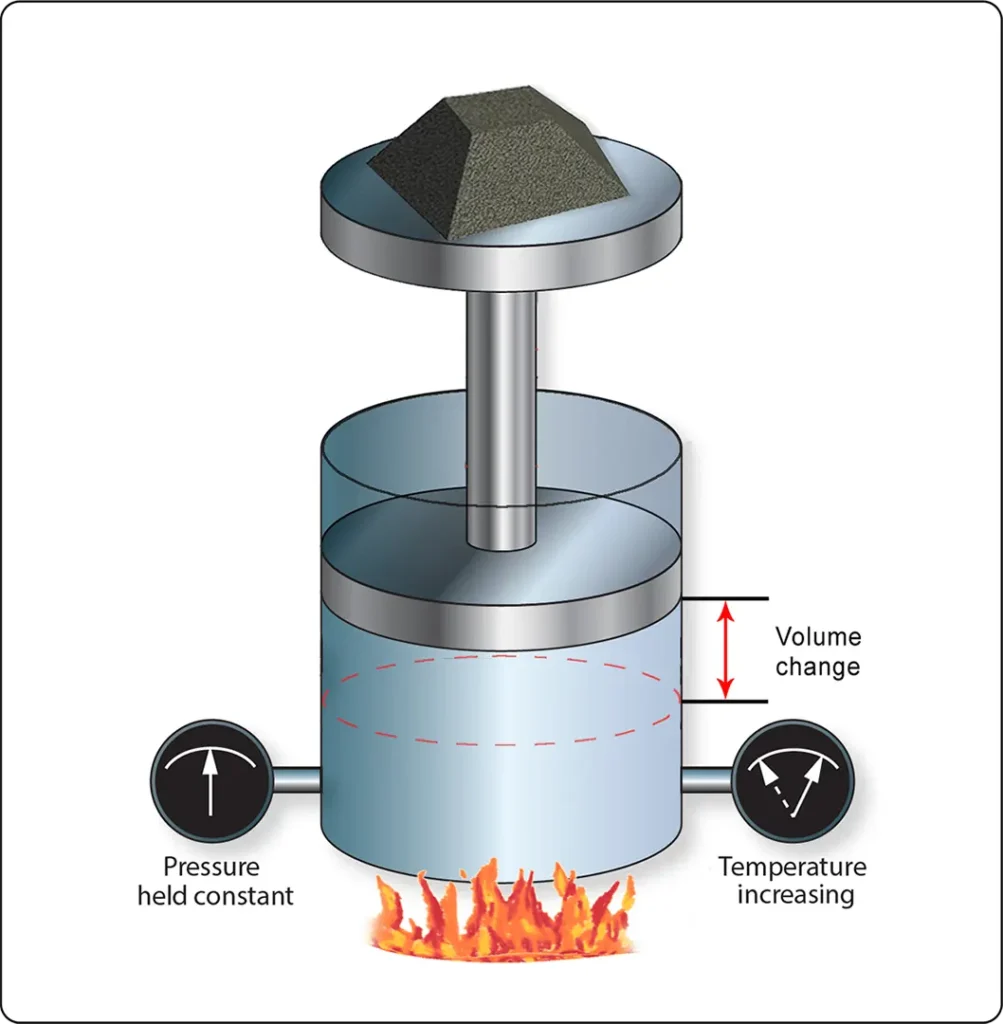
As a formula, this law is shown as follows:
Volume 1 × Absolute Temperature 2 = Volume 2 × Absolute Temperature 1
or
V₁T₂ = V₂T₁
Charles’ Law also applies when the volume is held constant and pressure and temperature are the variables. In this case, the formula is as follows:
P₁T₂ = P₂T₁
For this second formula, pressure and temperature must both be expressed in absolute units.
Example: A 15-ft³ cylinder of oxygen is at a temperature of 70 °F and a pressure of 750 psig. The cylinder is placed in the sun, and the temperature of the oxygen increases to 140 °F. What would be the new pressure in psig?
70 °F = 530 °R
140 °F = 600 °R
750 psig + 14.7 = 764.7 psia
P1T2 = P2T1
764.7 (600) = P2 (530)
P2 = 764.7 (600) ÷ 530
P2 = 865.7 psia
P₂ = 865.7 − 14.7
P2 = 851 psig
General Gas Law
By combining Boyle’s Law and Charles’ Law, a single expression can be derived that contains the information provided by both laws.
The formula used to express the general gas law is as follows:
Pressure 1 × Volume 1 ÷ Temperature 1 = Pressure 2 × Volume 2 ÷ Temperature 2
or
P₁V₁ ÷ T₁ = P₂V₂ ÷ T₂
Rearranging the formula gives:
P₁V₁T₂ = P₂V₂T₁
When using the general gas law formula, pressure and temperature must be expressed in absolute units.
Example: 20 ft³ of the gas argon is compressed to 15 ft³. The gas starts at a temperature of 60 °F and a pressure of 1,000 psig. After being compressed, its temperature is 90 °F. What would its new pressure be in psig?
60 °F = 520 °R
90 °F = 550 °R
1,000 psig + 14.7 = 1,014.7 psia
P₁V₁T₂ = P₂V₂T₁
1,014.7 (20) (550) = P2 (15) (520)
P₂ = 1,014.7 (20) (550) ÷ (15 × 520)
P2 = 1,431 psia
P₂ = 1,431 − 14.7
P2 = 1,416.3 psig
Dalton’s Law
If a mixture of two or more gases that do not combine chemically is placed in a container, each gas expands throughout the total space. The pressure contributed by each individual gas is called its partial pressure.
The pressure of the mixed gases is equal to the sum of their partial pressures. This principle was discovered by John Dalton, an English physicist, and is set forth in Dalton’s Law:
A mixture of several gases that do not react chemically exerts a pressure equal to the sum of the pressures that the individual gases would exert separately if each occupied the entire space alone at the same temperature.
This relationship can be expressed as:
Total Pressure = Partial Pressure 1 + Partial Pressure 2 + …
Or, for a mixture of several gases:
Pₜ = P₁ + P₂ + P₃ + …