
Heat is an important form of energy in aviation. It affects aircraft engines, electrical systems, structural materials, and the operation of many aircraft components. Understanding how heat is produced, measured, transferred, and controlled helps explain engine thermal efficiency, cooling systems, temperature changes, and the expansion and contraction of aircraft materials.
Table of Contents
Table of Contents
Heat Energy
Heat is energy transferred from one body or substance to another because of a temperature difference. It is associated with the motion of the molecules and atoms that make up a substance.
Several forms of energy can be converted into thermal energy. Some examples are as follows:
- Mechanical Energy — This includes methods of increasing the motion of molecules, such as friction, the impact of bodies, or the compression of gases.
- Electrical Energy — Electrical energy is converted into heat when an electric current flows through a resistance, such as in an electric iron, electric light, or electric blanket.
- Chemical Energy — Many chemical reactions convert stored chemical energy into heat. Examples include the explosive effects of gunpowder, the burning of oil or wood, and the combustion of grease in the presence of oxygen.
- Radiant Energy — Electromagnetic radiation can produce heat when it is absorbed by a material. Examples include visible light, infrared radiation, and some higher-energy radiation.
- Nuclear Energy — Energy stored in the nucleus of atoms can be released during nuclear reactions, such as nuclear fission in a nuclear reactor.
- The Sun — Solar energy originates from nuclear reactions occurring in the sun. It provides energy for many natural processes on Earth.
When a gas is compressed, work is done on the gas, and its temperature may increase. Conversely, when a high-pressure gas is allowed to expand, its temperature may decrease, depending on the conditions of expansion. In the first case, work is converted into internal energy; in the second case, the gas may lose internal energy.
Since energy can be transferred as heat or through work, there is a relationship between heat energy and mechanical work. When two surfaces are rubbed together, friction produces heat. Work is required to cause the friction, and experiments have shown that the work performed and the amount of heat produced are related. Thus, heat is a form of energy transfer.
According to the molecular theory of matter, the molecules, atoms, and electrons in substances are in continual motion. The microscopic motion and interactions of these particles contribute to a substance’s internal energy. As a substance becomes hotter, the average kinetic energy of its particles generally increases.
When work is done to slide one body over another, mechanical energy is transformed into internal energy, and the temperature of the materials may rise. This is why friction produces heat.
Heat Energy Units
Two different units are commonly used to express quantities of heat energy: the calorie and the British thermal unit (BTU).
One calorie is approximately equal to the amount of heat required to raise the temperature of 1 gram of water by 1 degree Celsius (1 °C).
The term calorie (spelled with a lowercase c) is one-thousandth of the Calorie (spelled with a capital C) used to measure the energy content of food.
One BTU is defined as the amount of heat required to raise the temperature of 1 lb of water by 1 degree Fahrenheit (1 °F), under specified conditions.
The calorie and gram are seldom used in discussions of aviation maintenance. The BTU, however, is commonly referred to when discussing engine thermal efficiency and the heat content of aviation fuel.
A device known as a calorimeter is used to measure quantities of heat energy. In aviation, it may be used to determine the quantity of heat energy available in 1 pound of aviation gasoline.
A given weight of fuel is burned in the calorimeter, and the heat energy released is absorbed by a large quantity of water. From the weight of the water and the increase in its temperature, it is possible to calculate the heat yield of the fuel.
A definite relationship exists between heat and mechanical energy. This relationship has been established and verified by many experiments, which show that:
1 BTU of heat energy = 778 ft-lb of work
As discussed in the Energy section under the topic “Potential Energy,” 1 pound of aviation gasoline contains approximately 18,900 BTU of heat energy.
Since each BTU is equivalent to approximately 778 ft-lb of work, 1 lb of aviation gasoline is capable of producing:
18,900 × 778 = 14,704,200 ft-lb of work
Heat Energy and Thermal Efficiency
Thermal efficiency is the relationship between the potential power contained in a specific heat source and the amount of usable power produced when that heat source is used.
The formula for calculating thermal efficiency is:
Thermal Efficiency = Horsepower Produced ÷ Potential Horsepower in Fuel
For example, consider the piston engine used in a small general aviation airplane, which typically consumes 0.5 lb of fuel per hour for each horsepower it creates.
Imagine that the engine is producing 200 hp. If we multiply 0.5 by the horsepower of 200, we find that the engine is consuming 100 lb of fuel per hour, or approximately 1.67 lb per minute.
In the Force, Work, Power, and Torque section, one horsepower was found to be equivalent to 33,000 ft-lb of work per minute.
The potential horsepower in the fuel burned by this example engine would be:
Hp = 1.67 lb/min × 18,900 BTU/lb × 778 ft-lb/BTU ÷ 33,000 ft-lb/min
Hp ≈ 744
The example engine is burning enough fuel to have the potential to produce approximately 744 horsepower, but it is producing only 200 hp.
The thermal efficiency of the engine would therefore be:
Thermal Efficiency = Hp Produced ÷ Hp in Fuel
= 200 ÷ 744
= 0.2688 or 26.88%
More than 70 percent of the energy in the fuel is not being converted into useful horsepower. Some of this energy is lost through friction and heat transfer to the surroundings, including heat carried away by the exhaust gases and the engine cooling system.
Heat Transfer
There are three methods by which heat is transferred from one location to another or from one substance to another. These three methods are conduction, convection, and radiation.
Conduction
Heat transfer by conduction occurs when energy moves through a substance or between substances in direct physical contact. Heat naturally flows from a region of higher temperature to a region of lower temperature.
Everyone knows from experience that the metal handle of a heated pan can burn the hand. A plastic or wooden handle, however, remains relatively cool even though it is in direct contact with the pan.
The metal transmits heat more easily than wood because it is a better conductor of heat. Different materials conduct heat at different rates. Some metals are much better conductors of heat than others.
Aluminum and copper are used in pots and pans because they conduct heat rapidly. Wood and plastics are used for handles because they conduct heat relatively slowly.
Figure 1 illustrates the different rates of thermal conductivity of various metals. Of those listed, silver is the best conductor, and lead is the poorest.
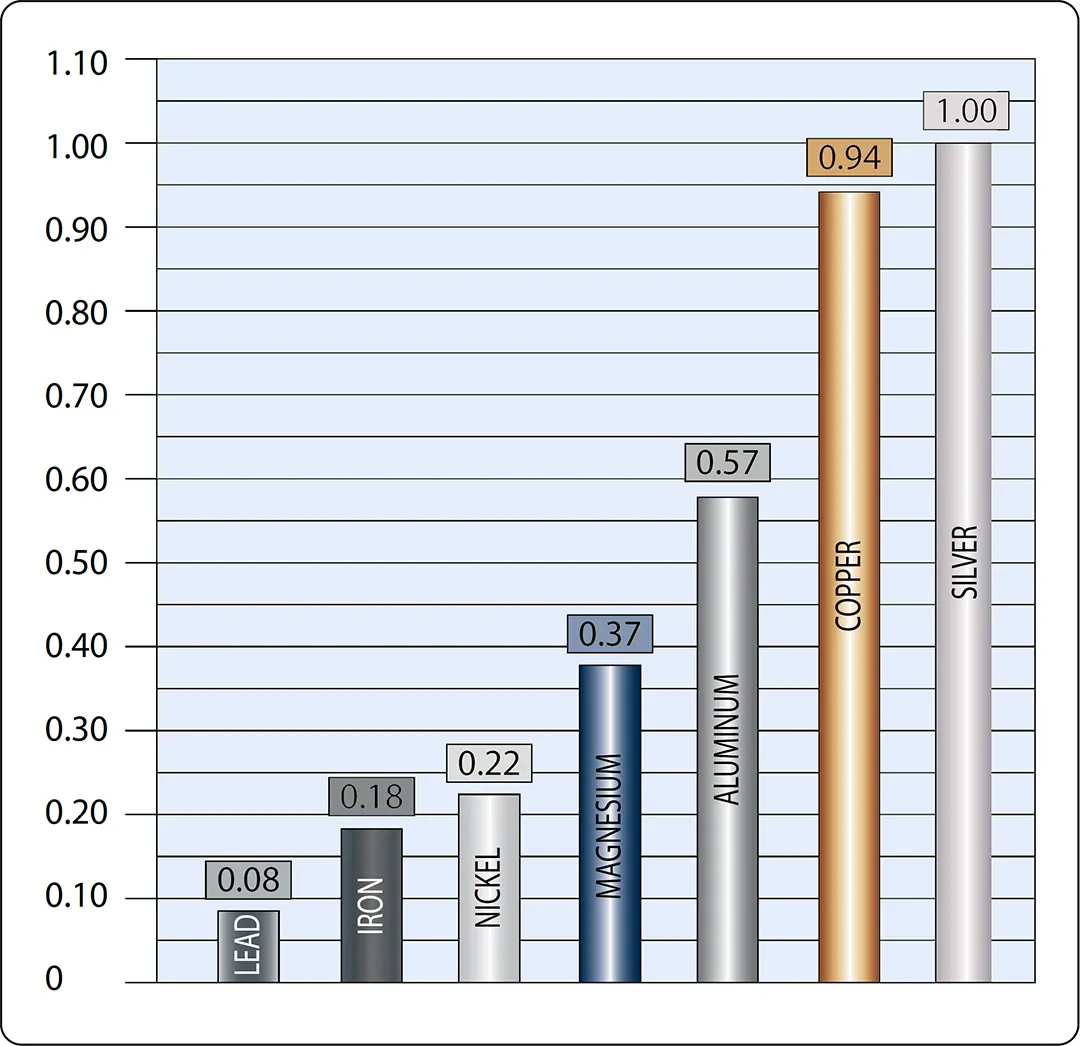
As mentioned previously, copper and aluminum are used in pots and pans because they are good conductors. It is interesting to note that silver, copper, and aluminum are also excellent conductors of electricity.
Liquids are generally poorer conductors of heat than metals. Notice that the ice in the test tube shown in Figure 2 is not melting rapidly even though the water at the top is boiling. Water conducts heat relatively poorly, so not enough heat is conducted down to the ice to melt it rapidly.
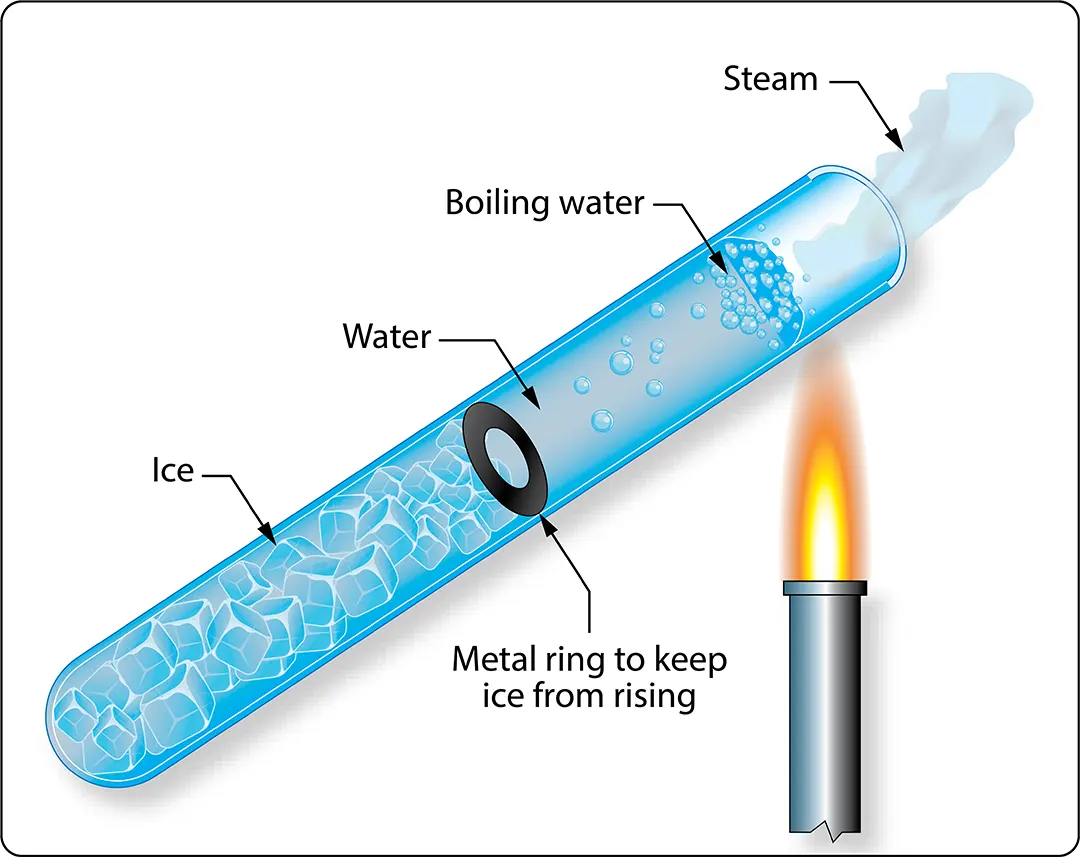
Gases are generally even poorer conductors of heat than liquids. It is possible to stand quite close to a stove without being burned by direct conduction through the air because air is a poor conductor of heat.
Since conduction involves the transfer of energy through interactions between particles, gases are poor conductors because their molecules are much farther apart than those in solids.
At the point where a heat source is applied, the molecules become more energetic. They interact with adjacent molecules, transferring energy to them. This process continues as thermal energy is distributed throughout the substance.
Materials that are poor conductors are used to reduce heat transfer and are called heat insulators. A wooden handle on a pot or a soldering iron serves as a heat insulator.
Certain materials, such as finely spun glass, are particularly poor heat conductors and are used for many types of insulation. Asbestos was also historically used as an insulating material, but it is hazardous to health and should not be used or disturbed.
Convection
Convection is the process by which heat is transferred through the movement of a heated fluid, either a gas or a liquid.
For example, an incandescent light bulb becomes increasingly hot when operating. The air surrounding it is heated and begins to move upward. This upward movement of heated air carries heat away from the bulb by convection.
Heat transfer by convection may be increased by using a ventilating fan to move the air surrounding a hot object.
The rate of cooling of a hot electronic component, such as the CPU in a computer, can be increased by providing copper fins that conduct heat away from the hot surface. The fins provide a large surface area against which cool air can flow.
Convection also takes place in liquids. A good example is a pan of water sitting on a stove. The bottom of the pan becomes hot because it conducts heat from the surface in contact with it. The water at the bottom of the pan also heats up through conduction.
As the heated water begins to rise and cooler water moves down to take its place, convection currents develop.
When the natural circulation of a gas or liquid is not rapid enough to remove sufficient heat, fans or pumps are used to increase the movement of the cooling material. In some installations, pumps circulate water or oil to help cool large equipment. In aircraft installations, electric fans and blowers are used to assist convection.
An aircraft air-cooled piston engine is a good example of convection being used to transfer heat. The engine shown in Figure 3 is a Continental IO-520, with six heavily finned air-cooled cylinders.
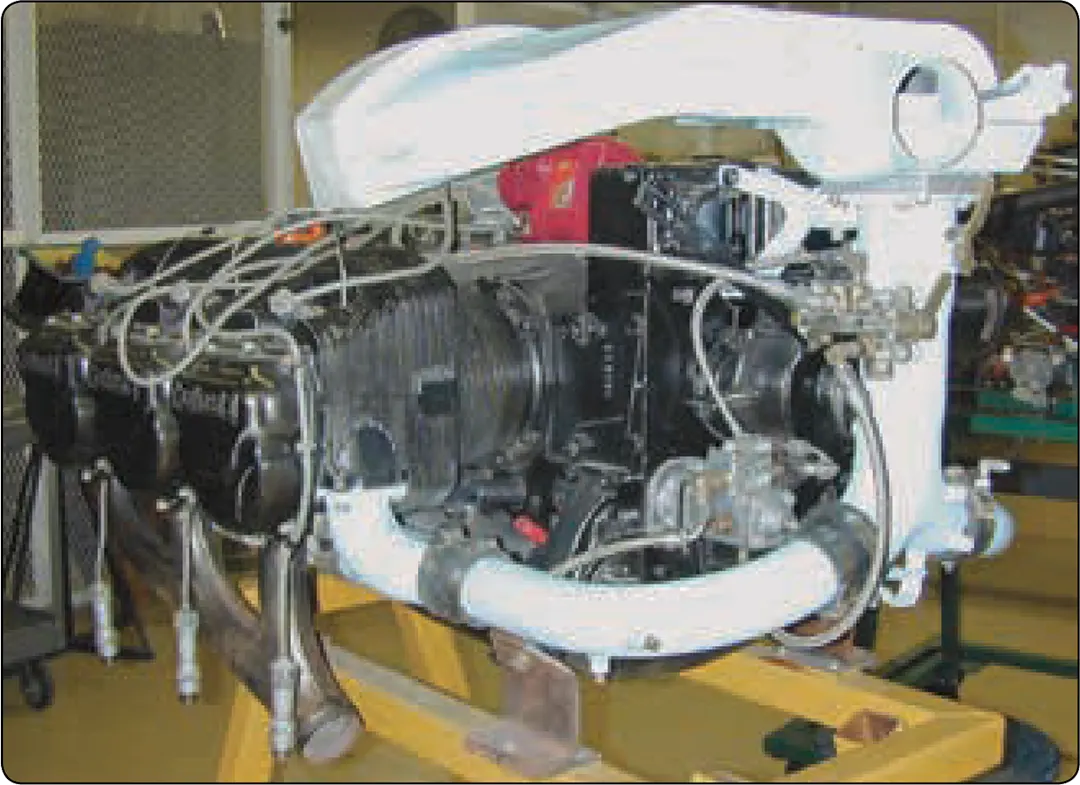
This engine does not depend on natural convection for cooling, but rather on forced-air convection produced by airflow from the propeller. Heat generated inside the engine travels to the cylinder cooling fins by conduction through the cylinder metal. Once the heat reaches the fins, forced air flowing around the cylinders carries it away.
Radiation
Conduction and convection cannot fully explain all the phenomena associated with heat transfer.
For example, the heat felt when sitting in front of an open fire cannot be explained entirely by convection because the air currents may be moving toward the fire. It cannot be explained by conduction through the air alone because air has low thermal conductivity, and cooler air moving toward the fire would limit the transfer of heat outward.
Therefore, there must be another way for heat to travel across space besides conduction and convection.
The existence of another process of heat transfer is even more evident when considering heat from the sun. Since conduction and convection require a material medium, such as a gas or liquid, heat from the sun must reach Earth by another method because space is nearly a vacuum.
Radiation is the third method of heat transfer.
The term radiation refers to the transfer of energy by electromagnetic waves. This energy is known as radiant energy. Electromagnetic radiation includes radio waves, visible light, infrared radiation, and X-rays, which differ in wavelength and frequency.
Electromagnetic waves travel at the speed of light and can travel through a vacuum. Some forms of radiation are absorbed by air, while others pass through it more readily.
Sunlight is radiant energy that travels through space to reach Earth. When electromagnetic radiation is absorbed by a material, its internal energy may increase, causing its temperature to rise.
The differences between conduction, convection, and radiation may now be considered.
First, radiation travels at the speed of light, whereas the overall rates of heat transfer by conduction and convection depend on the properties of the materials and the conditions involved. This fact is evident during a solar eclipse, when the reduction in sunlight and radiant heating occurs as the sun is obscured.
Second, radiant energy may pass through a medium without heating it significantly. For example, sunlight can pass through the glass of a greenhouse and heat objects inside. The glass and air may absorb some of the radiation, but much of the energy is absorbed by the objects and surfaces inside.
Third, radiant heat transfer can occur directly between surfaces without requiring the movement of a fluid. A screen placed between a heat source and the body to be protected can reduce the radiant heat reaching that body.
Specific Heat
One important way in which substances differ is in the amount of heat required to produce the same temperature change in a given mass of the substance.
Each substance requires a certain quantity of heat, called its specific heat capacity, to raise the temperature of a unit mass of that substance by 1 °C.
The specific heat of a substance is the ratio of its specific heat capacity to the specific heat capacity of water. Since it is a ratio, specific heat is expressed as a number without units when the same units are used for both substances.
It is fortunate that water has a high specific heat capacity. The large bodies of water on Earth help moderate the temperature of the air and solid matter on or near the surface.
A great quantity of heat is required to change the temperature of a large lake or river. Therefore, when the surrounding temperature falls below that of the water, the water releases heat. This process helps prevent atmospheric temperatures near the Earth’s surface from changing rapidly.
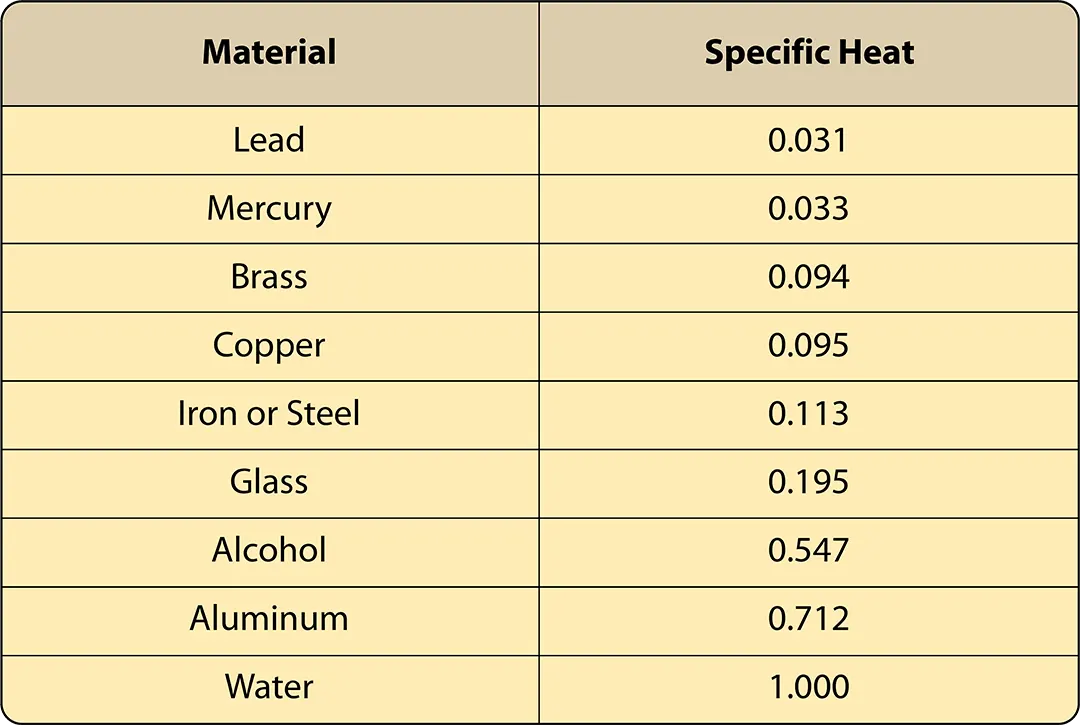
The specific heat values of some common materials are listed in Figure 4.
Temperature
Temperature is a dominant factor affecting the physical properties of fluids. It is of particular concern when calculating changes in the state of gases.
The three temperature scales used extensively are the Celsius, Fahrenheit, and absolute or Kelvin scales.
The Celsius scale is constructed by using the freezing and boiling points of water, under standard atmospheric pressure, as fixed points of 0 °C and 100 °C, respectively, with 100 equal divisions between them.
The Fahrenheit scale uses 32 °F as the freezing point of water and 212 °F as the boiling point, with 180 equal divisions between them.
The absolute or Kelvin scale has its zero point established at absolute zero, which is −273.15 °C. The relationships between the fixed points of the temperature scales are shown in Figure 5.
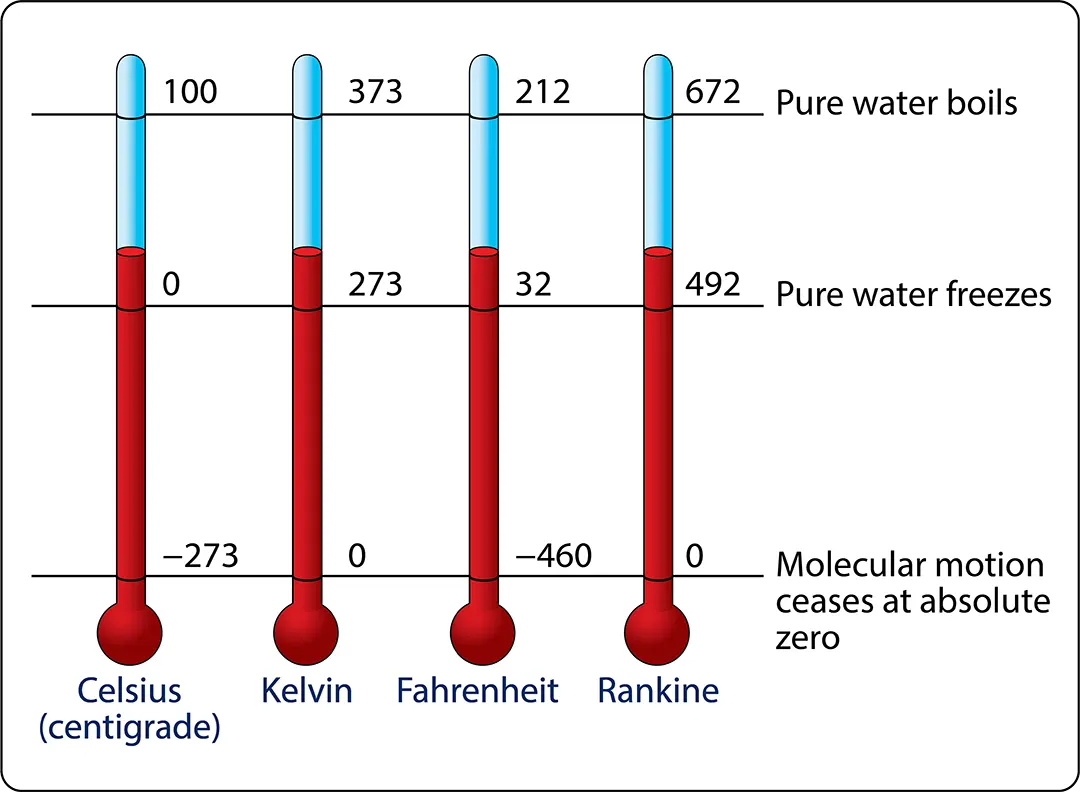
When working with temperatures, always make sure which system of measurement is being used and know how to convert from one scale to another.
The conversion formulas are as follows:
Degrees Fahrenheit = (1.8 × Degrees Celsius) + 32
Degrees Celsius = (Degrees Fahrenheit − 32) × 5/9
Degrees Kelvin = Degrees Celsius + 273.15
Degrees Rankine = Degrees Fahrenheit + 459.67
For many aviation calculations, rounded values of 273 and 460 are used.
For purposes of calculations, the Rankine scale is commonly used to convert Fahrenheit temperatures to an absolute temperature scale. For Fahrenheit readings above zero, approximately 460° is added.
Thus, 72 °F equals approximately 460° plus 72°, or 532 °R absolute.
If the Fahrenheit reading is below zero, it is subtracted from 460°. Thus, −40 °F equals approximately 460° minus 40°, or 420 °R absolute.
The Rankine scale is an absolute temperature scale, just as the Kelvin scale is. The two scales use different temperature increments: one degree Rankine is equal to one degree Fahrenheit in size, while one kelvin is equal to one degree Celsius in size.
The Kelvin and Celsius scales are used extensively in scientific work. Therefore, some technical manuals may use these scales in giving directions and operating instructions. The Fahrenheit scale is commonly used in the United States, and most people there are familiar with it.
Thermal Expansion and Contraction
Thermal expansion takes place in solids, liquids, and gases when they are heated. With few exceptions, solids expand when heated and contract when cooled.
The expansion of solids when heated is very slight in comparison with the expansion of liquids and gases because the molecules of solids are much closer together and are more strongly attracted to each other.
The expansion of fluids is discussed in the Gas Laws section. Thermal expansion in solids must be explained in some detail because of its close relationship to aircraft metals and materials.
It is necessary to measure experimentally the exact rate of expansion of each substance because some substances expand more than others.
The amount by which a unit length of a substance expands for a 1-degree rise in temperature is known as the coefficient of linear expansion for that substance.
The coefficient of linear expansion for various materials is shown in Figure 6.
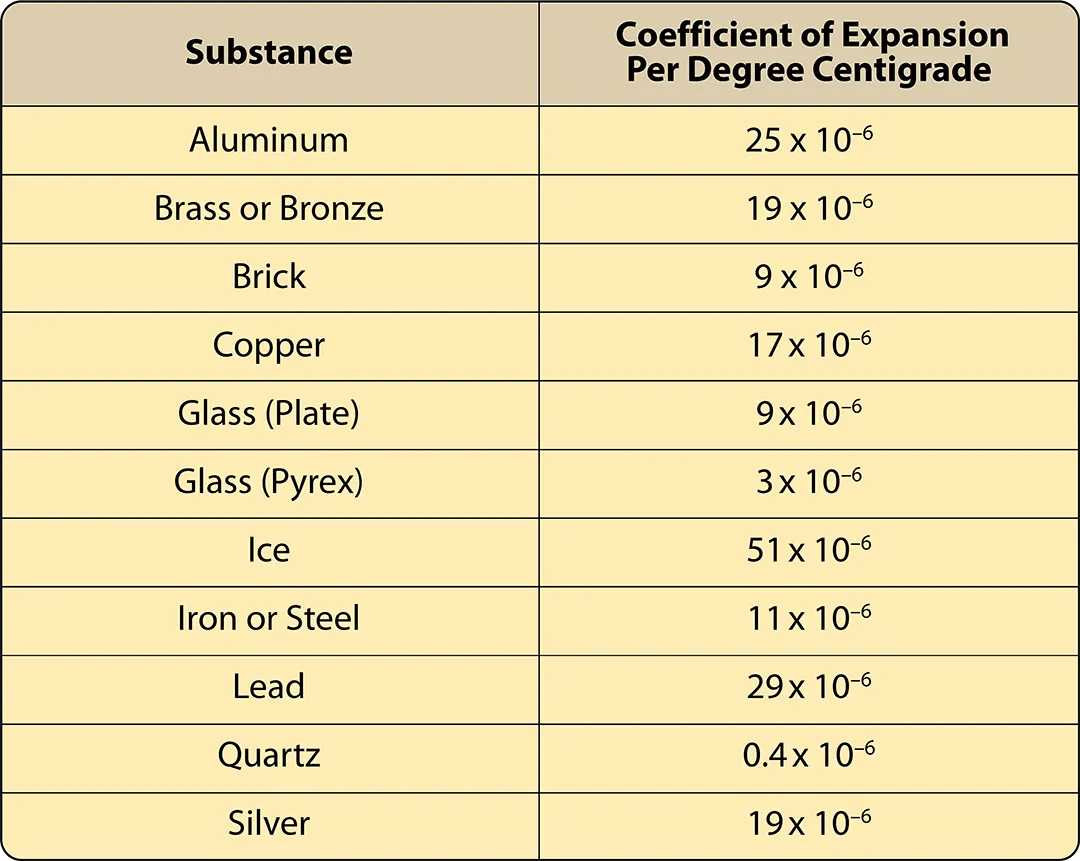
To estimate the expansion of any object, such as a steel rail, it is necessary to know three things about it: its original length, the rise in temperature to which it is subjected, and its coefficient of expansion.
This relationship is expressed by the equation:
Expansion = (Coefficient of Linear Expansion) × (Original Length) × (Rise in Temperature)
If a steel rod measures exactly 9 ft at 21 °C, what is its length at 55 °C? The coefficient of expansion for steel is 11 × 10⁻⁶ per °C.
The temperature increase is:
55 − 21 = 34 °C
Expansion = (11 × 10⁻⁶) × (9 feet) × 34
Expansion = 0.003366 feet
This amount, when added to the original length of the rod, makes the rod:
9 + 0.003366 = 9.003366 ft long
Its length has increased by approximately 4/100 of an inch.
The increase in the length of the rod is relatively small, but if the rod were placed where it could not expand freely, a considerable force could develop due to thermal expansion.
Thus, thermal expansion must be taken into consideration when designing airframes, power plants, and related equipment.