
The atmosphere plays an essential role in aviation because aircraft depend on the properties of air for lift, engine operation, and flight performance. Atmospheric pressure, temperature, density, and moisture change with altitude and weather conditions. Understanding these changes is important when maintaining aircraft, evaluating engine performance, and planning flights.
Table of Contents
Table of Contents
Composition of the Atmosphere
Aviation is so dependent upon that category of fluids called gases, and the effects of forces and pressures acting upon gases, that a discussion of the atmosphere is important to persons maintaining and repairing aircraft.
Data available about the atmosphere may determine whether a flight will succeed or whether an aircraft will even become airborne. The various components of the air around Earth, changes in temperature and pressure at different levels above the surface, weather conditions encountered by aircraft in flight, and many other details are considered in the preparation of flight plans.
Pascal and Torricelli have been credited with developing the barometer, an instrument for measuring atmospheric pressure. The results of their experiments are still used today, with improvements in instrument design and measurement techniques. They demonstrated that air has weight and that atmospheric pressure changes with altitude relative to sea level. Today, scientists are also interested in how the atmosphere affects aircraft performance and equipment.
The atmosphere is a complex and ever-changing mixture. Its ingredients vary from place to place and from day to day. In addition to several gases, it contains foreign matter such as pollen, dust, bacteria, soot, volcanic ash, spores, and particles from outer space.
The proportions of the major gases in dry air remain relatively constant throughout much of the lower atmosphere. However, the density of the atmosphere diminishes rapidly with altitude.
At higher altitudes, the air becomes progressively thinner. This makes breathing difficult for people without supplemental oxygen and affects the operation of aircraft engines that depend on atmospheric oxygen for combustion.
At the upper limits of the atmosphere, gas particles become extremely sparse. Some particles escape into space, while others remain gravitationally bound to Earth. There is no sharply defined outer boundary between the atmosphere and space.
Layers of the Atmosphere
The atmosphere is divided into layers based mainly on how temperature changes with altitude. The transitions between these layers are gradual rather than sharply defined.
The five main temperature-based layers are:
- Troposphere
- Stratosphere
- Mesosphere
- Thermosphere
- Exosphere
The ionosphere is another important region of the atmosphere. It contains electrically charged particles and overlaps portions of the mesosphere, thermosphere, and exosphere. It is therefore not a separate temperature-based layer.
The ozone layer, sometimes called the ozonosphere, is located mainly in the stratosphere. Ozone absorbs much of the Sun’s harmful ultraviolet radiation and helps protect life on Earth.
Troposphere
The troposphere extends from Earth’s surface to approximately 35,000 ft at middle latitudes, but its height varies from about 28,000 ft near the poles to approximately 54,000 ft near the equator.
The troposphere is characterized by changes in temperature and humidity and by generally turbulent conditions. Nearly all ordinary weather phenomena and most cloud formations occur within this layer.
Approximately three-fourths of the total mass of the atmosphere is contained in the troposphere. Temperature generally decreases with increasing altitude in this layer.
The upper boundary of the troposphere is called the tropopause. It is the region where the normal decrease in temperature with increasing altitude becomes much smaller or ceases.
Stratosphere
The stratosphere extends upward from the tropopause to approximately 50 km (31 miles). Unlike the troposphere, temperature generally increases with altitude in much of the stratosphere because ozone absorbs ultraviolet radiation from the Sun.
The stratosphere is relatively stable, with less vertical mixing than the troposphere. Some aircraft operate in its lower portions.
Mesosphere
The mesosphere lies above the stratosphere and extends to approximately 85 km (53 miles). Temperature generally decreases with altitude in this layer, reaching very low values near its upper boundary.
Most meteors entering Earth’s atmosphere burn up in the mesosphere.
Thermosphere
The thermosphere lies above the mesosphere and extends upward to several hundred kilometers. Temperature increases significantly with altitude because gases in this region absorb high-energy solar radiation.
Although the temperature can reach very high values, the air is extremely thin. Consequently, there are very few gas molecules available to transfer heat to an object.
Exosphere
The exosphere is the outermost region of Earth’s atmosphere. It gradually transitions into space, and there is no sharply defined upper boundary.
Gas particles are extremely far apart in this region. Some particles can escape Earth’s gravitational influence and move into space.
Ionosphere
The ionosphere contains electrically charged particles, including ions and free electrons, produced mainly by solar radiation. It overlaps portions of the mesosphere, thermosphere, and exosphere.
Electrical phenomena occur in this region, and the ionosphere plays an important role in radio-wave propagation and long-distance radio communication.
Atmospheric Pressure
The human body is under pressure because it exists at the bottom of a sea of air. This pressure is due to the weight of the atmosphere.
On a standard day at sea level, if a 1-in² column of air extending to the top of the atmosphere were weighed, it would weigh approximately 14.7 lb. That is why standard-day atmospheric pressure is said to be 14.7 pounds per square inch (14.7 psi).
Since atmospheric pressure at any altitude is due to the weight of the air above it, pressure decreases with increasing altitude. Obviously, the total weight of air above an area at 15,000 ft would be less than the total weight of air above an area at 10,000 ft.
Atmospheric pressure is often measured by a mercury barometer. A glass tube somewhat over 30 inches in length is sealed at one end and then filled with mercury. It is inverted, and the open end is placed in a dish of mercury.
Immediately, the mercury level in the inverted tube drops a short distance, leaving a small volume of mercury vapor at very low absolute pressure in the tube just above the top of the liquid mercury column.
Gravity acting on the mercury in the tube tends to make the mercury run out. Atmospheric pressure pushing down on the mercury in the open container supports the column inside the tube. The mercury stabilizes at a height where the pressure exerted by the column balances the atmospheric pressure.
Under standard-day atmospheric conditions, the air in a 1-in² column extending to the top of the atmosphere would weigh approximately 14.7 lb. A 1-in² column of mercury, 29.92 inches tall, would also exert a pressure equivalent to approximately 14.7 psi.
That is why 14.7 psi is equal to 29.92 inches of mercury (inHg). Figure 1 demonstrates this point.

A second means of measuring atmospheric pressure is with an aneroid barometer. This mechanical instrument is a much better choice than a mercury barometer for use in airplanes.
Aneroid barometers are used in aircraft altimeters to indicate altitude. The instrument uses a sealed, flexible metal capsule that expands or contracts as the surrounding atmospheric pressure changes. The movement is transmitted to the altimeter pointers.
The calibrations are made in thousands of feet rather than in psi or inches of mercury.
For example, the standard pressure at sea level is 29.92 inHg, or approximately 14.7 psi. At 10,000 ft above sea level, standard pressure is approximately 20.58 inHg, or 10.10 psi.
An altimeter is calibrated so that, under standard atmospheric conditions, a pressure corresponding to approximately 10,000 ft will produce an altitude indication of 10,000 ft when the appropriate standard pressure reference is used. [Figure 2]

Atmospheric Density
Since both temperature and pressure generally decrease with altitude in the troposphere, it might appear that the density of the atmosphere would remain fairly constant with increasing altitude. This is not true, however, because pressure drops more rapidly with increasing altitude than does temperature. The result is that density generally decreases with increasing altitude.
By using the general gas law, it can be shown that, for a particular gas, pressure and absolute temperature determine its density. Since standard pressure and temperatures have been associated with each altitude, the density of the air at these standard temperatures and pressures is also considered standard.
Thus, a particular atmospheric density is associated with each altitude under standard atmospheric conditions. This gives rise to the expression density altitude, symbolized as (H_d).
A density altitude of 15,000 ft is the altitude in the standard atmosphere at which the air has the same density as the air at the aircraft’s present location.
Remember, however, that density altitude is not necessarily the same as true altitude.
For example, on a day when the atmospheric pressure is higher than standard and the temperature is lower than standard, the density normally associated with 10,000 ft in the standard atmosphere might occur at a different actual altitude.
Density altitude is a calculated altitude obtained by correcting pressure altitude for nonstandard temperature. It is an important indication of aircraft performance because air density affects engine power, propeller efficiency, and aerodynamic lift.
When density altitude is high, the air is less dense. Aircraft generally require longer takeoff distances and experience reduced climb performance under these conditions.
Water Content of the Atmosphere
In the troposphere, the air is rarely completely dry. It contains moisture in two forms: water vapor and liquid water droplets.
Fog consists of minute droplets of liquid water held in suspension in the air. Clouds also consist of tiny water droplets, ice crystals, or a combination of both.
The presence of water vapor in the air is invisible under ordinary conditions. Figure 3 shows a military F-18 performing a high-speed fly-by at nearly Mach 1, with a visible vapor cloud forming around the aircraft.
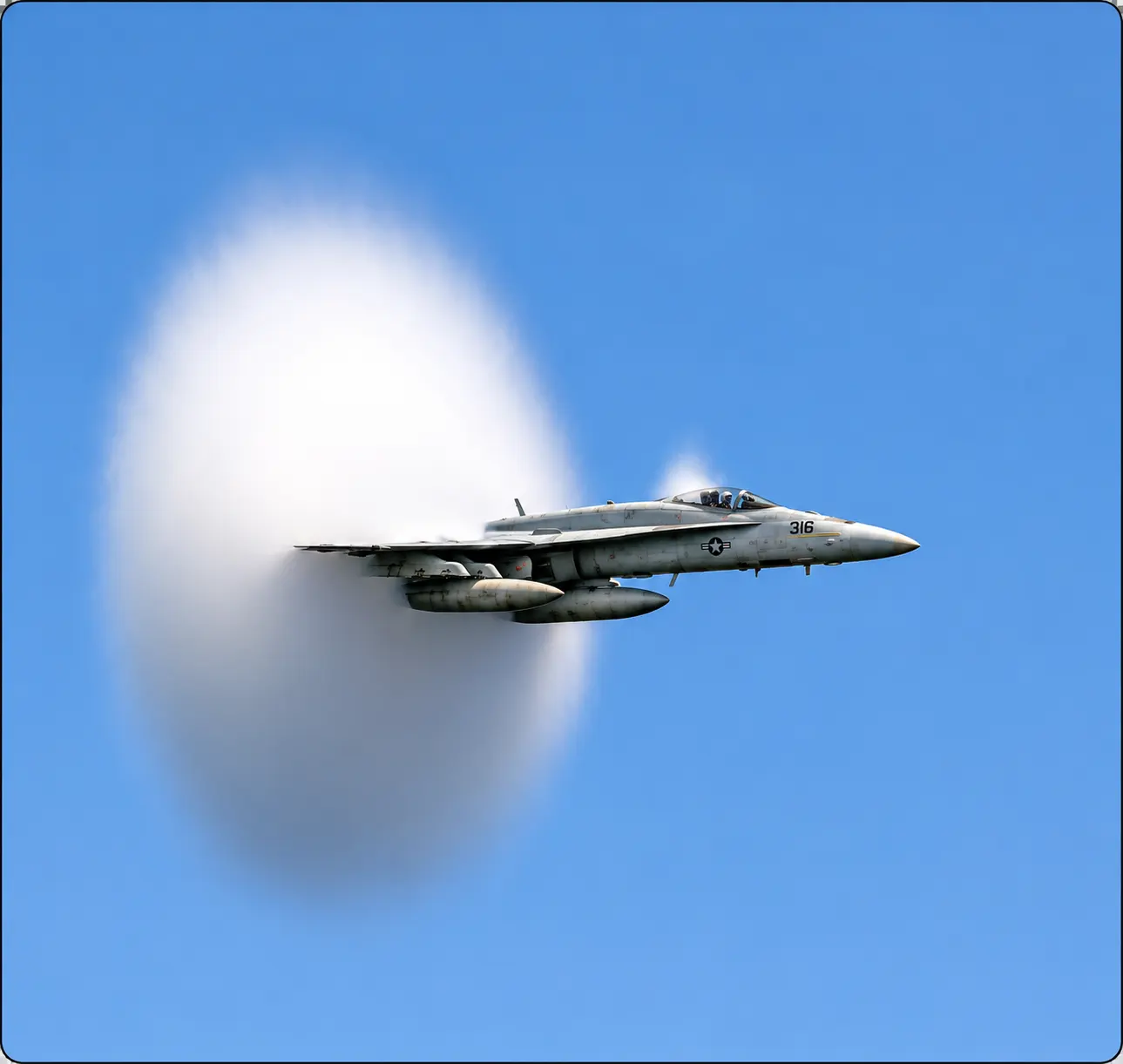
The visible cloud is not water vapor itself. It consists of tiny water droplets that form when local pressure and temperature changes cause the air to become saturated and some of its water vapor to condense.
As a result of evaporation, the atmosphere always contains some moisture in the form of water vapor. The moisture in the air is called the humidity of the air.
Moisture in the form of water vapor does not consist of tiny particles of liquid held in suspension in the air, as in the case of fog. It is an invisible gas that mixes with the other gases in the atmosphere.
Fog and humidity can both affect aircraft performance. Humidity has an effect on air density because moist air is slightly less dense than dry air at the same temperature and pressure. This effect is generally smaller than the effects of altitude and temperature.
During takeoff, atmospheric conditions must be considered when determining aircraft performance and allowable takeoff weight.
The power output of naturally aspirated reciprocating engines can decrease under humid conditions because water vapor displaces some of the oxygen-containing dry air that would otherwise enter the engine.
Engine power output and takeoff performance must be determined using the aircraft manufacturer’s performance charts and procedures. Any adjustment to manifold pressure or engine operating settings must follow the applicable engine and aircraft instructions.
Engine power output is calculated on the basis of the air available for combustion. Since water vapor does not support combustion in the same way as oxygen-containing dry air, its presence reduces the amount of dry air available in a given volume.
The mixture of water vapor and air is drawn through the carburetor, and fuel is metered into it. This mixture enters the combustion chamber, where it is ignited.
Since water vapor does not burn, it can reduce the amount of oxygen available for combustion. This contributes to a reduction in engine power under humid conditions.
The reduction in power that can be expected from humidity is usually given in charts in the aircraft flight manual or pilot’s operating handbook. Some charts show the expected reduction in power due to humidity, while others provide the information needed to determine the appropriate engine operating conditions.
Effect of Fog on Engine Performance
The effect of fog on the performance of an engine can be noticeable, particularly on engines with high compression ratios.
Normally, some detonation may occur during acceleration under high brake mean effective pressure (BMEP). However, on a foggy day, it may be more difficult for detonation to occur.
The explanation lies in the fact that fog consists of liquid water droplets that have not yet vaporized. When these droplets enter the cylinders, they absorb heat energy as they vaporize. This can lower the temperature of the charge and reduce the tendency for detonation.
Fog generally causes a decrease in horsepower output. However, under some conditions, the cooling effect of water droplets can allow a supercharged engine to operate at higher manifold pressures with reduced detonation tendency.
The actual permissible operating limits must always be obtained from the applicable engine manufacturer’s instructions.
Absolute Humidity
Absolute humidity is the actual amount of water vapor present in a given volume of air. It is commonly expressed in grams per cubic meter (g/m³).
The amount of water vapor that can be present in the air depends on temperature and pressure. At a given pressure, warmer air can contain more water vapor before becoming saturated.
When air contains the maximum amount of water vapor possible at the prevailing temperature and pressure, it is said to be saturated.
Relative Humidity
Relative humidity is the ratio of the amount of water vapor actually present in the atmosphere to the amount that would be present if the air were saturated at the prevailing temperature and pressure.
This ratio is usually multiplied by 100 and expressed as a percentage.
Suppose, for example, that a weather report includes the information that the temperature is 75 °F and the relative humidity is 56 percent. This indicates that the air contains 56 percent of the water vapor required to saturate it at 75 °F.
If the temperature drops and the actual water vapor content remains constant, the relative humidity will increase. This is because less water vapor is required to saturate the air at the lower temperature.
Dew Point
The dew point is the temperature to which humid air must be cooled, at approximately constant pressure and without changing its water vapor content, to become saturated.
If the temperature drops below the dew point, condensation occurs.
People who wear eyeglasses have experienced going from cold outside air into a warm room and having moisture collect quickly on their glasses. This happens because the glasses were colder than the dew point temperature of the air in the room.
The air immediately in contact with the glasses is cooled below its dew point temperature, and some of the water vapor condenses on the surface.
This principle is applied in determining the dew point. A vessel is cooled until water vapor begins to condense on its surface. The temperature at which this occurs is the dew point.
Vapor Pressure
Vapor pressure is the portion of atmospheric pressure exerted by water vapor in the air. It is commonly expressed in units such as inches of mercury (inHg), millibars, or hectopascals.
The dew point for a given condition depends on the amount of water vapor present. Therefore, a direct relationship exists between water vapor pressure and dew point: higher vapor pressure generally corresponds to a higher dew point.
Standard Atmosphere
If the performance of an aircraft is computed, either through flight tests or wind tunnel tests, some standard reference conditions must be determined first in order to compare results with those of similar tests.
The conditions in the atmosphere vary continuously, and it is generally not possible to obtain exactly the same set of conditions on two different days or even on two successive flights. For this reason, a set of standard conditions is used as a point of reference.
The standard conditions used in aviation are based on the International Standard Atmosphere (ISA). The U.S. Standard Atmosphere is also used as a reference and agrees with the ICAO Standard Atmosphere over their common altitude range.
The standard atmosphere approximates average atmospheric conditions and is determined on the basis of defined assumptions.
The standard sea-level conditions are:
- Pressure at 0 altitude (P₀): 29.92 inHg (approximately 14.696 psi)
- Temperature at 0 altitude (T₀): 15 °C or 59 °F
- Gravity at 0 altitude (g₀): 32.174 ft/s²
The International Standard Atmosphere has been adopted as a standard reference by most of the principal nations of the world. It provides a common basis for aircraft performance calculations, instrument calibration, and comparison of atmospheric conditions.